







Get Full Digital Shelf Visibility With Nimble, Databricks, and Claude
How Nimble and Databricks turn any retail monitoring idea into a live category dashboard in an afternoon.



Charlie Klein

Get Full Digital Shelf Visibility With Nimble, Databricks, and Claude
How Nimble and Databricks turn any retail monitoring idea into a live category dashboard in an afternoon.
Charlie Klein


Most popular articles
Get structured, reliable data for your stack.
Describe what you want to track on the web and have a live dashboard running in your Databricks workspace in an afternoon. That is the promise behind the Nimble and Databricks retail intelligence solution. This post walks through an example of an app you can build on top of Nimble and Databricks, which enables CPG brands to monitor their products and competitors across Amazon, Walmart, and Target in real time without building a custom data pipeline.
You can clone the app and use it yourself here.
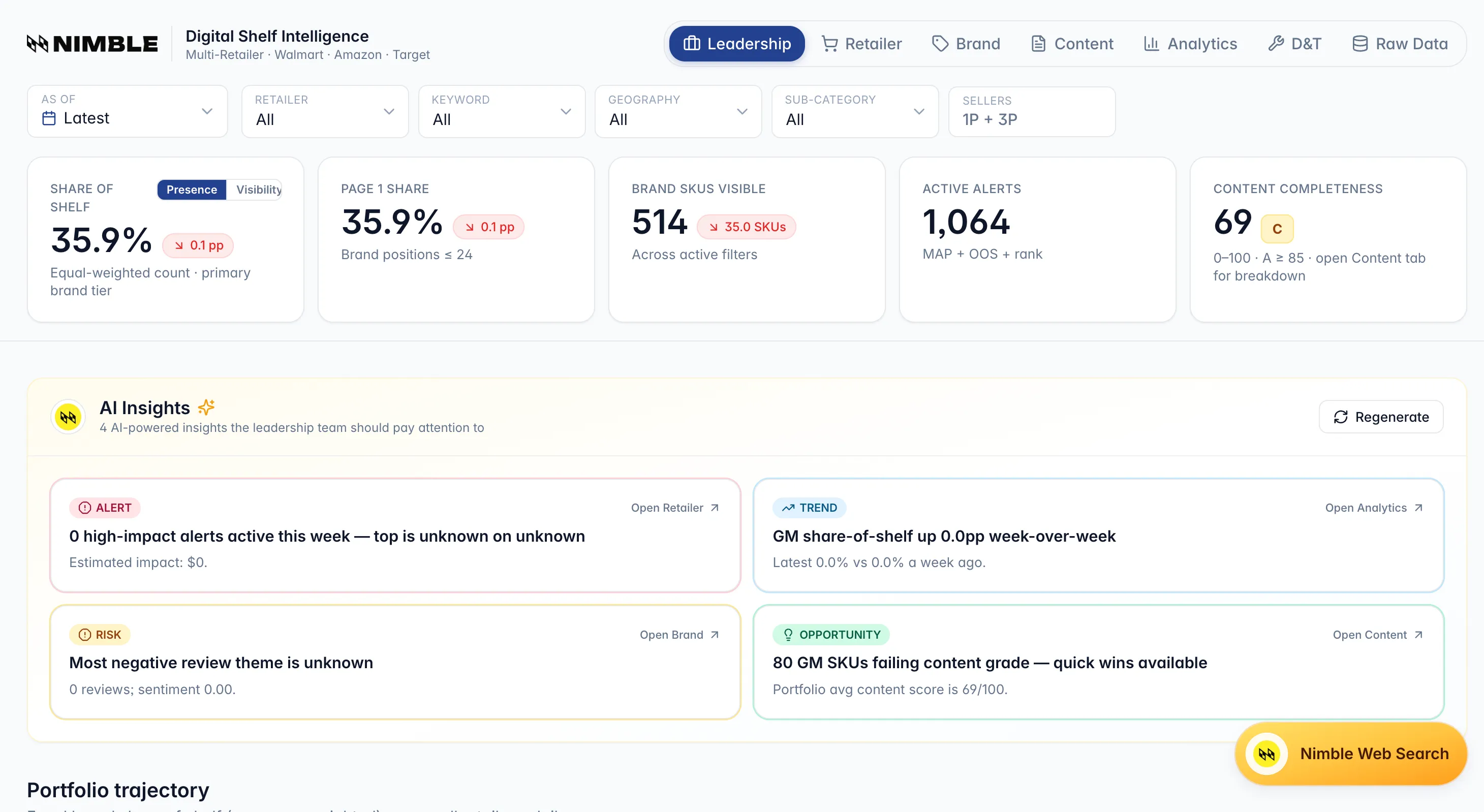
The Business Impact of Live, Flexible Retail Intelligence with Nimble + Databricks
With Nimble and Databricks, any brand manager or category analyst can turn a retail monitoring idea into a live, deployed application without writing a single line of pipeline code. Nimble collects live search data directly from retailer pages, Databricks stores and governs it inside your existing workspace, and Claude builds and deploys the dashboard tailored to your category. The result is shelf intelligence that reflects what is happening right now, not what happened last week.
Key benefits at a glance:
- Full visibility into your products vs competitors on the digital shelf: See who owns page one across Amazon, Walmart, and Target the moment you need to know, not after a weekly report cycle
- See what's driving results: Understand what is actually selling versus what is just ranking, and where competitors are vulnerable right now
- Act on your intelligence: Get a clear next action with every insight, powered by AI analysis layered directly on top of live shelf data
Five Ways Nimble + Databricks Delivers Unique CPG Value
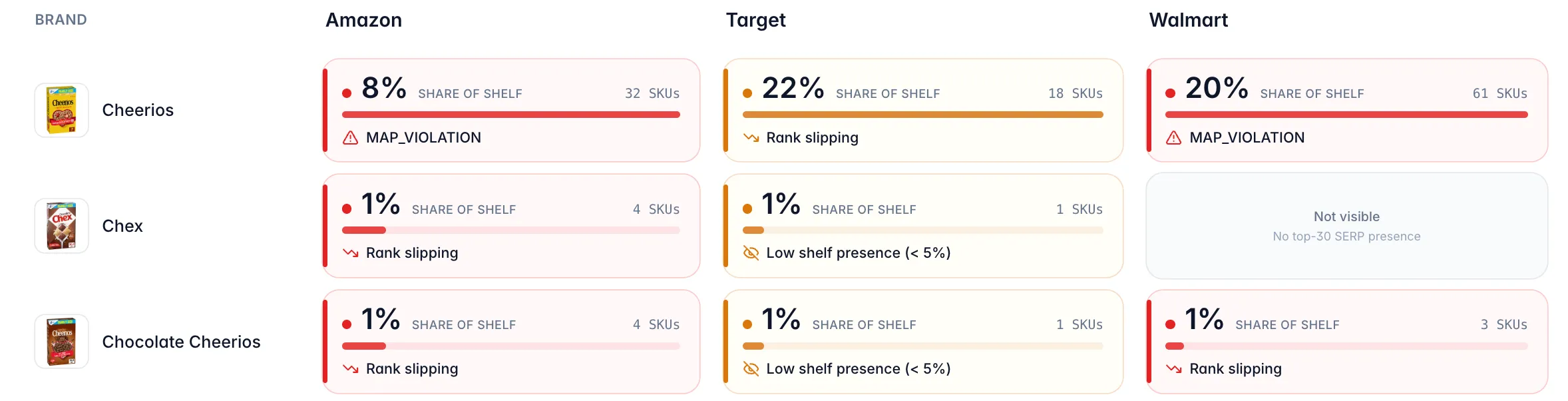
1. Real-Time Share of Shelf Across Three Retailers at Once
Nimble fires parallel web search agents against Amazon, Walmart, and Target simultaneously, streaming structured results back as each retailer responds. Within seconds, a brand manager sees exactly which brands own page one, how many positions they hold, and how that splits between organic and paid placement across all three shelves at once.
- No more retailer-by-retailer exports: simultaneous visibility means brands catch a competitor's surge on Walmart the same moment they see it on Amazon, all in one view inside Databricks
- Monitor pricing and product differences across geos: monitor local markets by segmenting products and their pricing by zip code or country.
- Category reviews that used to take hours now take 30 seconds: everything a team previously pulled manually from three separate platforms lives in one governed Databricks table
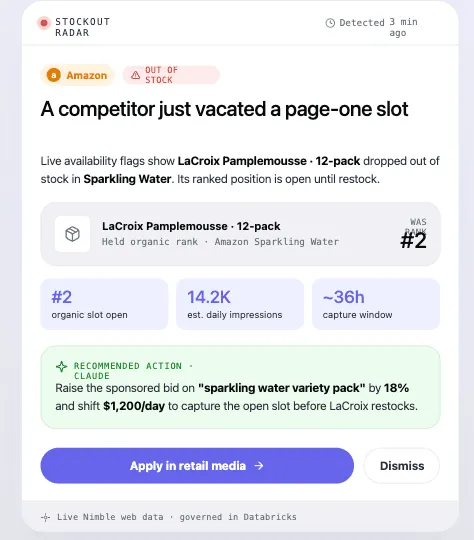
2. Stockout Radar: Turning a Competitor's Bad Day Into Your Win
The app checks live availability flags on every ranked product and surfaces out-of-stock events as prioritized opportunity alerts. When a competitor loses a high-ranking position due to a stockout, that slot is open, but only for the brand that knows about it in time to act with a budget shift or a targeted promotion.
- Converts competitor supply chain failures into incremental revenue: brands that act within hours of a stockout capture the organic lift; those acting days later do not
- Informs retail media budget reallocation in real time: a live stockout signal is one of the highest-confidence inputs a media buyer can have for increasing sponsored bids on those exact keywords
- No engineering team required to get this signal: because the app is built and deployed by Claude from a single description, there is no custom pipeline to maintain
3. Selling Velocity vs. Rank: Exposing the Demand Gap
Nimble retrieves live sales velocity data alongside organic rank, revealing a gap that static rank trackers cannot show: products that rank high but do not sell, and products that sell heavily but rank poorly. This signal is only available because Nimble retrieves live fields directly from retailer pages rather than relying on aggregated third-party data.
[Insert screenshot: selling velocity module showing rank vs. sales velocity card comparison]
- Identifies underpriced organic opportunities: a high-velocity, low-rank product is a paid media investment with near-guaranteed return that no scheduled report would ever surface
- Detects ranking inflation from aggressive paid spend: a competitor holding rank 1 with low sales velocity is propped up by ads rather than real demand, and is vulnerable to a well-timed organic push
- Validates or challenges internal forecasting assumptions: when sell-through velocity does not match expected rank performance, something has changed in the category and the live data shows it immediately

4. Sponsored vs. Organic Breakdown: Know Who's Paying to Win
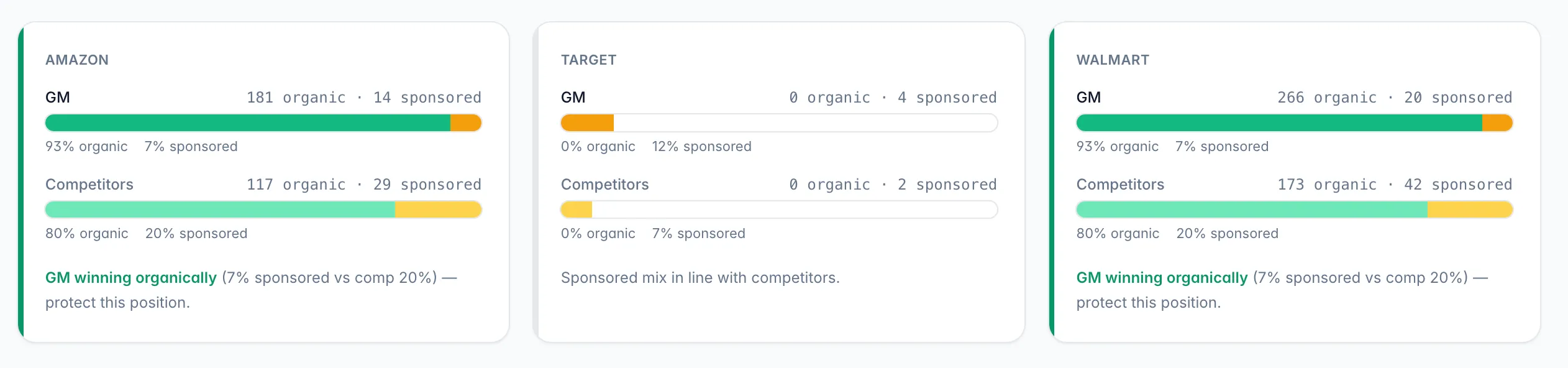
Every product result is tagged as sponsored or organic, and the insight engine computes the category's sponsored percentage, showing what proportion of page one is paid. This signals both competitive intensity and organic opportunity in a single view, and because it is powered by live Nimble data inside Databricks, it can be queried at any time without a new data pull.
- Benchmarks paid efficiency against the category: if the category is 60% sponsored but your brand holds three organic positions, that is a cost-per-visibility advantage worth quantifying and defending
- Flags visibility collapse risk before it happens: a high sponsored percentage with low organic diversity signals that pulling ad spend will cause a near-total drop in page-one presence
- Surfaces low-cost entry points for challenger brands: subcategories with low sponsored percentage and fragmented organic ownership are cheaper and faster to enter than conventional share-of-voice metrics suggest
5. Claude-Powered Ask-the-Data: Analyst-Grade Answers Without the Analyst
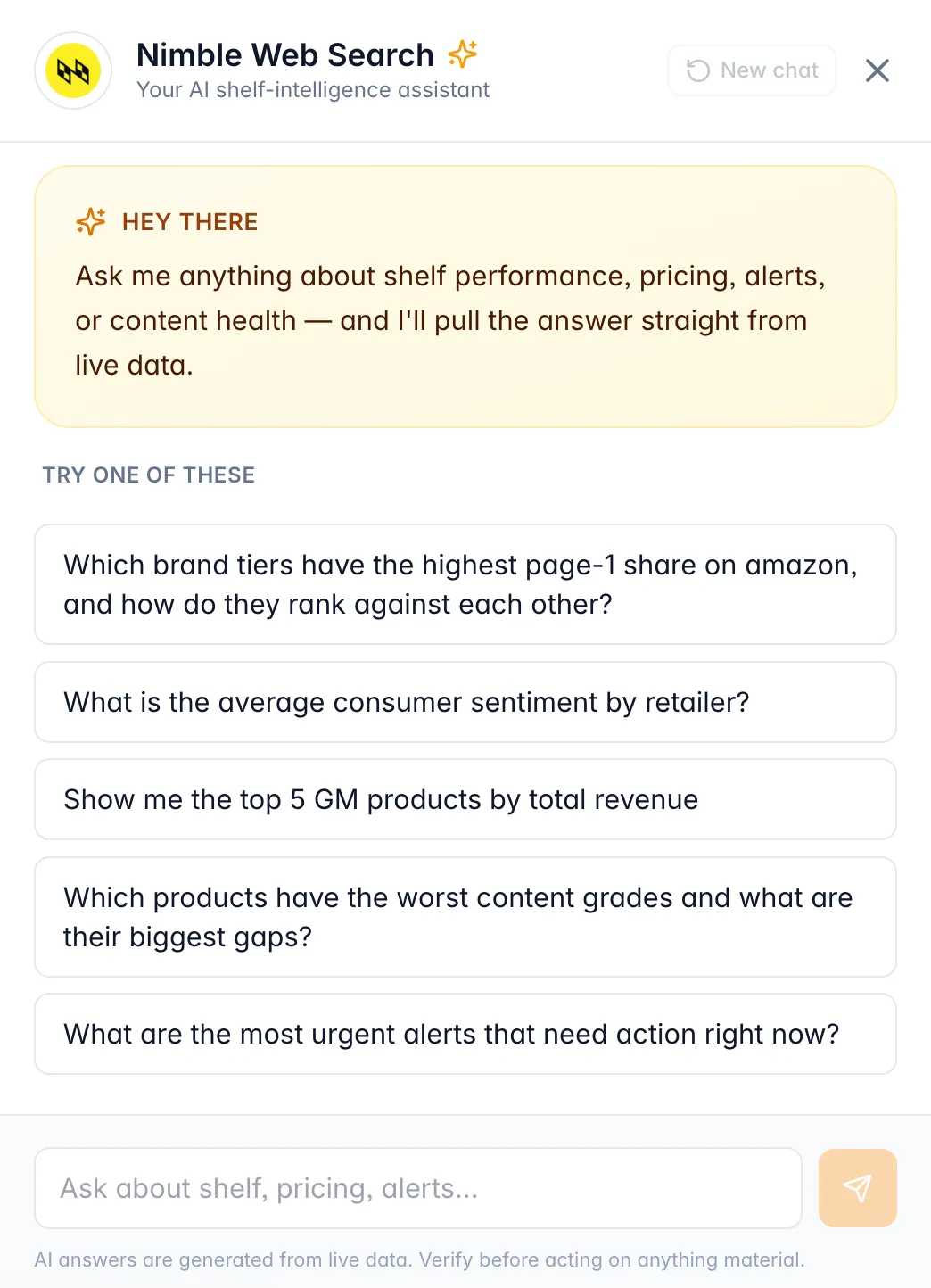
Once Nimble delivers the live data and the rule-based insight engine has run, Claude streams a plain-English narrative summarizing what is happening in the category and why it matters. Users can then ask follow-up questions in natural language and receive specific answers grounded in the actual data sitting in Databricks.
- Eliminates the "so what?" problem: Claude tells teams what the data means and what to do next, compressing analyst interpretation time from hours to seconds
- Makes insights accessible to business leaders without technical skills: brand managers and executives can ask questions in plain language and get board-ready answers without reading pivot tables
- Enables hypothesis testing without commissioning a new report: teams can probe the live data, ask unexpected questions, and surface insights that no pre-built dashboard was designed to show
The Bottom Line
The Nimble and Databricks solution removes the biggest barrier between a retail monitoring idea and a live, production-grade intelligence application: the need for a dedicated engineering team. For CPG brands, that means three concrete business advantages:
- Speed to insight: describe what you want to monitor and have a live category dashboard inside Databricks in an afternoon, replacing multi-week reporting cycles
- Signal depth: live data points including stockout flags, sales velocity, price changes, and sponsored placement that scheduled DSA tools simply do not carry
- Actionability without overhead: every insight arrives with a Claude-generated recommendation, delivered inside the Databricks workspace your team already uses, with no separate tools to host or maintain
FAQ
Answers to frequently asked questions
%20(1).webp)
.avif)
.webp)

%20(2).webp)
.webp)
.webp)
.webp)