









Specialized Intelligence Needs Specialized Web Search
Introducing Web Search Agents and Harness as a Tool: expert web search that learns your domain while keeping you in control.



Uri Knorovich
Specialized Intelligence Needs Specialized Web Search
Introducing Web Search Agents and Harness as a Tool: expert web search that learns your domain while keeping you in control.
Uri Knorovich
The first wave of AI gave everyone access to the same general-purpose models. We are now entering the era of specialized intelligence, where businesses build their own AI advantage using foundation models, open weights, and agentic platforms.
Every company needs its own way to search, retrieve, and validate external information. The public web is the largest source of live knowledge, but every business relies on different sources, signals, and standards of trust. Search itself needs to become specialized.
That specialized search becomes the foundation for every AI application, assistant, and agent the company builds.
Generic web search systems slow down specialized intelligence
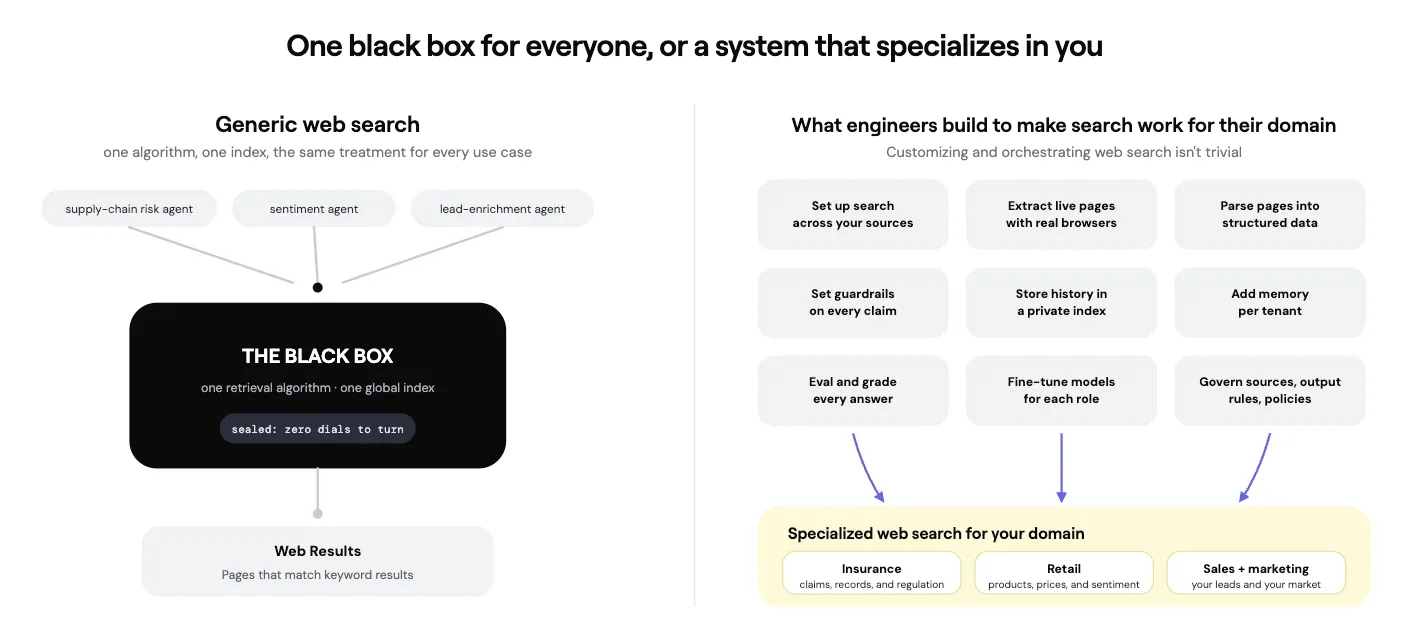
Most web search products are still black boxes. They use the same retrieval logic and broad index regardless of the task. You cannot get the search weights and fine-tune your own search system. Whether it’s an insurance claims agent or a B2B sales agent, they receive generic results, spend tokens filtering noise, and often still miss the context they actually need.
As a result, many AI engineering teams are rebuilding search themselves. They start with a web search API, then add extraction, browser automation, parsing, validation, memory, and evaluation to make it production-ready. What begins as a simple integration quickly becomes a complex system that requires constant tuning, debugging, and maintenance. Instead of building differentiated AI products, engineering teams end up maintaining search infrastructure.
Today, we are introducing Web Search Agents, built around an idea we call Harness as a Tool.
It is a new way to give agents access to the web without forcing engineering teams to build and maintain an entire search system themselves.
Building agentic web search is much harder than calling a search API
Over the past 4 years, Nimble has provided the web infrastructure behind some of the largest enterprise AI workloads: web search, large-scale crawling, extraction, browser automation, and data processing. Working with leading AI engineering teams across the big AI labs, banks, AI-native startups, and enterprise software companies we all use every day, we’ve consistently seen customers build their own orchestration layer on top of that infrastructure. Months of engineering to build, followed by continuous maintenance.
Building the individual components is only part of the challenge. The harder problem is making them work together as a reliable system. Search, live browsing, extraction, memory, validation, and evaluation all need to be orchestrated: deciding when each step runs, how results flow between them, when to retry, and how to balance accuracy, latency, and cost.
What appears to be a simple search feature quickly becomes an orchestration problem that requires continuous tuning as models, websites, and business requirements evolve.
Introducing Web Search Agents: Harness as a Tool
A harness is everything around a model that turns it into a functioning agent: its tools, execution loop, memory, budgets, retries, and guardrails.
Most serious agent teams already operate some form of harness.
Our view is that a complete harness can also be called as a tool.
With Harness as a Tool, your agent delegates a complete task to another specialized agent. Your agent remains in control of how that task is executed, including search, extraction, memory, storage, guardrails, and infrastructure.
A task goes in. A complete, cited, confidence-graded result comes back.
The calling agent can adjust the behavior for a single request or set policies that apply across every future request. At the same time, the specialized harness learns from repeated deployments and becomes better at handling that organization’s domain.
Web Search Agents is our implementation of this model for the web. It is a managed search harness that learns how to retrieve information for your domain, while leaving the important controls in your hands.
What happens inside the harness
Behind a single request, Web Search Agents coordinates the full search process.
First, it translates the task into an auditable Search Plan. It searches the Nimble independent web index, identifies the most relevant sources, and uses live browsers to crawl and extract the pages that matter.
Unlike generic search, every request doesn’t start from scratch. The harness remembers which sources matter, how to retrieve them efficiently, and what works for your domain. That shared retrieval knowledge compounds over time, reducing token usage while continuously improving search quality.
Memory and caching preserve useful information from earlier runs (can be stored on your tenant), while an evaluation layer verifies every claim before the answer is returned. The orchestrator manages the complete process, selecting the right tools and models for each step.
The orchestrator coordinates planning, search, browsing, extraction, memory, and evaluation. Evaluation results update memory, which improves the next Search Plan.
The feedback loop is what allows the system to become specialized.
Over time, it learns which sources are valuable for your questions and which are not. It learns where relevant information tends to appear, how deeply a site needs to be crawled, and which extraction approach works best for the structure you need.
It can spend more effort on sources that consistently produce useful evidence and stop wasting time on paths that repeatedly lead to noise.
Each run improves how the next one is planned.
In our expert-task evaluation, exact-answer accuracy increased from 22% with baseline web search, to 46% with generic deep research, to 71% with the Nimble harness. Tokens per resolved query fell from 38,000 to 11,200, web-tool calls dropped from 14 to 4, with overall cost savings up to 20x compared to other search systems.
Search that becomes specific to your business
A Web Search Agent does not become an expert in every industry at once. It becomes better at the work your organization repeatedly asks it to do.
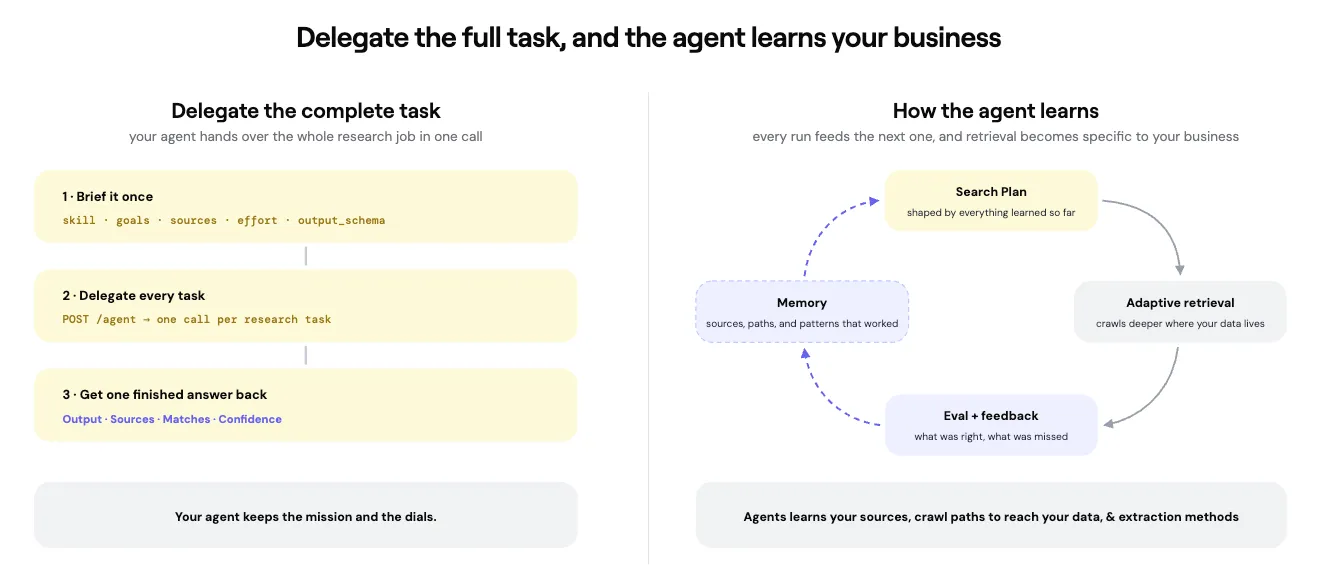
Figure 9: A request is converted into a Search Plan, executed through adaptive retrieval and live browsing, checked through a trust layer, and returned as an optimized, cited response. Memory and caching improve future runs.
For an insurance company, the system can become better at finding claims information, public records, policies, and regulatory material.
For a retailer, it gets better at extracting products, prices, reviews, and inventory from complex JavaScript sites, often retrieving structured data that generic search misses.
For a sales or marketing organization, it can learn how to research the accounts, prospects, competitors, and market signals that matter to that business.
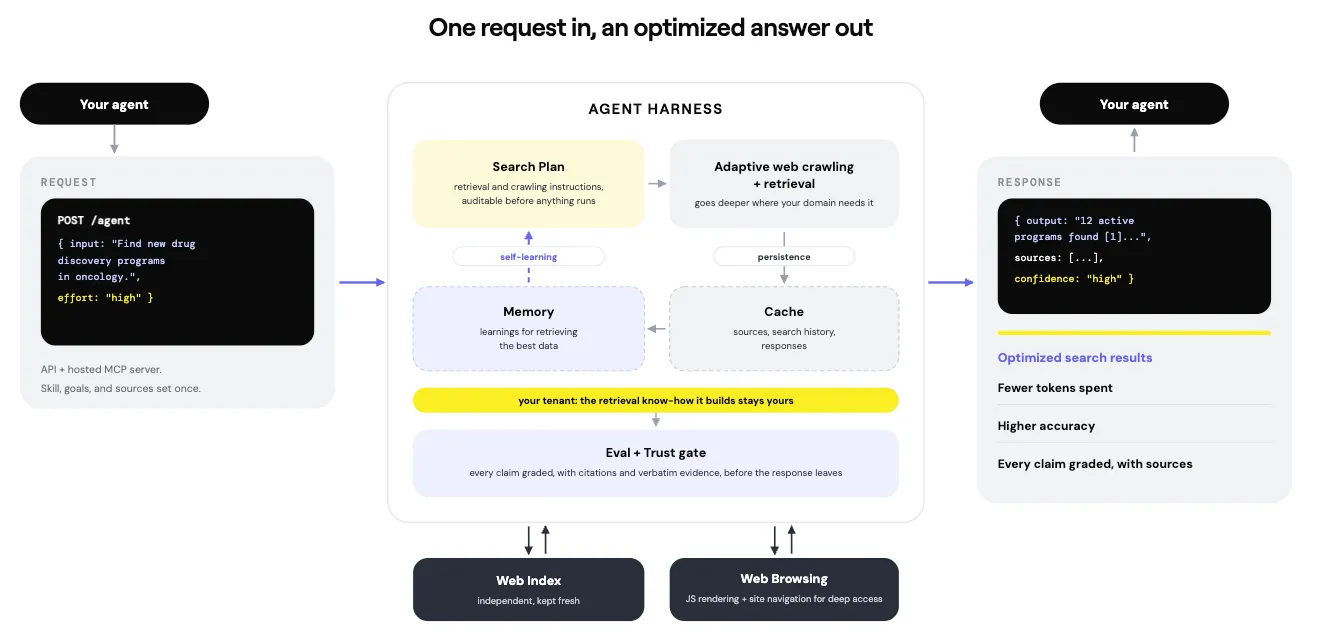
Delegate the full task, and the agent learns your business. Left: the one-call delegation contract. Right: the learning loop that compounds retrieval know-how.
The web search models are fine-tuned to your domain using trusted sources, internal vocabulary, schemas, and your definition of a good answer. As the system searches, feedback continuously improves retrieval quality, creating compound knowledge that becomes your organization’s own retrieval model, runs in your tenant, and gets better with every search.
Our bet on open web search models
Enterprise AI is moving toward specialized systems that companies can shape around their own expertise.
Web search will be a major part of that shift. The web remains the largest source of current, external context available to an agent, but accessing it reliably requires far more than returning a list of links or AI overview.
Our bet is to provide that capability as flexible infrastructure: a complete search harness with visible primitives, configurable controls, and retrieval knowledge that compounds for the customer.
Web Search Agents are available through our API and hosted MCP server, and through the platforms and SDKs where developers already build their agents.
This is what we mean by expert-level web search: a search system that understands your domain, supports its answers with evidence, and improves through use.
Generic search may be enough to demonstrate an agent. Nimble is designed to help that agent operate in production, with the accuracy, control, and economics that production requires.
Go deeper: Try Web Search Agents in the Playground or explore the documentation.
FAQ
Answers to frequently asked questions
.avif)
.webp)

.webp)
.webp)

.webp)