









Announcing Web Search Skills: From Fetch to Full Research



Charlie Klein
.webp)
Announcing Web Search Skills: From Fetch to Full Research
Charlie Klein
Coding agents can fetch information from the web. But fetching a page and knowing how to research a topic are two different things.
High quality web research requires knowing which sources are best for the task, which data points matter most, and how to structure that data in the most useful way. It also requires rendering dynamic, JavaScript-heavy sites to access the broader web.
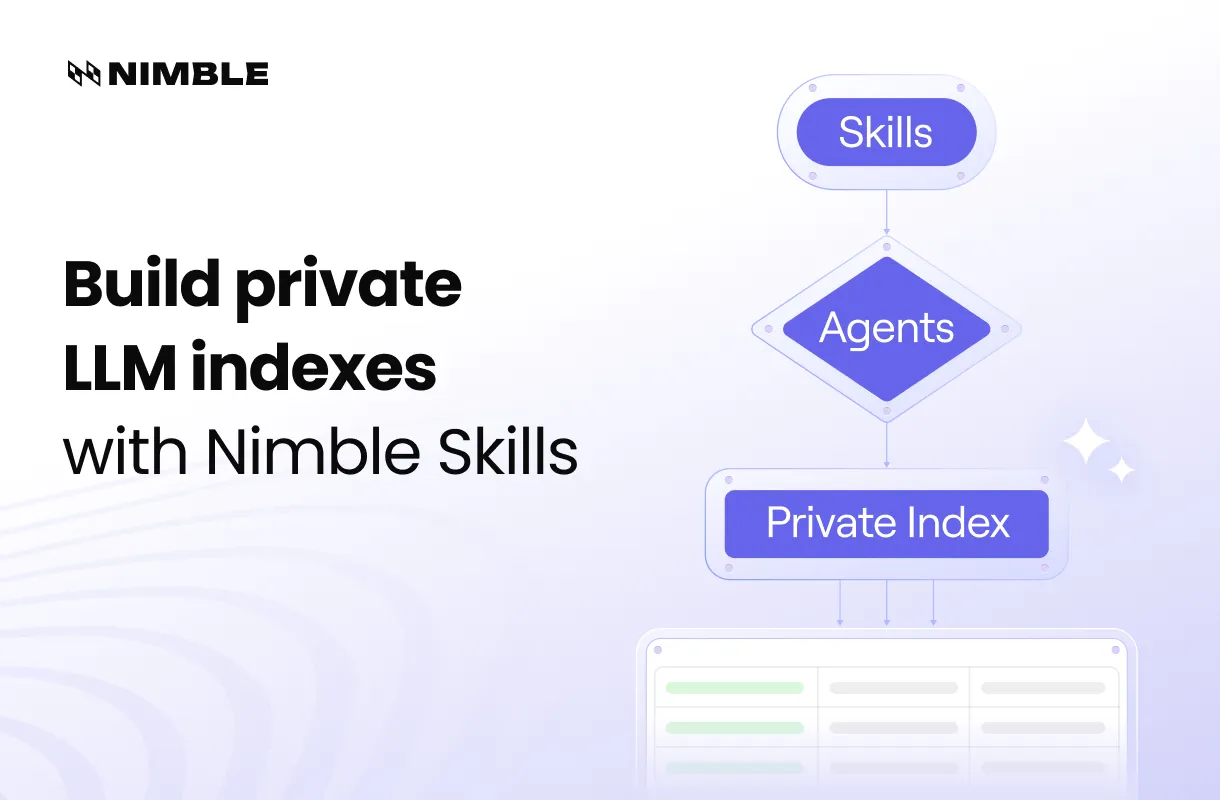
We built Web Search Skills to solve both problems. Skills help agents navigate the digital world more effectively, so we gave them the skills to become experts in specific web research workflows.
Each Web Search Skill gives your coding agent the task-specific knowledge to find the right information for a specific use case: the right sources, the most relevant data points, the right output format. And because Skills run on Nimble's web data infrastructure, they can retrieve data from any public website, at any scale, with the reliability and performance that production workflows require.
Learn how to implement Web Search Skills in our docs or our GitHub.
.webp)
Get To Know Our Web Search Skills
Business Research
competitor-intel — Monitors competitors across news, product launches, hiring signals, and funding. Runs parallel searches, compares against previous findings, and surfaces only what's new. Supports full mode for first-time runs and quick refresh for ongoing monitoring.
"Give me a competitor intel report on Deel"
company-deep-dive — Produces a sourced 360° report on any company: funding, leadership, product, market position, and recent news. Always fetches live data — never answers from memory.
"Deep dive on Stripe"
market-finder — Discovers all businesses of a given type in any geography. Discovery mode builds a list from scratch; Audit mode compares your existing list against fresh discovery to surface gaps.
"Find all pediatric dental practices in Phoenix"
Marketing & SEO
competitor-positioning — Scrapes competitor homepages, features pages, pricing pages, and blogs to extract messaging, value props, and content strategy. Tracks changes against previous snapshots. Outputs a messaging matrix, content gap analysis, and battlecard inputs.
"How does Notion position itself vs. other knowledge management platforms?"
seo-intel — Seven SEO workflows in one Skill: keyword research, rank tracking, site audits, content gap analysis, competitor keyword reverse-engineering, AI visibility (ChatGPT / Perplexity / Google AI / Gemini / Grok), and GitHub repo SEO. Routes automatically based on your request.
"What keywords is Asana ranking for that we're not?"
Productivity
meeting-prep — Researches every attendee using live web data: role, recent activity, career history, and conversation hooks. Adds company context and cross-attendee relationship mapping. For sales, partnership, or investor meetings, includes a positioning section that maps the other company's signals and tech stack to your product.
"Prepare me for my meeting with the Head of Partnerships at HubSpot tomorrow."
local-places — Discovers and scores local businesses of any type in any area. Pulls from maps, review platforms, and social profiles, then merges results into a ranked list with ratings, hours, and source links.
"Find the best co-working spaces in Austin with day passes and good coffee."
Healthcare
healthcare-providers-extract — Extracts structured practitioner data from healthcare practice websites: names, credentials, specialties, contact info, and education. Accepts practice URLs directly or discovers practices from specialty and location.
healthcare-providers-enrich — Fills gaps in an existing provider list. Analyzes which fields are missing across all records, then searches and extracts to fill them — without overwriting existing data.
healthcare-providers-verify — Validates practitioner credentials against the NPI registry. Returns a status per practitioner — Verified, Partially Verified, Unverified, or Flagged — with mismatch details and source URLs for every finding.
Run all three in sequence: "Find the top 5 orthopedic surgeons in Austin, enrich their profiles, and verify their NPI credentials."
Human Resources
talent-sourcer — Searches the web for ideal candidates based on your criteria and JD and returns names, LinkedIn profiles, years of experience, and more.
Run all three in sequence: "Find the top 5 orthopedic surgeons in Austin, enrich their profiles, and verify their NPI credentials."
Two Modes: Interactive and Autonomous
Every Skill works in two modes from launch.
Interactive — You ask, the Skill delivers. Type "what are my competitors doing this week?" into Claude Code or Cowork and get back a structured briefing.
Autonomous — The Skill runs on a schedule and delivers output where you already work. A competitor digest lands in Slack every Monday at 8am.
On the first run, Skills ask for a few key inputs, like who are your competitors, what industry are you in. Every run after that is one command.
Web Search Skills vs. Asking Claude to Fetch
Claude’s built-in fetch is perfectly suitable for consumer use cases, but for enterprise workflows that depend on accurate, precise, and complete information, it can fall short. Here's what's different under the hood:
- JavaScript rendering: Nimble renders JavaScript, so Skills can access data on complex, dynamic sites that Claude's fetch can't reach at all.
- Extraction logic, not just LLMs: Nimble uses dedicated extraction logic rather than relying on an LLM to find and parse data, which means results are more precise and token costs are significantly lower.
- Live web data: Nimble pulls directly from the live web, not a search index, so results reflect what's actually there right now (rather than what was crawled days or weeks ago).
- Use case-specific search: Each Skill knows which sources to search and which data to extract for its specific task, delivering more relevant results than a general-purpose fetch ever could.
- Batch scale: Nimble can run across thousands to millions of pages in a single workflow, making it viable for research that goes far beyond what a handful of fetches can cover.
The result is research that's complete, accurate, and current, without the gaps that come from relying on a single page grab.
FAQ
Answers to frequently asked questions
.avif)
%20(1).webp)

.webp)

.webp)
.webp)