









8 Tips for Digital Shelf Success in 2026



Nimble's Expert
.webp)
8 Tips for Digital Shelf Success in 2026
Nimble's Expert


Most popular articles


Get structured, reliable data for your stack.
The placement that matters most for your product in 2026 isn’t made of steel or wood but of search results and AI-driven recommendations. As more shopping journeys begin (and often end) online, the performance of your digital shelf now drives real bottom-line outcomes.
In a nutshell, the “digital shelf” is the network of touchpoints between the product and consumer throughout their buyer journeys. In Q2 2025, eCommerce accounted for 16.3% of all retail sales. But the digital shelf is bigger than just eCommerce alone. It has a direct impact on all retail purchases. In fact, analysts estimate the influence of digital marketing on all retail purchases to be roughly three times larger than direct eCommerce sales figures suggest.
Digital shelf success is not a one-time operation. With market conditions shifting rapidly, optimization requires continuous monitoring and quick adjustment. Winning here depends on constant visibility and adjustment, powered by structured, real-time data and digital shelf analytics (DSA) that keep you aligned with how fast digital shelves evolve. Let’s explore how you can strengthen visibility, protect share, and convert more sessions across your key retailers.
What is the digital shelf, and why does it matter?
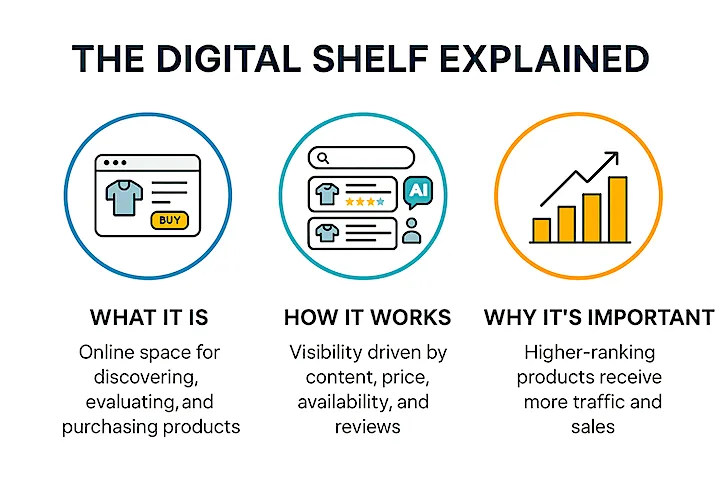
The digital shelf is the online environment where potential buyers discover, evaluate, and purchase products. It encompasses all the places where shoppers can interact with your brand on their way to purchase: retailer search results, category pages, ratings, reviews, product detail pages (PDPs), and AI assistant replies.
Think of it as your virtual physical storefront, but highly dynamic and algorithm-driven. Visibility is shaped by content quality (such as titles, images, category, and attributes), price integrity, availability, and social proof. When these variables outperform your competitors’, you get more impressions and buy-box opportunities. Over time, this translates into compounding competitive advantage.
Another way to define the digital shelf is as the surface where algorithms rank you and shoppers evaluate you. Placement on the digital shelf is critical. On major retailer sites, the first three products to appear in search results often capture as much as 80% of clicks. However, optimizing only search result visibility is not enough, as AI-driven referrals to retail sites are estimated to rise by over 500% year over year in the 2025 holiday season.
The digital shelf also extends beyond traditional eCommerce. On platforms such as Uber Eats, DoorDash, and Instacart, product visibility changes constantly based on location, availability, pricing, delivery speed, and algorithmic recommendations. These marketplaces operate like living digital shelves that update minute by minute. To stay competitive, brands and retailers need continuous monitoring, accurate data, and adaptive optimization powered by Digital Shelf Analytics (DSA).
Across all these environments, algorithms evaluate a mix of performance signals - content quality, pricing consistency, availability, and review sentiment—when determining rank and visibility. Maintaining real-time accuracy across those signals is what defines success on the digital shelf, and DSA provides the continuous insight required to achieve it.
5 Benefits of Digital Shelf Success
Before we discuss the how, let’s briefly review the reasons why you should invest in optimizing your digital shelf and implementing digital shelf analytics (DSA) for success.
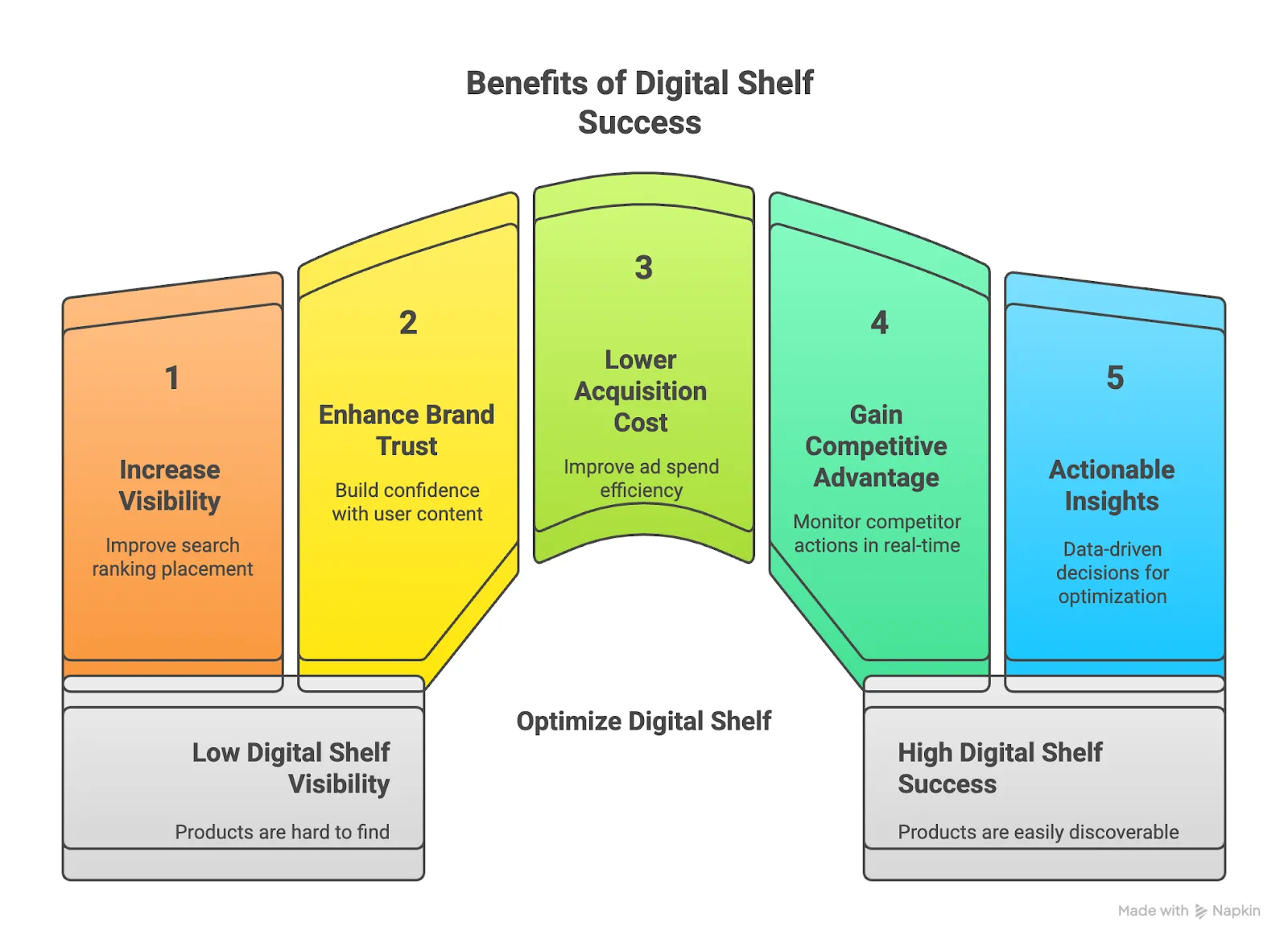
1. Increased Visibility
Getting discovered is the first step to selling products, but most shoppers rarely look beyond the first page of results. For sellers, this means competing for higher placement in search rankings and category listings within an increasingly dynamic arena.
Visibility drives outcomes: more impressions turn into more add-to-carts, which in turn translates into more verified purchases that strengthen your category position. Digital shelf analytics (DSA) helps quantify these patterns, revealing how content, pricing, and availability influence rank and conversion. Today’s share of attention becomes tomorrow’s share of sales.
For revenue and channel teams, this means:
- Lower blended acquisition costs, because organic discoverability does much of the “heavy lifting.”
- Stronger credibility, since consistent top-of-category presence signals reliability.
- More predictable baselines for planning and forecasting.
2. Enhanced Brand Trust
Trust is the shortcut to “buy now.” When shoppers see authentic ratings, insightful reviews, photos, videos, and Q&A, they feel more confident choosing your brand.
Shoppers who engage with user-generated content (UGC) become paying customers 144% more often and generate 162% more revenue per visitor. This is especially true in crowded categories where specifications and pricing are similar.
In addition, transparent expectations reduce post-purchase regrets and minimize product returns. The average eCommerce return rate was 16.9% in 2024, and cutting preventable returns helps protect margins and retailer relationships.
3. Lower Blended Acquisition Cost
When your products sit high on the digital shelf, your ad dollars work better. Since strong organic rank captures more organic demand, retail media becomes an amplifier, so every incremental impression has a higher chance to convert.
A layer of paid promotion on top of high organic placements often delivers a meaningful sales lift. In addition, availability and stock monitoring of your digital shelf helps protect ad budgets and ensure you don’t pay for attention you can monetize due to the low availability of popular items.
The net effect is lower blended CPA/CAC, less budget waste on non-shippable product SKUs, and a data-driven baseline you can use to plan and forecast demand.
4. Competitive Advantage
Things happen incredibly fast on the digital shelf. Rivals can change prices, launch badges and promos, or swap PDP content in minutes, often programmatically.
With real-time price monitoring and digital shelf analytics (DSA) across retailers and competitors, powered by automated, structured data collection, you can respond much faster to the competition’s moves, like pricing changes and even product availability. What better time to promote your products than when your rivals are running low on their version or alternative?
Real-time visibility into competitor movements lets you close price gaps with shorter windows in a disadvantaged position, keep your content fresh, stabilize your rank, and improve your share of search and Buy Box share.
5. Actionable Insights via Digital Shelf Analytics (DSA)
Digital Shelf Analytics (DSA) is the practice of continuously collecting, structuring, and analyzing digital shelf signals—such as search rank, pricing gaps, availability, content accuracy, and review sentiment—to understand how products perform across online retailers. In essence, DSA turns fragmented shelf data into clear, actionable intelligence.
Effective DSA programs unify these signals into a single, always-on dataflow that transforms noise into clarity. They help brands identify what drives rank, visibility, and conversion, while revealing where to intervene - whether to close a price gap, replenish stock, or refresh PDP content.
When digital shelf analytics connect directly to pricing, supply, and marketing workflows, they replace lagging insights with real-time decision power. Teams can detect shelf risks instantly, understand the business impact of every change, and coordinate responses before performance or revenue is lost.
Powered by structured, real-time data, DSA becomes a predictive engine for growth. Nimble’s Web Search Agents provide this intelligence backbone by streaming validated shelf data into enterprise systems so brands can anticipate trends, act faster, and sustain a competitive edge across every channel.
8 Tips for Digital Shelf Success
What can you do today for digital shelf success? Here are practical steps you can take to gain an edge across eCommerce channels:
1. Optimize Product Content for Visibility & Conversion
Product Detail Pages (PDPs) drive results across the full path to purchase. Complete and accurate content lifts retailer search rank, boosts trust, and increases conversion rates. To achieve this, you must optimize your product content for both shoppers and the algorithms that power retailer search results. You should also apply SEO and Generative Engine Optimization (GEO) strategies to strengthen visibility across search engines and Generative AI systems that reference retail data.
How to do it:
- Aim for omnichannel readiness with:
- Clear, search-matching titles
- Benefit-led bullets
- Fully populated product attributes
- HD imagery/video
- Clean variant logic
- Retailer-specific information
- Template by retailer: Standardize required product attributes, such as title formulas, bullets, and image sets, for each channel. Maintain a log of how metrics for each channel change over time.
- Talk your shoppers’ language: Naturally weave keywords and synonyms from auto-suggest, reviews, and Q&A into your PDP content.
- Revamp your data model: Normalize product properties (like size, count, materials, certifications, etc.) with precise variant mapping, and consistent UPC/GTIN and brand naming.
- Engage with UGC: Address common objections in FAQs, maintain Q&A sections, and include comparison tables for shoppers debating alternatives.
- Measure content impact: Track your share of search (10–20 priority terms per SKU, per retailer), PDP CTR, add-to-cart, and conversion by retailer, then tie lifts to specific content changes. Be sure to run regular content health checks for things like missing attributes or stale reviews.
2. Monitor Competitor Pricing & Promotions in Real-Time
Price and promo positioning shape Featured Offer/Buy Box wins and share. The quicker you respond to what your competitors do, the likelier you are to hit your sales targets - or exceed them. Track rivals continuously across priority retailers so your pricing and promotions reflect the current market.
How to do it:
- Accurately map your competitive set: Identify up to 10 direct competitors per SKU, and match on exact UPC/GTIN.
- Capture the complete price picture: Collect list vs. current price, discount depth, promo type (coupon/BOGO/Subscribe & Save), added shipping/fees, etc. across all relevant retailers and resellers.
- Automate with Nimble’s Web Search Agents: Feed structured, always-current pricing and promo data from key retailers into your BI/pricing systems, and preset alerts on pricing gaps and shocks.
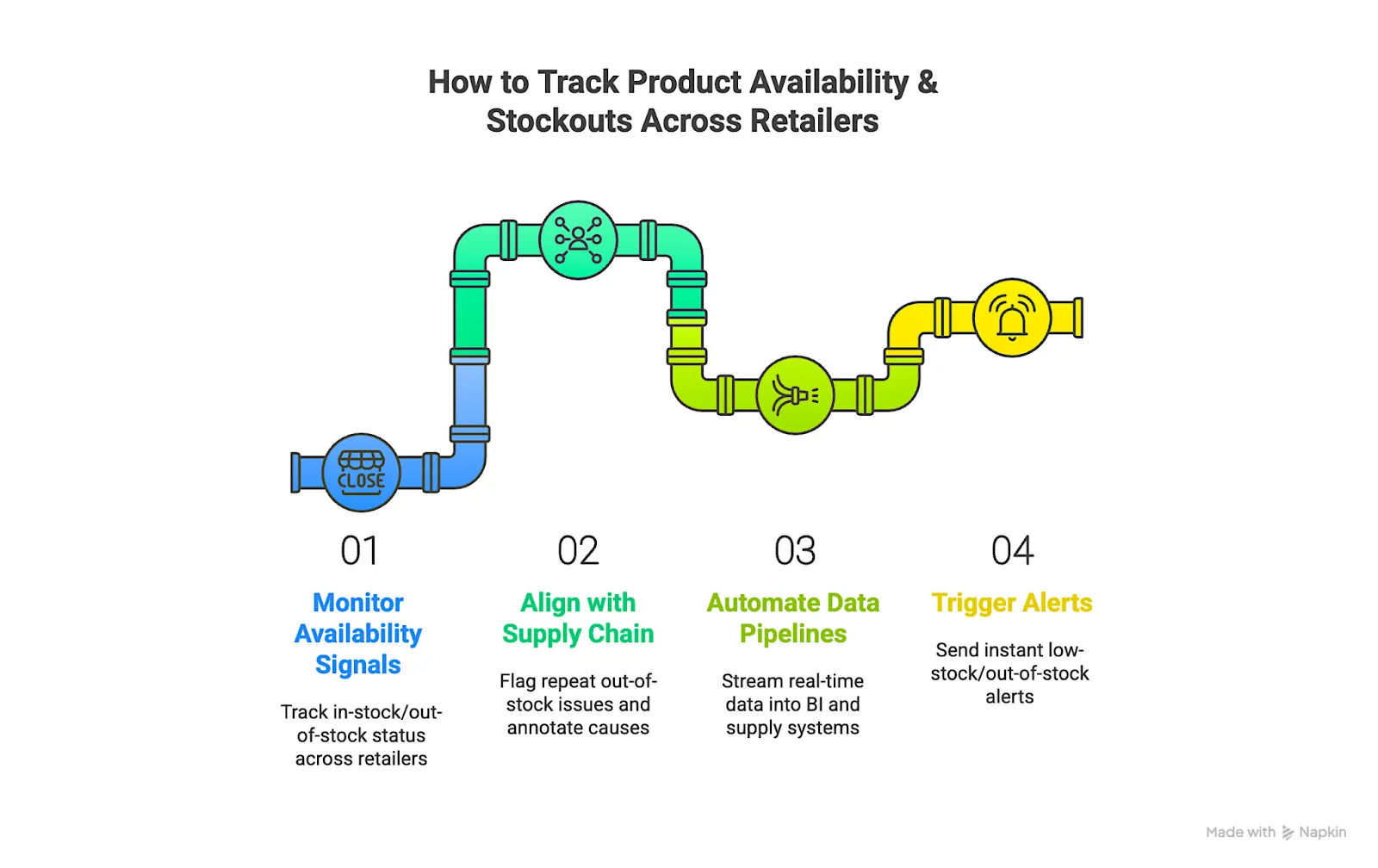
3. Track Product Availability & Stockouts Across Retailers
Accurate real-time stock level and availability signals across all channels are critical for many of the processes in the organization. You can detect inventory gaps faster than your competitors with automated shelf monitoring. It can route alerts to supply teams early enough to prevent stockouts and other issues from eroding category or market share.
How to do it:
- Track key availability signals: Monitor in-stock/out-of-stock, backorder/ETA, delivery speed, pickup/ship badges, and regional availability across priority retailers, noting that these signals can fluctuate throughout the day.
- Align with your supply chain: Flag repeat OOS by SKU/retailer, annotate the causes (such as promo spikes or supply delays), and trigger replenishment actions before your competitors can capture share.
- Automate with Nimble data pipelines: Stream real-time, structured availability and badge data extracted from multiple retailers into your BI and supply systems, with instant low-stock/OOS alerts to eliminate blind spots.
4. Actively Manage Customer Reviews & Ratings
Customer reviews shape purchase decisions and influence retailer visibility. Review volume, recency, and sentiment are as important to track as conversion rates and search performance to enhance your digital shelf.
How to do it:
- Track relevant signals: Review count, average rating, recency/freshness, and sentiment by SKU and retailer.
- Ethically increase your review flow: Use compliant programs (like Amazon Vine and Walmart Review Accelerator) and post-purchase requests. Be sure to encourage photo/video UGC.
- Respond quickly and consistently: Acknowledge critical reviews, offer remedies, and follow up with updates to rebuild trust.
- Take action: Route recurring themes to product/CX for fixing, and reflect changes made in PDP copy and FAQs. It’s also essential to feed the insights gathered from reviews into product and marketing cycles.
5. Measure Share of Search & Category Placement
Visibility in retailer search results and category pages drives discoverability and conversions. Employ continuous benchmarking of how often and where your SKUs appear versus competitors, and act to remedy the gaps.
How to do it:
- Build a focused keyword set per SKU/category (brand, generic, seasonal) mapped to each retailer’s taxonomy/browse nodes.
- Track ranks where it matters: Record page-one presence and average position for 10–20 priority terms per SKU and brand-level share of page-one placements.
- Audit category coverage: Verify placement on key category/subcategory pages and in top filters/facets, like size and pack count. Review taxonomy updates regularly to ensure your listings align with retailer changes.
6. Standardize & Syndicate Product Data Across Channels
Inconsistent or inaccurate product data erodes trust and damages rankings, but keeping all the product data accurate and consistent across channels at all times is nearly impossible to do manually, especially with an extensive catalogue and multiple sales channels.
How to do it:
- Map retailer requirements: Maintain up-to-date channel profiles for each retailer’s taxonomy and required fields, like units, locales/languages, and attribute names.
- Establish a single source of truth: Use a PIM/DAM to centralize product titles, attributes, specs, images/video, certifications, etc.
- Enforce identifiers & variants: Keep UPC/GTIN consistent, map parent–child variants, multipacks, and ensure canonical brand naming to avoid duplicates.
- Automate syndication: Push your updates through secure APIs and feeds on a schedule with retries and validations, eliminating manual copy/paste tasks.
- Validate and audit: Monitor live PDPs for drift and completeness and reconcile mismatches back into the PIM, while keeping change logs and approval documentation. Make sure to validate listing completeness, mismatch rate across channels, time-to-publish, and error rate.
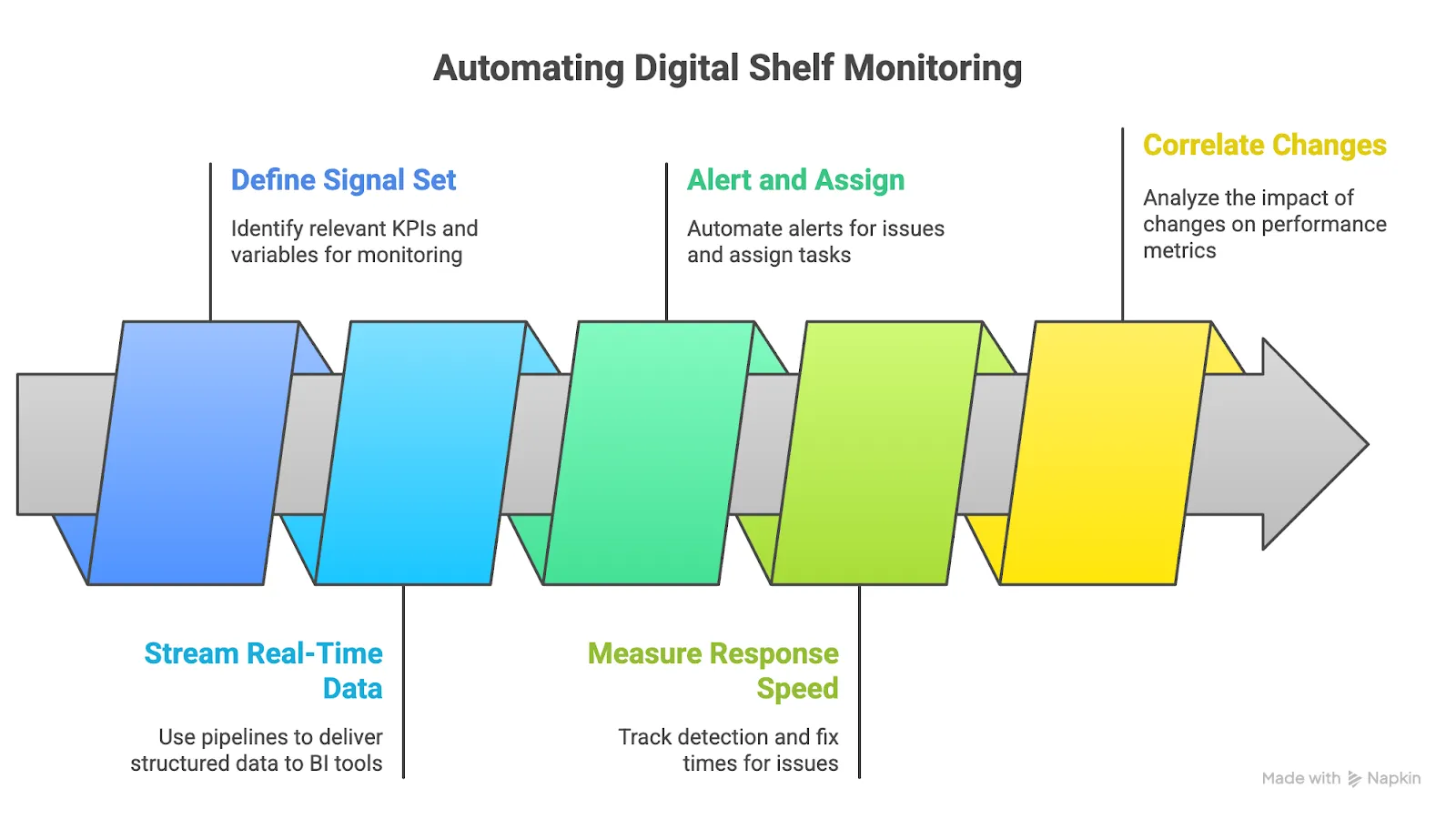
7. Automate Digital Shelf Monitoring with Real-Time Data Pipelines
Much like cross-channel product data syndication, manual checks of your digital shelf are not enough. Effective digital shelf monitoring and DSA depends on continuously tracking changes across retailers, from price and availability to reviews and rankings. Real-time pipelines can collect and normalize these shelf signals so your teams can detect issues faster and address them sooner.
How to do it:
- Define your signal set: Include relevant per SKU and retailer KPIs and variables. These include price/promo, availability/badges, content completeness, reviews/ratings, and share of search.
- Stream real-time data pipelines into BI: Employ solutions like Nimble’s data pipelines and Web Search Agents to deliver deep, structured, and governed data directly to dashboards and analytics workflows while maintaining accuracy across multiple channels.
- Alert and assign: Automate instant alerts on relevant events like OOS signals, price gaps, and content drift to owners with SLAs, and annotations for fixes attached.
- Measure response speed: Track the time-to-detection and time-to-fix of your digital shelf issues, then correlate the changes you made with rank, CTR, and conversion lifts.
8. Translate Insights into Cross-Functional Action
Winning the digital shelf is a collaborative effort. When pricing, supply, and marketing decisions use the same live data, brands can respond immediately to market changes and protect share. Acting on shelf insights across teams ensures faster adjustments and stronger results.
How to do it:
- Set sync cadence: Consider the frequency of alerts, cross-functional standups, and business reviews to ensure alignment on strategic topics and goals.
- Assign owners & SLAs: Keep clear documentation with assignments of who acts on each alert type with an estimated time-to-resolve. Be sure to track time-to-detect vs. time-to-resolve to optimize response speeds.
- Convert insights into workflows: Automate ticket creation for content, supply, pricing, and retail media changes, and annotate actions so you can measure impact.
- Share the data: Leverage a real-time data pipeline solution to deliver governed, structured digital-shelf data straight into the dashboards your sales, marketing, and ops teams already use.
Gain Consistent Digital Shelf Success with Nimble
Conquering the digital shelf requires constant readiness and responsiveness. Brands that stay visible, agile, and consistent across product content, pricing, availability, reviews, and search placement win more often at the point of purchase. The only way to stay competitive is by leveraging continuous monitoring, digital shelf analytics, and rapid adaptation to shifting conditions across markets and retailers. Continuous visibility across every channel is now the foundation of sustained digital shelf performance.
Delivering that level of visibility requires deep, real-time, and structured data that can be trusted across teams and systems. Nimble provides your teams with a real-time, structured, and compliant data backbone you can trust. With its Web Search Agents and SDK, you get channel-ready signals fed directly into enterprise workflows and BI systems to ensure your digital shelf monitoring and DSA are always accurate, scalable, and production-ready for measurable profitability.
Connect with Nimble today to discover how it supercharges your digital shelf.
FAQ
Answers to frequently asked questions
%20(2).webp)



.webp)
.avif)
.webp)
.webp)