









6 Exa Alternatives You Should Know About



Charlie Klein
.webp)
6 Exa Alternatives You Should Know About
Charlie Klein


Most popular articles


Get structured, reliable data for your stack.
Abstract
Exa is an AI-native web search API used in RAG pipelines and agent workflows to retrieve semantically relevant web results from its own index. Exa alternatives range from AI-native search APIs for RAG pipelines to live-web data platforms built for production AI agents that need fresh, structured web data.
Top Exa alternatives include:
- Nimble
- Tavily
- You.com Search API
- Brave Search API
- Linkup
- Perplexity Sonar API
___________________________________________________________________________
6 Exa Alternatives You Should Know About
Choosing an AI search API for production-grade agents is no longer a simple developer tooling decision. It directly impacts how accurately your agents reason, how much your pipeline costs to run, and whether your system can handle production-grade agentic workflows vs just research prototypes.
Industry research shows that more than 30% of the demand increase for APIs will come from AI and LLM-driven systems by 2026. One AI-native search API solution that’s popular with developers is Exa, which is used as a retrieval layer in RAG pipelines and agent workflows that rely on semantic web search. But many of those teams are now hitting limits with Exa around data freshness on fast-changing information, output structure for direct agent consumption, and reliability on complex or protected sites that indexed search may not reliably access or keep up to date.
In this guide, we compare six AI-native search APIs for developers whose agentic workflows require AI-native search. We compared six Exa alternatives based on factors like data freshness, output format, search depth, and use cases. Start with Tavily for lightweight, fast-setup AI search for RAG pipelines and agent workflows, or for real-time, structured web data at enterprise scale, look at Nimble. The goal is to provide AI engineers and developers with the information needed to choose the right AI-native search API for the job at hand.
What is Exa, and what does it do?
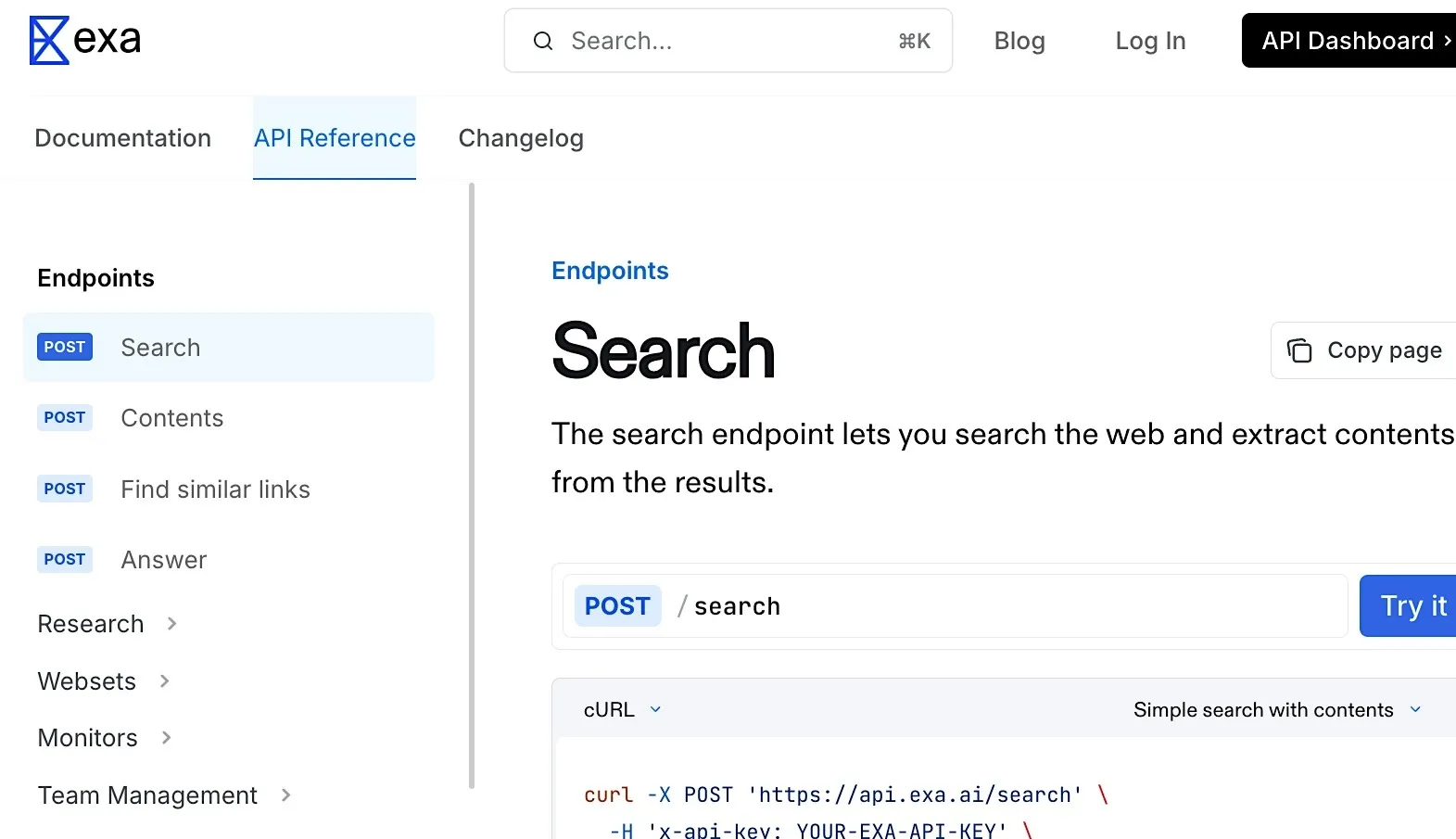
Exa is an AI-native web search API designed for machines, and is often used as part of AI agent infrastructure. Instead of keyword matching, it uses neural embeddings to understand intent and return semantically relevant results. It maintains its own index with specialized datasets for companies, people, news, and code documentation.
Results are returned inline as indexed content and summaries, allowing developers to pass them into retrieval-augmented generation pipelines without an additional retrieval layer. That makes Exa a strong fit for early-stage RAG systems and research-heavy workflows where semantic relevance matters more than real-time data.
When Exa May Not Be the Right Fit
Teams usually start looking for alternative solutions when Exa moves from research use into production retrieval due its limitations:
- Because Exa relies on a pre-built index, it can lag on newly published or niche content.
- It can have limited coverage on JavaScript-heavy or bot-protected sites, since it relies on indexed data rather than real-time browsing.
- Exa is not designed for high-volume, repeatable retrieval from the live web. Teams that need large-scale web data pipelines will run into rate limits and gaps in coverage on dynamic or protected pages.
Pricing can also become a factor as usage scales. Because Exa is often used as a retrieval layer in agent or RAG workflows, costs increase with query volume, especially when additional calls are needed to process or structure results.
Key Terms
In 2026, evaluating the AI/Agentic search API landscape means focusing on the technical benchmarks that actually matter when things scale. Key terms to know include:
- Data Freshness – How up-to-date the results are, based on whether the tool retrieves data at request time from the live web or relies on a pre-built index that updates periodically.
- Output Format – The structure of the response, such as raw text and links or structured, schema-defined data like JSON.
- Search Depth – The type of retrieval the tool performs, which can range from single-pass indexed retrieval to multi-step reasoning or live browsing across multiple sources.
- AI Agent and RAG Compatibility – For agents, this includes support for tool-calling, streaming, multi-step retrieval, and support for emerging agent protocols, such as Model Context Protocol (MCP). For RAG, compatibility depends on how directly outputs can be passed into generation pipelines without additional transformation.
- Ease of Integration – How straightforward it is to set up and use the API, based on available SDKs, documentation, and compatibility with common frameworks.
Top Exa Alternatives by Use Case
- Recommended for production AI agents requiring real-time, structured web data at enterprise scale: Nimble
- Recommended for lightweight, fast-setup AI search for RAG pipelines and agent workflows: Tavily
- Recommended for real-time search with cited, conversational outputs: You.com Search API
- Recommended for privacy-first search on an independent, non-Google index: Brave Search API
- Recommended for high-accuracy, sourced answers on complex agentic queries: Linkup
- Recommended for search with built-in LLM synthesis and inline citations: Perplexity Sonar API
Comparison Table: Best Exa Alternatives Compared
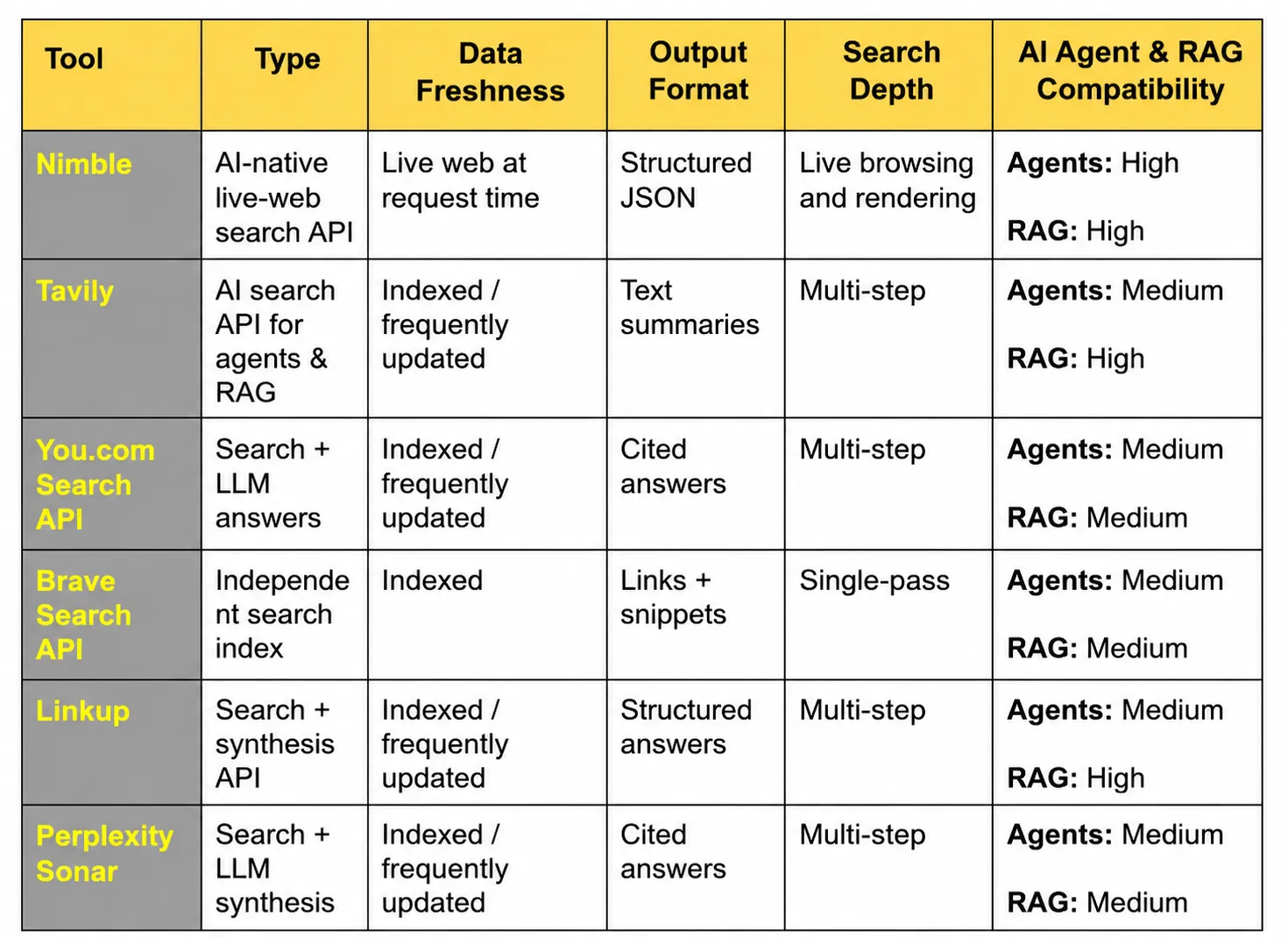
Choosing the right Exa alternative depends on how your retrieval layer needs to perform in production. The decision depends on whether the API needs to retrieve semantically relevant sources, return cited answers, access current web data, or deliver structured outputs for an agent or RAG pipeline. The table below compares six AI-native search APIs based on the criteria that matter most for developers building agentic workflows and RAG pipelines.
How We Compared These Tools
We evaluated these six Exa alternatives using a consistent set of criteria so you can compare them directly. Our analysis is based on publicly available information as of 29 April 2026. That includes product documentation, official websites, pricing pages, and relevant third-party reviews.
What we reviewed:
- Official product pages and documentation
- Feature descriptions and integration details
- Pricing and usage models, where available
- Vendor comparison pages
- Third-party review sites and software directories
How we compared tools:
We focused on buying factors like search capabilities, data freshness, output format, answer synthesis, search depth, agent and RAG support, developer experience, pricing clarity, and production fit.
We did not run full hands-on testing for every tool. As such, we have avoided definitive claims when a capability was unclear or when sources conflicted.
6 Exa Alternatives and What They Are Better For
Search API requirements change when systems move from prototype to production. Once AI agents and RAG pipelines move beyond testing, the way the API fits into the retrieval layer becomes the deciding factor. Choosing an Exa alternative comes down to which capability your workflow depends on most, and how consistently the API can deliver it in production.
1. Nimble AI Search API – Recommended for production AI agents requiring real-time, structured web data at enterprise scale
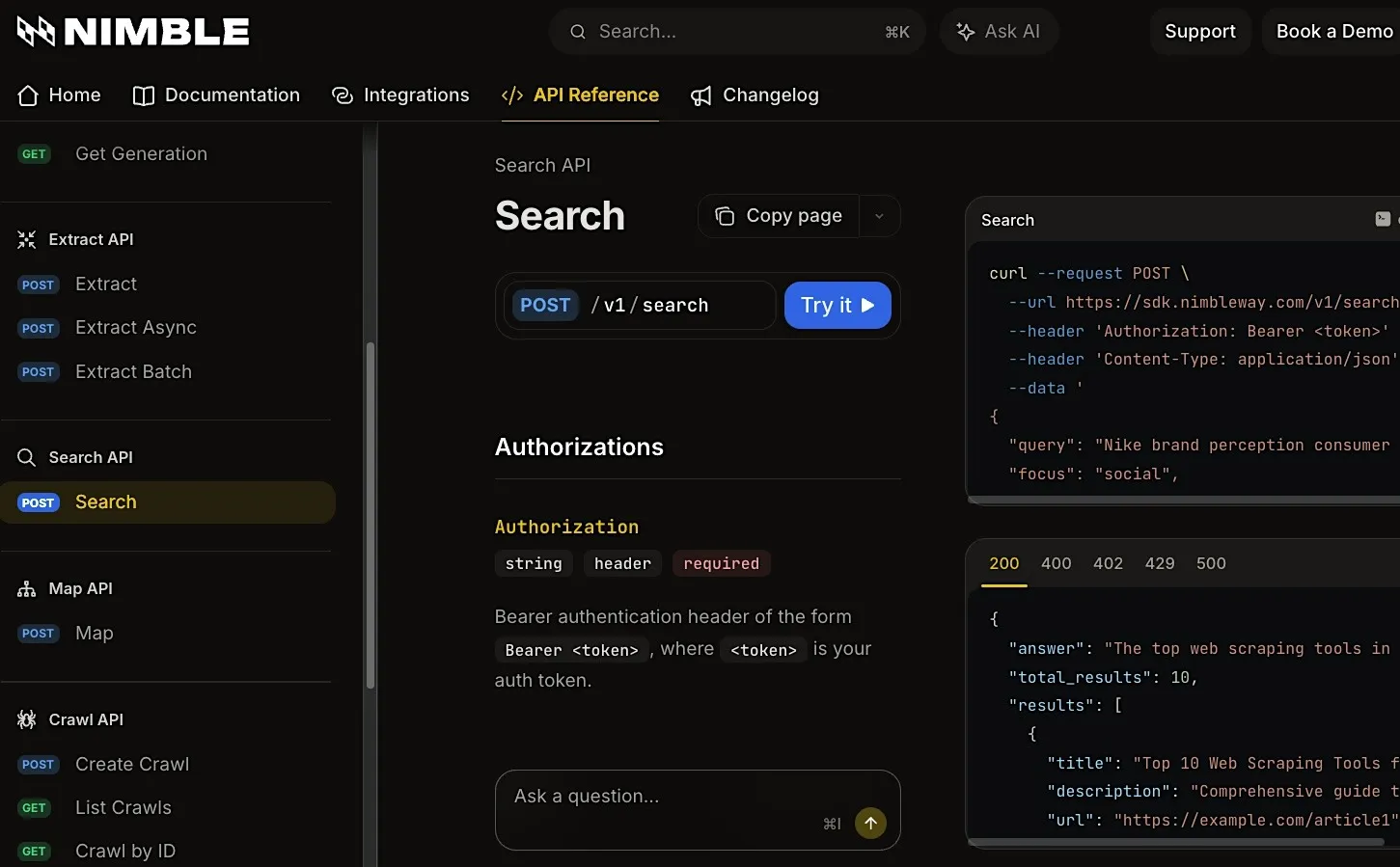
Nimble’s AI Search API is a live-web search API built for production AI agents that need current, structured web data at scale. Instead of returning results from a pre-built index, it retrieves data from the live web at request time and returns structured JSON that developers can pass into agent, RAG, and downstream data workflows.
The API is backed by Nimble’s browser, proxy, and extraction infrastructure. It helps teams access complex, JavaScript-heavy web pages and reduce the engineering overhead of maintaining their own retrieval stack.
Key Strengths
- Request-time retrieval for fast-changing information such as prices, news, product data, and company intelligence
- Machine-readable responses that reduce post-processing, parsing, and extra LLM calls
- Handles JavaScript-heavy and bot-protected sites reliably
- Built for production-scale agent workflows
Key Limitations
- More complex than plug-and-play search APIs
- May require tuning for specific schemas or workflows
Why Choose It Over Exa
Choose Nimble when your agents need fresh, structured data from live web pages instead of semantically ranked results from a periodically updated index. Exa is useful for finding relevant content, but Nimble is better suited for production workflows where retrieval quality depends on data freshness, machine-readable output, and reliable access to complex, JavaScript-heavy web pages.
Pricing
There’s a pay-as-you-go free trial available, and pricing is customized based on usage and scale.
Review
“For our organization, up-to-date financial data is crucial. Nimble API’s intuitive interface made it easy for us to integrate and pull data from multiple sources without the steep learning curve we faced with other tools. It streamlined our data gathering processes, allowing us to adjust strategies in real-time.”
2. Tavily – Recommended for lightweight, fast-setup AI search for RAG pipelines and agent workflows
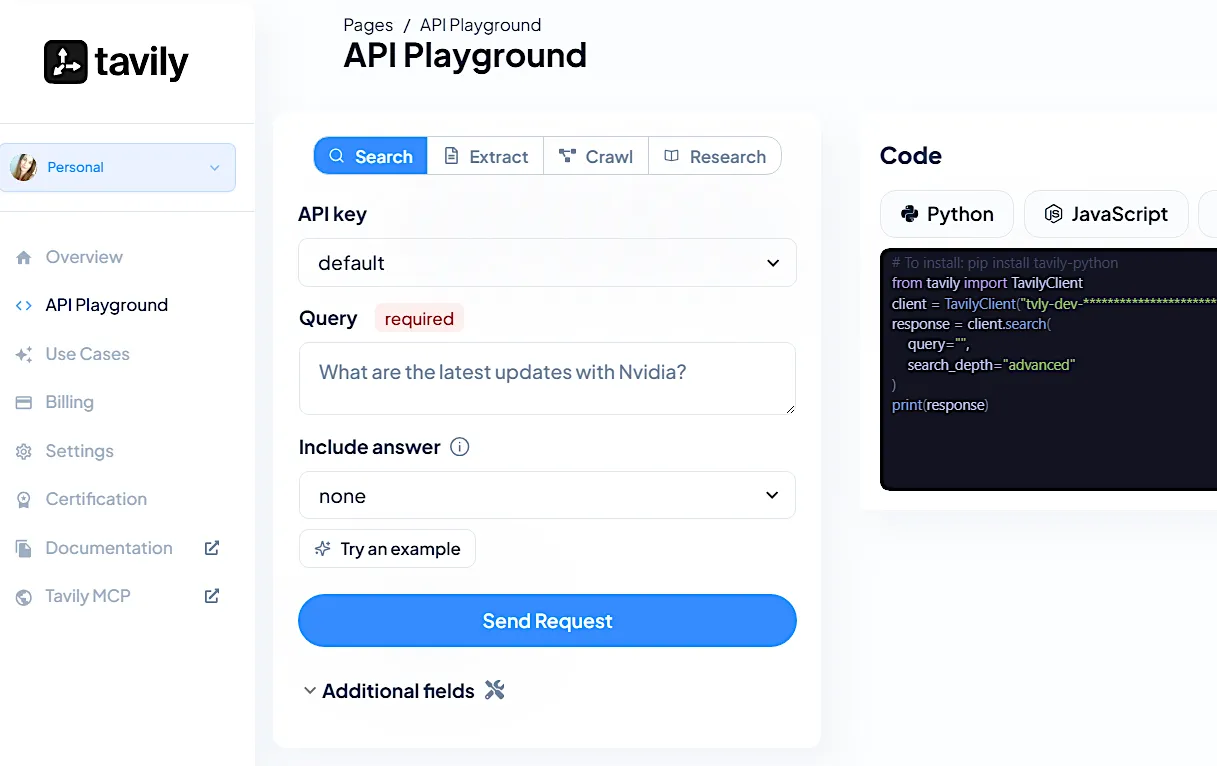
Tavily is an AI search API built for agents and RAG workflows that need fast access to web results with minimal setup. In addition to search, it provides extract, crawl, map, and research endpoints, making it useful for teams that want simple web retrieval and content ingestion without building a custom search pipeline.
Key Strengths
- Fast setup with minimal configuration
- Strong developer experience with Python, JavaScript, and REST support
- Affordable for early-stage projects
Key Limitations
- Limited structured output support
- Less suited for enterprise-scale live-web retrieval where schema-defined outputs, browser rendering, and advanced extraction control are required
Why Choose It Over Exa
Choose Tavily when you need a fast way to connect web search and content extraction to an agent or RAG pipeline. Compared with Exa, Tavily is a better fit when developer speed, simple setup, and built-in extraction workflows matter more than advanced semantic search or enterprise-scale live-web retrieval.
Pricing
Four usage-based tiers are available: Free with 1,000 API credits/month; Pay As You Go at $0.008 credit; Project at $30/4,000 API credits/month; and Enterprise with custom pricing and limits.
Review
“Tavily is a solid tool in many cases, but like most web search APIs, it doesn’t always guarantee live or high-quality links. It likely pulls from cached or indexed sources that haven’t been revalidated, which can lead to 404s or dead pages, especially for fast-changing or low-authority sites.”
3. You.com Search API – Recommended for real-time search with cited, conversational outputs
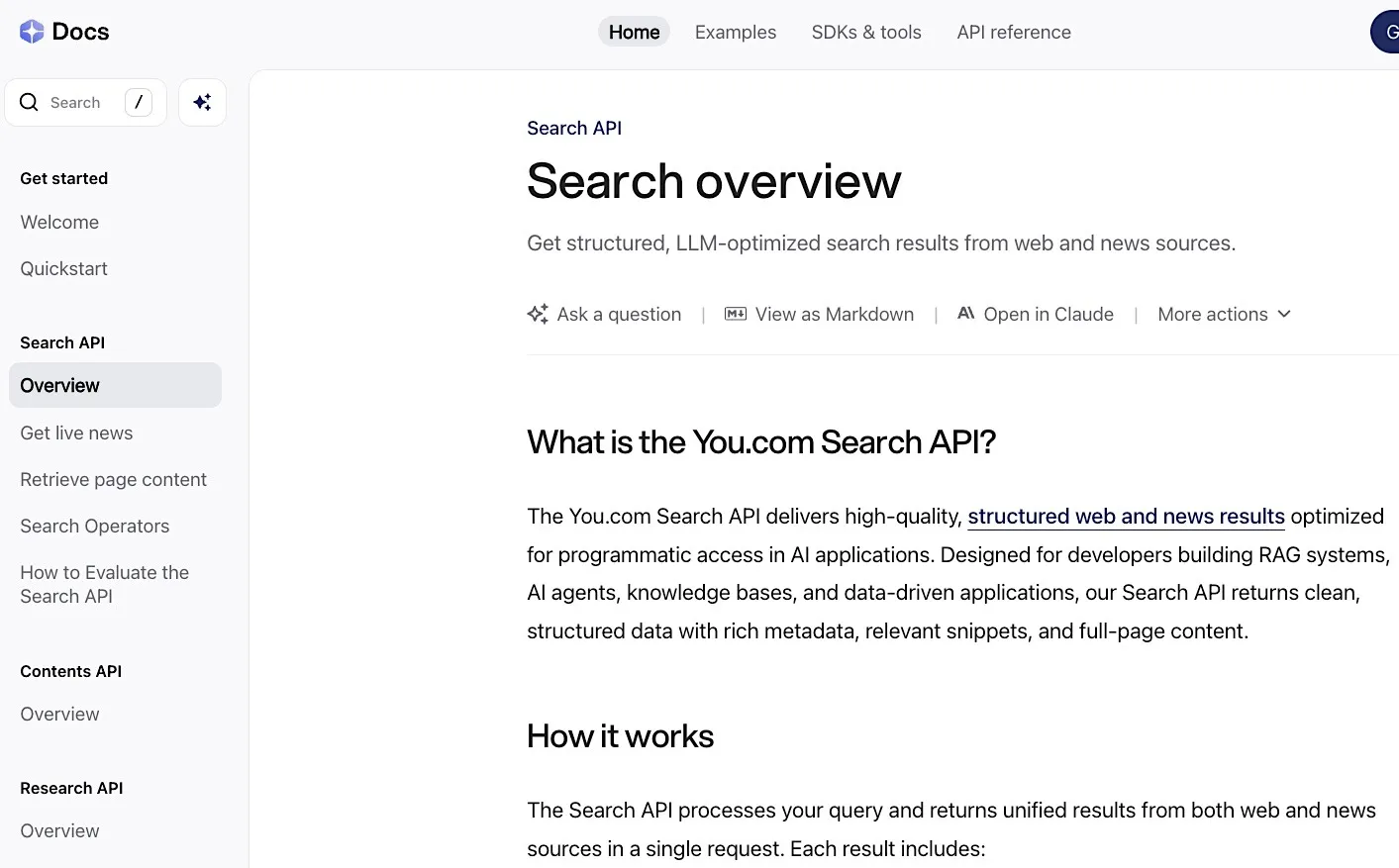
You.com Search API gives developers access to real-time, LLM-ready web and news results for AI agents, RAG systems, knowledge bases, AI search visibility tools, and data-driven applications. It returns structured search results with titles, URLs, snippets, metadata, and page content, which makes it useful for applications that need current source material with citations.
Key Strengths
- Returns search results with citation-ready source links
- Provides current web and news results for AI applications
- Offers a straightforward API for adding search to agent and RAG workflows
Key Limitations
- Less suited for schema-defined extraction workflows
- May require additional normalization when workflows need fixed fields or custom schemas
Why Choose It Over Exa
Choose You.com Search API when citation quality and current web coverage matter more than semantic similarity. Exa is stronger for finding conceptually similar content across its index, while You.com Search API is a better fit when developers need source-backed web results that are easier to ground in user-facing agent responses.
Pricing
The You.com Search API offers a free plan, and a paid plan with a base cost of $5.00/1,000 calls.
Review
“The real-time accuracy of the Search API is something I have come to rely on heavily in my production environments.”
4. Brave Search API – Recommended for privacy-first search on an independent, non-Google index
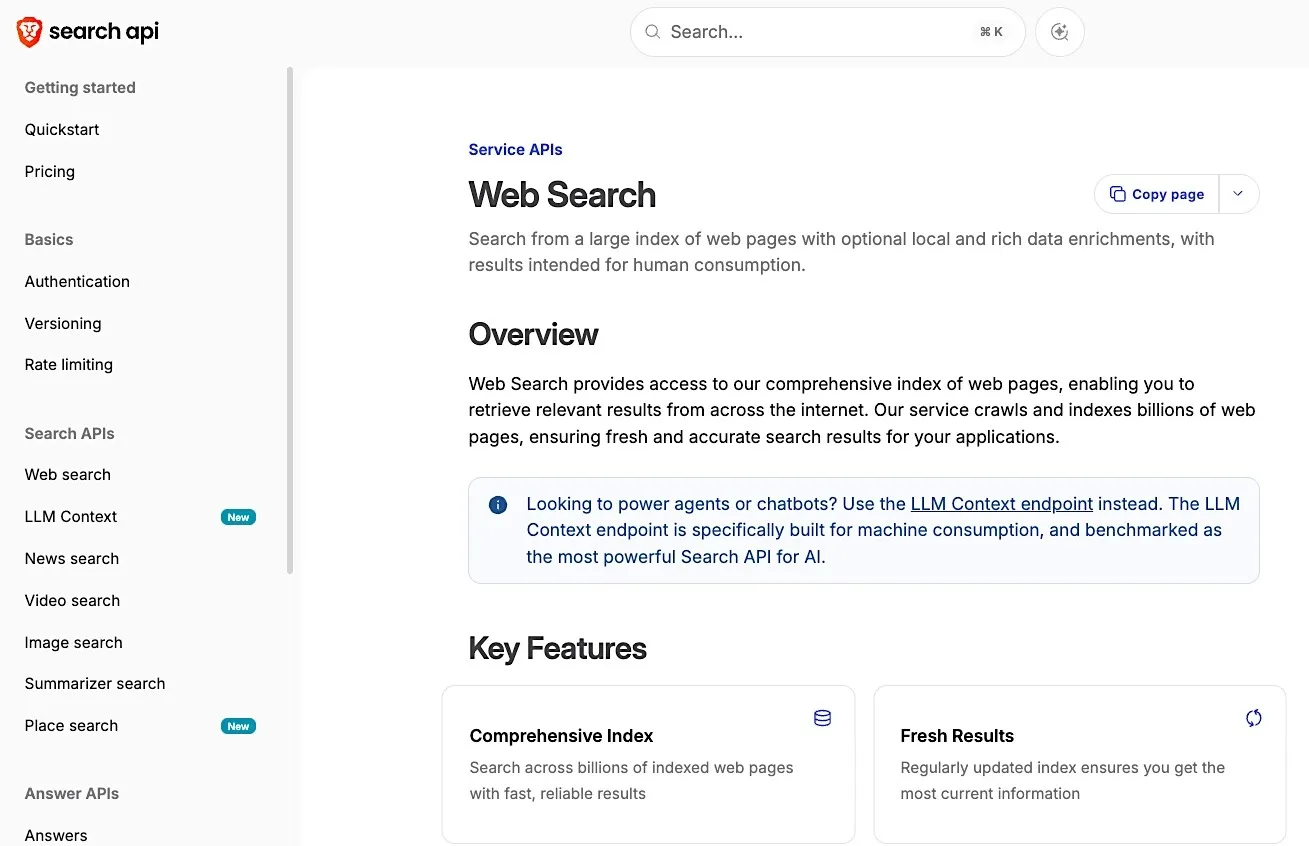
Brave Search API gives developers access to Brave’s independent search index, separate from Google and Bing. Enterprise plans also include a zero data retention option, which helps privacy-sensitive teams strengthen data governance for AI by limiting query storage and logging. It is a strong fit for teams that need privacy-first search infrastructure with independent index coverage.
Key Strengths
- Independent index with privacy-first positioning
- Predictable performance for general web queries
- Simple integration
Key Limitations
- Limited support for structured data outputs
- Lower-level search API without built-in agent orchestration
Why Choose It Over Exa
Choose Brave Search API when you need traditional search coverage, independent indexing, and less dependency on major search providers that can change pricing and access terms. It’s recommended for teams that value search infrastructure control more than built-in reasoning or answer generation.
Pricing
The Search API has a base cost of $5.00/1k calls, and an Enterprise tier with custom terms, capacity, or endpoints is available by inquiry.
Review
“The Brave Search API provides accurate search results for our academic citation services. It delivers high-quality data at a reasonable price, and with intuitive data structuring.”
5. Linkup – Recommended for high-accuracy, sourced answers on complex agentic queries
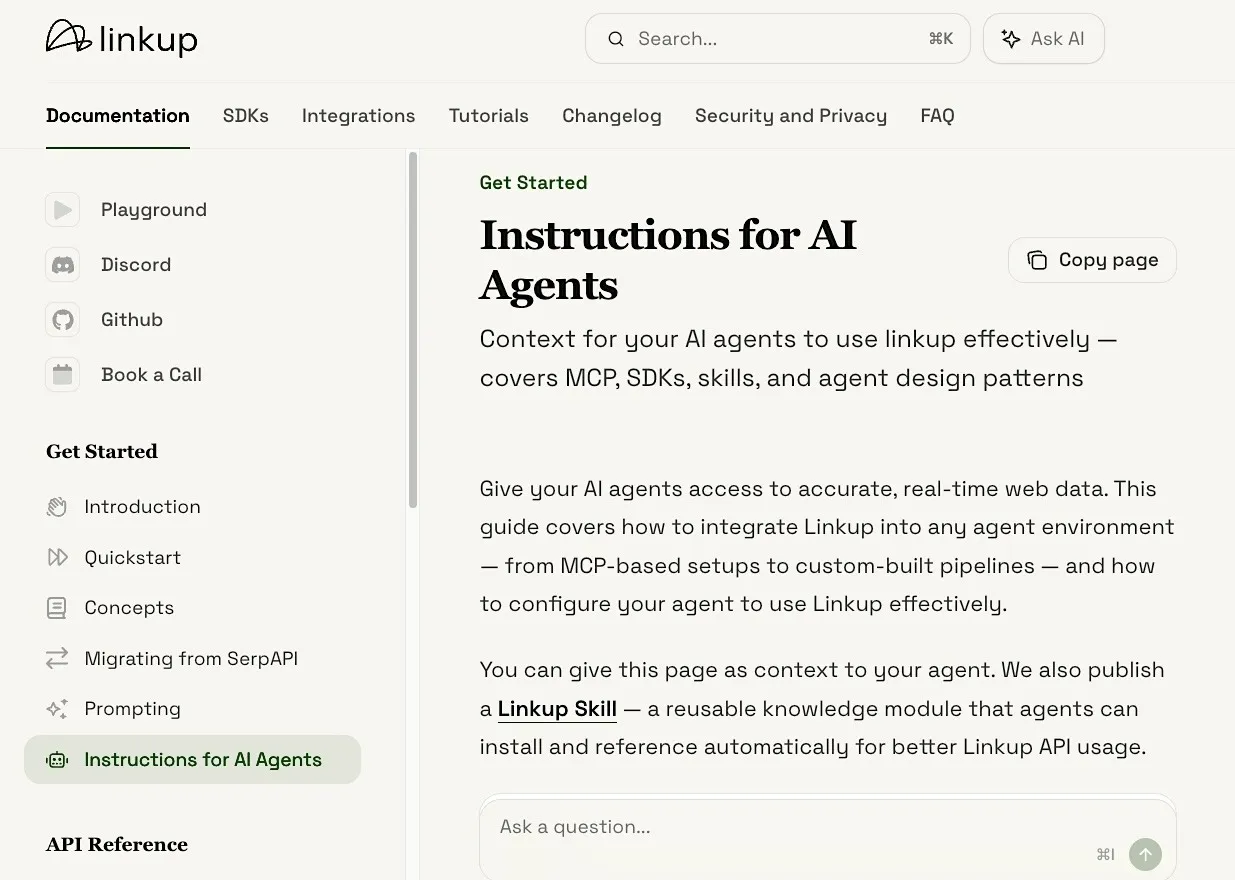
Linkup is a web search API for AI applications that provides grounding data for LLMs and agents. It retrieves online information from natural language queries and can return search results for agent-side reasoning, sourced answers with citations, or structured outputs that follow a defined schema. It supports standard and deep search modes for workflows that require multi-step source gathering and verification for complex queries.
Key Strengths
- High-quality, source-backed answers
- Supports deeper search modes for complex queries
- Can return outputs suitable for downstream agent or RAG workflows
Key Limitations
- Less control over raw retrieval compared to lower-level APIs
- Deep search modes may introduce higher latency or cost than simpler search calls
Why Choose It Over Exa
Choose Linkup when the output needs to be an answer with clear source grounding, not only a set of semantically relevant results. Exa is stronger for semantic retrieval across its index, while Linkup is better suited to complex queries where the system needs to retrieve, evaluate, and return source-backed answers.
Pricing
Three plans are available: Free at 1,000 standard/100 deep queries monthly; Pay-as-you-go at €5/1,000 standard searches and €50/1,000 deep searches; and Custom with bespoke pricing, priority access, and enterprise-grade solutions for high-volume users.
Review
“We integrate Linkup into various AI workflows to enrich our systems with hard-to-find insights on companies, individuals, and legal documentation.”
6. Perplexity Sonar API – Recommended for search with built-in LLM synthesis and inline citations
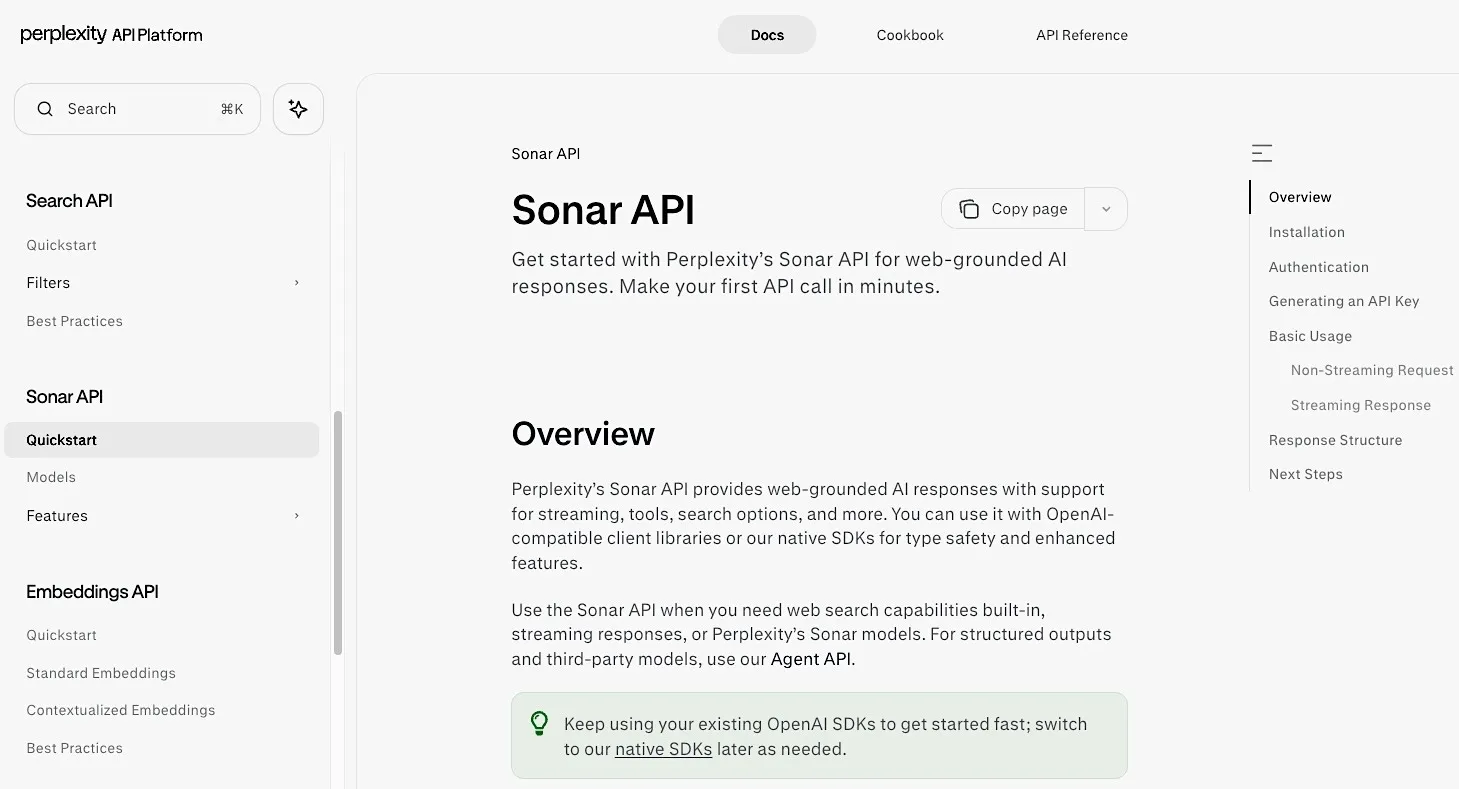
Perplexity’s Sonar API blends search with LLM synthesis, returning answers with inline citations. It also lets you control how sources are used and returned, including filtering domains and adjusting how much context gets pulled into the answer. It supports model options with different depth and cost profiles, so that developers can choose between lower-latency search responses and more advanced answer generation.
Key Strengths
- Built-in answer generation
- Strong citation support
- Handles complex queries well
Key Limitations
- Outputs are text-heavy rather than structured
- Less flexible for custom pipelines
Why Choose It Over Exa
Choose Sonar when the search experience needs to return a synthesized answer, not just source material (e.g., user-facing products, analyst tools, or research assistants). Exa is strong if you want semantic retrieval that can be routed into your own RAG pipeline, but Sonar is useful if you want search plus answer synthesis handled in a single API call.
Pricing
Sonar API pricing combines token costs with request fees. Sonar starts at $1 per 1M input tokens and $1 per 1M output tokens, plus request fees from $5 to $12 per 1,000 requests depending on search context size; Sonar Pro and Sonar Reasoning Pro have higher token and request rates, while Sonar Deep Research adds citation, search query, and reasoning-token costs.
Review
“Perplexity's API is fast, easy to integrate, and the AI market leader for summarizing the most recent information.”
Choose the AI-Native Search API That Fits Your Workflow
The right Exa alternative depends on the retrieval problem your team needs to solve. Exa-style indexed search still has a place when semantic relevance is the main requirement. Other workflows prioritize source-backed answers, lower integration overhead, or fresher data from the live web. The best choice comes down to whether the AI-native search API returns data that is current, usable, and easy to plug into your agent or RAG pipeline.
Nimble’s AI Search API is designed for production agents that need current web data in a structured format they can use directly. It retrieves data from the live web at request time, returns structured JSON, and reduces the need for additional extraction or parsing before downstream reasoning. For teams moving from indexed retrieval to production-grade agent workflows, Nimble provides the live web access, data freshness, and output structure needed to support reliable AI systems.
Book a demo to see how Nimble’s AI Search API delivers live, structured web data for production agents.
FAQ
Answers to frequently asked questions
.webp)
.avif)
.webp)
.webp)

.webp)
.webp)
.webp)