









Top 16 Brave Search Alternatives
Top 16 Brave Search Alternatives



Charlie Klein
Top 16 Brave Search Alternatives
Top 16 Brave Search Alternatives
Charlie Klein


Most popular articles

Get structured, reliable data for your stack.
Abstract
Brave Search alternatives span three distinct roles: web retrieval, research and synthesis, and structured SERP data.
| Category | Recommended for |
|---|---|
| AI-native web retrieval | Best when applications need search results or page-level web context but keep reasoning downstream. |
| Research and synthesis | Better suited to workflows where the provider searches across sources and returns a completed answer. |
| SERP APIs | Fit SEO, monitoring, and localization workflows that depend on structured search-engine results. |
The right choice depends on which part of Brave Search API your architecture needs to replace.
Brave Search API now competes with tools that can play very different roles in an AI application. Some return ranked results or live page content for downstream processing, while others provide LLM-ready context or handle deeper research across multiple sources. For AI engineers, that changes what the search layer needs to deliver and how much work remains for the application.
That distinction matters as more teams move AI agents toward production. McKinsey found that 62% of organizations were already experimenting with AI agents in 2025, yet fewer than 10% had scaled agents within any individual business function. As agent workloads become more complex, teams need to decide what the search layer should handle and what should remain inside their application. That includes retrieval, extraction, and reasoning.
Choosing a Brave Search alternative therefore starts with deciding which of those functions you need to replace. The 16 alternatives below are grouped by their primary use case, from web retrieval and page-level context to deeper research and structured SERP data.
What Is Brave Search API?
Brave Search API gives developers programmatic access to Brave’s independent web index. Its Web Search endpoint returns ranked results and snippets, while the LLM Context API can return extracted page content formatted for RAG and agent workflows.
Developers can also control how much context is returned and set relevance and freshness thresholds for that content. Brave Answers adds synthesis. It uses web search to generate a cited response and can run additional searches for more involved research tasks.
What a team needs from a Brave Search alternative depends on which Brave capabilities its application currently uses. It could be replacing basic retrieval for its own application to process, LLM-ready context for RAG or agent workflows, and search plus synthesis.
Brave Search Alternatives at a Glance
- Recommended for AI-native web retrieval: Nimble Search API
- Recommended for research and synthesis: Parallel Search API
- Recommended for SERP data: DataForSEO
Top 16 Brave Search Alternatives
AI-Native Web Retrieval
These tools are for applications that handle reasoning downstream and need search results, page content, or both. Some also offer research capabilities, but compare their core retrieval features based on page-content access, extraction controls, and crawling support.
| Alternative | Best for | Page content |
|---|---|---|
| Nimble Search API | Live retrieval + extraction and crawling | Yes |
| You.com Web Search API | Search with optional live crawling | Optional |
| Firecrawl Search | Search with configurable scraping | Optional |
| TinyFish Search | Search + browser-based fetching | Separate Fetch API |
| Jina AI | Lightweight LLM-ready retrieval | Separate Reader |
| Tavily Search | Agent-framework integrations | Optional |
| Exa Search | Semantic discovery | Optional |
1. Nimble Search API: Best for Live Web Retrieval for AI Agents
Recommended for:
AI agents and applications that need current search results, webpage content, or structured web data as inputs to their own reasoning workflows.
Why it fits:
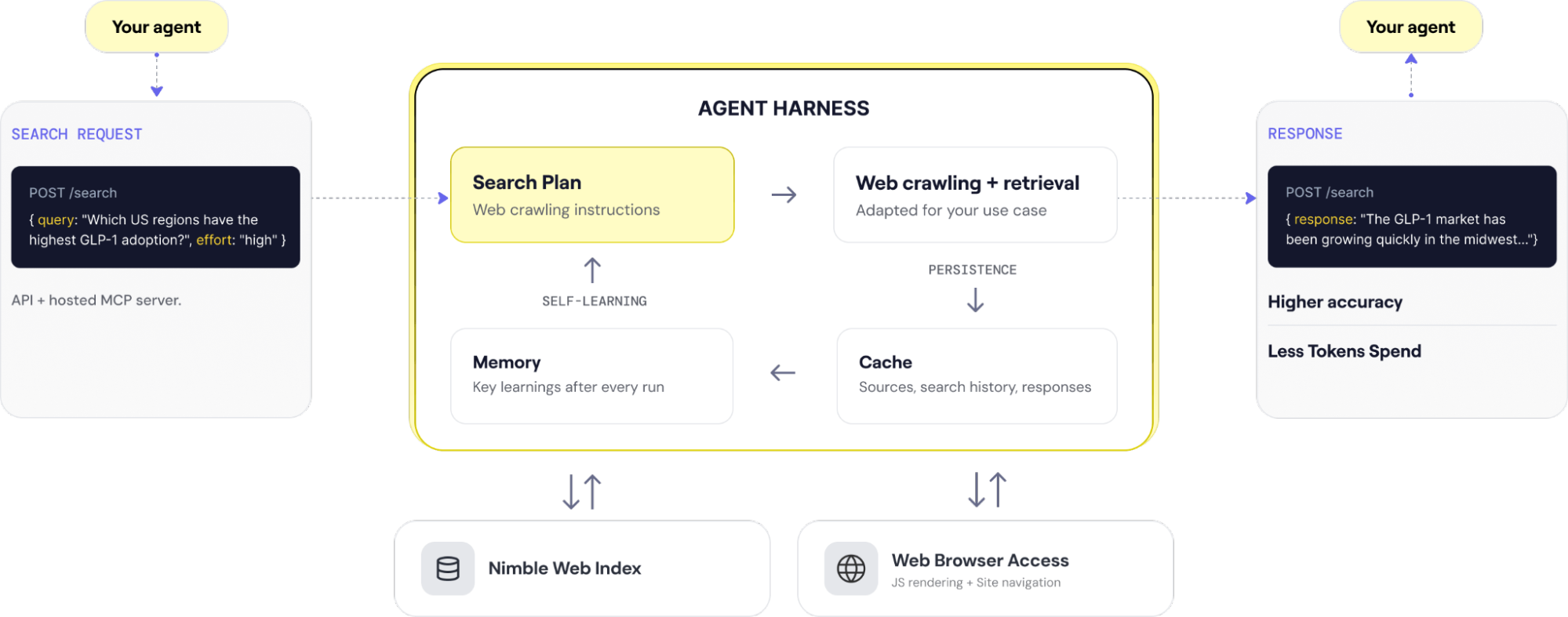
Nimble Search API is designed for applications that need reliable web retrieval while keeping reasoning and synthesis inside their own system. It can return search results and web content for downstream processing, making it a fit for straightforward, high-volume, or latency-sensitive retrieval workflows.
Nimble also gives developers access to the broader web retrieval stack when they need to go beyond search results, including web data parsing, extraction, and crawling. For more complex questions that require multiple searches, extraction, and reasoning across sources, Nimble positions Web Search Agents as the better fit.
Key capabilities:
- Retrieve current web search results for downstream agent workflows
- Access webpage content for RAG and agent context
- Return structured web data for application-side processing
- Extend retrieval with extraction and crawling when deeper web context is needed
- Use Web Search Agents for multi-step research tasks that require search, extraction, and reasoning across sources
Strengths and considerations:
The combination of search, extraction, mapping, and crawling lets teams move beyond snippet-only retrieval when an agent needs richer web context. Page-level content and structured outputs can also reduce the parsing and cleanup required before retrieved data is passed downstream.
Nimble is most relevant when the customer’s application already owns reasoning and synthesis. Teams that only need lightweight ranked results may not need the deeper extraction and crawling capabilities, while teams that want the search provider to complete a multi-source research task should evaluate a research-oriented product instead.
Pricing and availability:
Speak to the Nimble team for current pricing.
2. You.com Web Search API: Best for Structured Search Results With Optional Live Crawling
Recommended for:
Teams that need structured search results and want the option to pull current page content without switching providers.
Why it fits:
You.com combines standard search retrieval with optional live crawling in the same API workflow.
Key capabilities:
- Up to 100 results per request
- livecrawl with HTML or Markdown output
- Country and language controls
- Domain inclusion, exclusion, and ranking boosts
- Contents API for known URLs
Strengths and considerations:
Teams can add page retrieval selectively instead of crawling every result. Full-page crawling adds latency and page-based cost.
Pricing and availability:
New accounts include $100 in free credits. PAYG search costs $5 per 1,000 calls. Live crawling and Contents cost $1 per 1,000 pages.
3. Firecrawl Search: Best for Combining Search Discovery With Full-Page Scraping
Recommended for:
Teams that need search plus configurable scraping of the resulting pages.
Why it fits:
Firecrawl Search returns standard search metadata and can scrape result pages within the same request.
Key capabilities:
- Configurable search result limits
- Full-page scraping through scrapeOptions
- Markdown or HTML page output
- Time and location filtering
- Separate Scrape, Crawl, and Map APIs
Strengths and considerations:
Firecrawl saves teams from having to set up a separate scraping step after search. Teams should account for the additional credits used when search results are scraped.
Pricing and availability:
The free plan includes 1,000 credits per month. Paid plans start at $16 for 5,000 credits per month.
4. TinyFish Search: Best Emerging Option for Agent-Oriented Search and Page Fetching
Recommended for:
Agent developers that need inexpensive search with browser-based retrieval for dynamic pages.
Why it fits:
TinyFish separates Search and Fetch, so applications can retrieve ranked results first and fetch full-page content as needed.
Key capabilities:
- Structured results with titles, snippets, and URLs
- Country and language controls
- Browser-rendered Fetch for JavaScript-heavy pages
- Markdown, JSON, or HTML output
- Search and Fetch available at no charge
Strengths and considerations:
Free Search and Fetch make TinyFish budget-friendly, though teams with higher throughput requirements will need a paid tier for increased rate limits.
Pricing and availability:
Search and Fetch are free. Agent and Browser access is PAYG at $0.015 per credit.
5. Jina AI: Best for Lightweight Web Search and LLM-Ready Content
Recommended for:
Teams that need web search and clean page content for RAG or agent pipelines.
Why it fits:
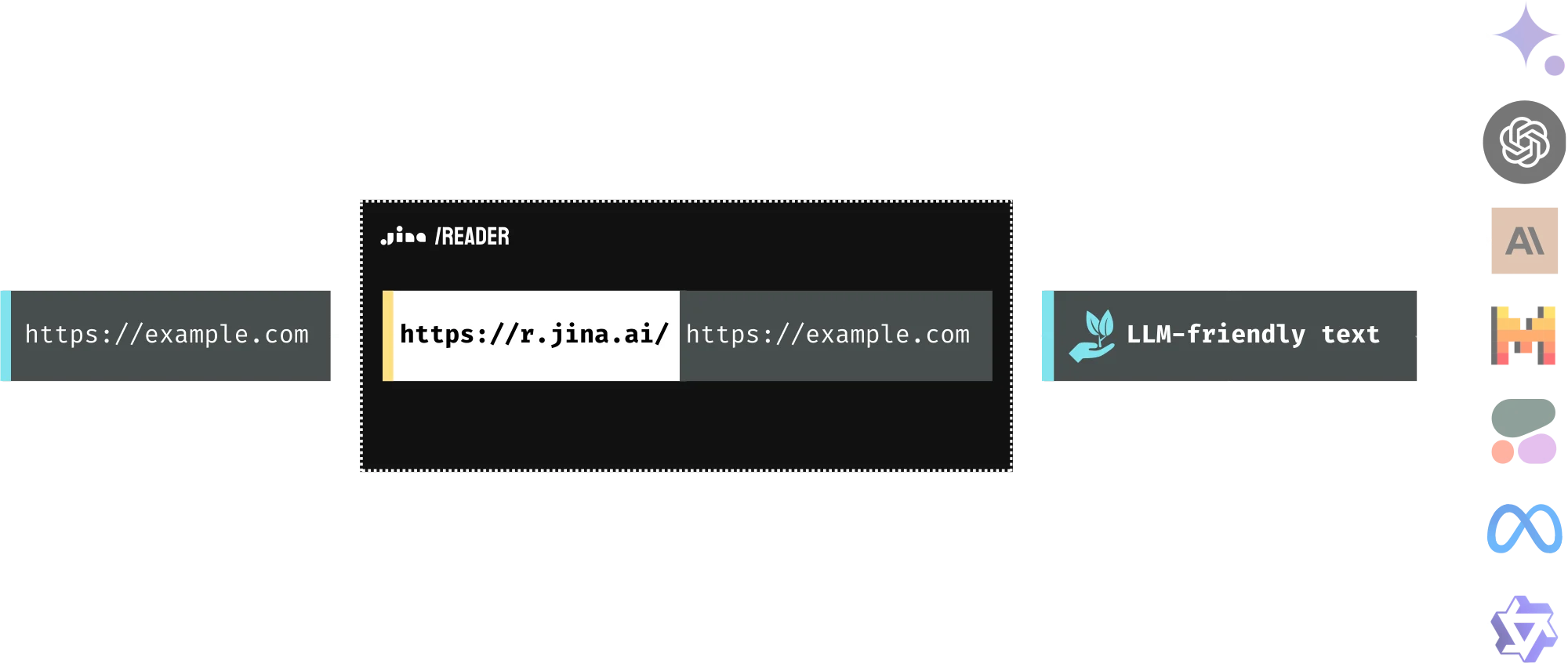
Jina pairs its Search endpoint with Reader, which converts supplied URLs into LLM-ready content.
Key capabilities:
- s.jina.ai for web search
- r.jina.ai for URL-to-text conversion
- Webpage and PDF extraction
- JSON or text output
- Structured extraction
Strengths and considerations:
Jina fits easily into existing retrieval pipelines, but Reader respects site access restrictions and will not fetch blocked pages. Reader is URL-focused, so site-wide crawling requires another solution.
Pricing and availability:
Paid plans start at $50 for 1 billion tokens.
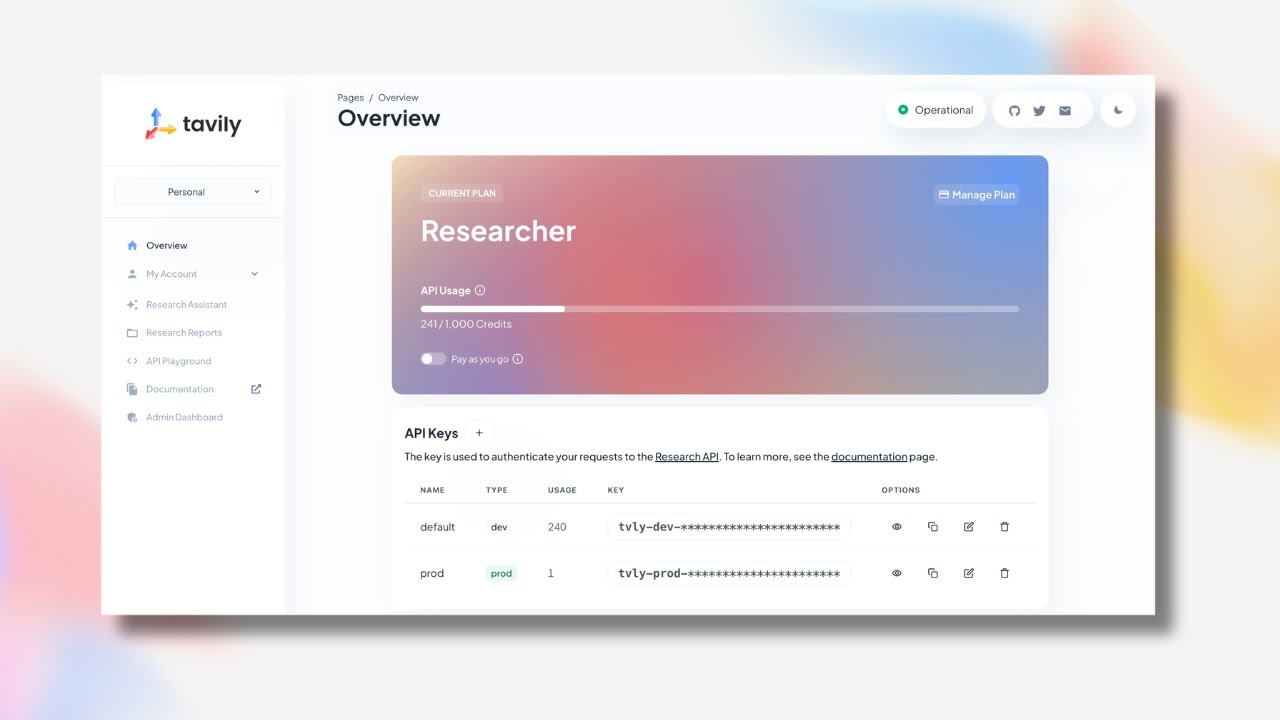
6. Tavily Search: Best for Developer-Friendly AI Search and Framework Integration
Recommended for:
Agent developers using common AI orchestration frameworks such as LangChain or LlamaIndex.
Why it fits:
Tavily provides search-oriented retrieval alongside Extract, Crawl, and Map APIs.
Key capabilities:
- basic, fast, ultra-fast, and advanced search modes
- Optional raw page content
- Domain inclusion and exclusion controls
- Country and time-based filtering
- Official LangChain and LlamaIndex integrations
Strengths and considerations:
Tavily integrates directly with common AI frameworks, which can reduce implementation work, but watch for auto_parameters – it can move queries to the higher-cost advanced mode.
Pricing and availability:
The free plan includes 1,000 credits per month. PAYG starts at $0.008 per credit. Paid plans start at $30 per month.
7. Exa Search: Best for Semantic and Concept-Based Web Discovery

Recommended for:
Applications where conceptual relevance is more useful than conventional keyword matching.
Why it fits:
Exa supports semantic-oriented search alongside several speed and depth options.
Key capabilities:
- Full-page text or query-relevant highlights
- Structured outputs
- Freshness controls through maxAgeHours
- Subpage crawling from known URLs
Strengths and considerations:
Exa gives teams more control over both relevance and how much page content is returned. Freshness is configurable, but forcing live retrieval can increase latency.
Pricing and availability:
PAYG search starts at $7 per 1,000 requests, with Contents at $1 per 1,000 pages per content type.
Research & Synthesis
These tools either take on more of the research process through deeper multi-source search and synthesis, or integrate web search directly into the model workflow. The main differences are research depth, how much synthesis the provider handles, and the cost of deeper processing.
| Alternative | Best for | Deeper Research option |
|---|---|---|
| Perplexity Search API | Perplexity API ecosystem | Sonar / Deep Research |
| Parallel Search API | Objective-driven retrieval | Task |
| Linkup Search | Adjustable search depth | Research API |
| Valyu Search API | Web + specialist sources | DeepResearch |
| OpenAI Web Search | OpenAI-powered agents | N/A |
| Anthropic Web Search | Claude applications | N/A |
8. Perplexity Search API: Best for Teams Already Using Perplexity’s AI API Ecosystem
Recommended for:
Applications already using Perplexity models or agent tooling.
Why it fits:
Perplexity provides raw Search separately from its model-grounded Sonar and Agent APIs.
Key capabilities:
- Ranked real-time web results
- Multi-query search
- Domain, language, and regional filtering
- Configurable extracted content per page
- Total content budget controls
Strengths and considerations:
Teams can choose raw retrieval or Perplexity-managed reasoning. The number of overlapping API surfaces makes that architectural choice important during migration.
Pricing and availability:
Search costs $5 per 1,000 requests. Agent web-search and URL-fetch operations have separate usage charges.
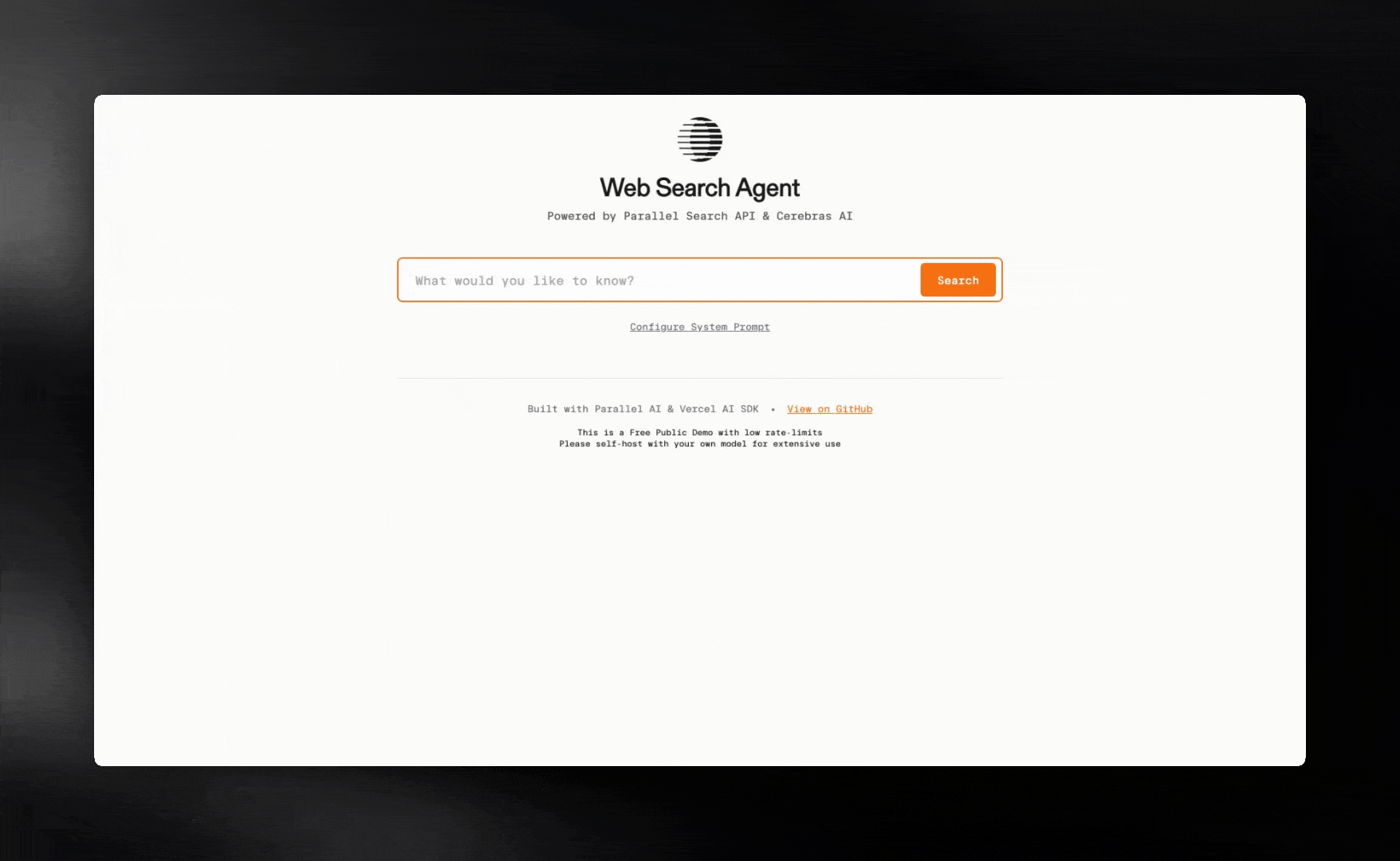
9. Parallel Search API: Best for Objective-Driven Retrieval and Token-Dense Context
Recommended for:
Agents that need focused web context tailored to a specific research objective.
Why it fits:
Parallel accepts a natural-language objective alongside search queries and returns relevant excerpts that can be passed directly to a model.
Key capabilities:
- Natural-language objectives plus keyword queries
- Ranked results with LLM-optimized excerpts
- Extract for known URLs, including full-page content
- Up to 20 URLs per Extract request
- Shared session IDs across Search and Extract
Strengths and considerations:
Parallel keeps model context compact with objective-focused excerpts. Task adds deeper research, with cost and completion time varying by processor.
Pricing and availability:
Turbo costs $1 per 1,000 requests; Basic/Advanced cost $5 per 1,000.
10. Linkup Search: Best for Configurable Fast, Standard, and Deep Search
Recommended for:
Teams that need configurable search depth across different query types.
Why it fits:
Linkup offers direct indexed retrieval for simpler queries and agentic search when more investigation is needed.
Key capabilities:
- fast, standard, and deep modes
- Raw results or sourced answers
- Structured JSON output
- Domain and date filtering
- fast mode (beta) with sub-second target latency
Strengths and considerations:
Linkup can return raw results or process them into sourced and structured answers. Deep mode adds more search depth, but takes 5–30 seconds and costs about 10× more than standard search.
Pricing and availability:
Fast and standard search starts at $0.005 per call. Deep starts at $0.05 per call.
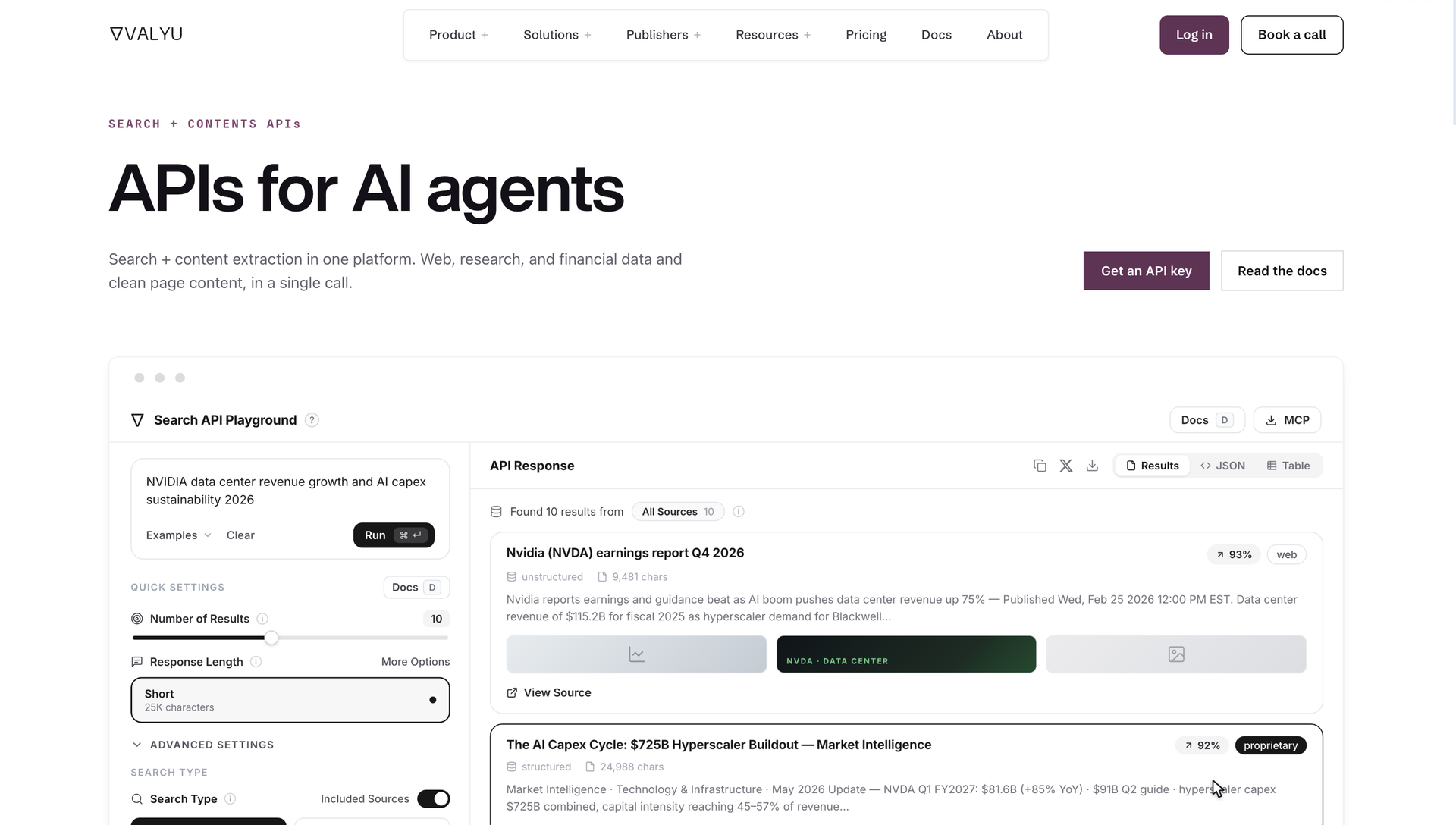
11. Valyu Search API: Best for Specialist Research Sources
Recommended for:
Research workflows that draw from both the open web and specialist data sources.
Why it fits:
Valyu combines web retrieval with datasets covering areas such as academic literature, finance, and biomedicine.
Key capabilities:
- web, proprietary, news, or combined search
- Full-text content
- Source inclusion, exclusion, and ranking biases
- Date and country filtering
- 36+ documented data sources, including arXiv, PubMed, and SEC filings
Strengths and considerations:
Valyu gives teams access to specialist sources without building separate retrieval pipelines for each one. Source-dependent pricing can make costs vary significantly.
Pricing and availability:
Search pricing varies by source, currently ranging from about $0.50 to $30 per 1,000 retrievals. Specialist datasets carry different source-specific rates.
12. OpenAI Web Search: Best for Adding Search Directly to OpenAI-Powered Agents

Recommended for:
Applications already using OpenAI models for reasoning.
Why it fits:
Web search runs as a built-in tool in the Responses API, keeping search within the existing model workflow.
Key capabilities:
- Source citations and reporting
- Allowed-domain filtering
- low, medium, or high search context
- Approximate user-location controls
Strengths and considerations:
Search requires little additional orchestration when the agent already runs on OpenAI, but its model-integrated design gives teams less direct control over retrieved results. Web search can be combined with other Responses API tools for multi-step agent workflows.
Pricing and availability:
Web search costs $10 per 1,000 tool calls, with model usage billed separately.
13. Anthropic Web Search: Best for Adding Cited Web Retrieval to Claude Applications
Recommended for:
Claude applications requiring current web information.
Why it fits:
Web Search runs as a Claude server tool, letting the model search and cite current sources while generating its response.
Key capabilities:
- Automatic source citations
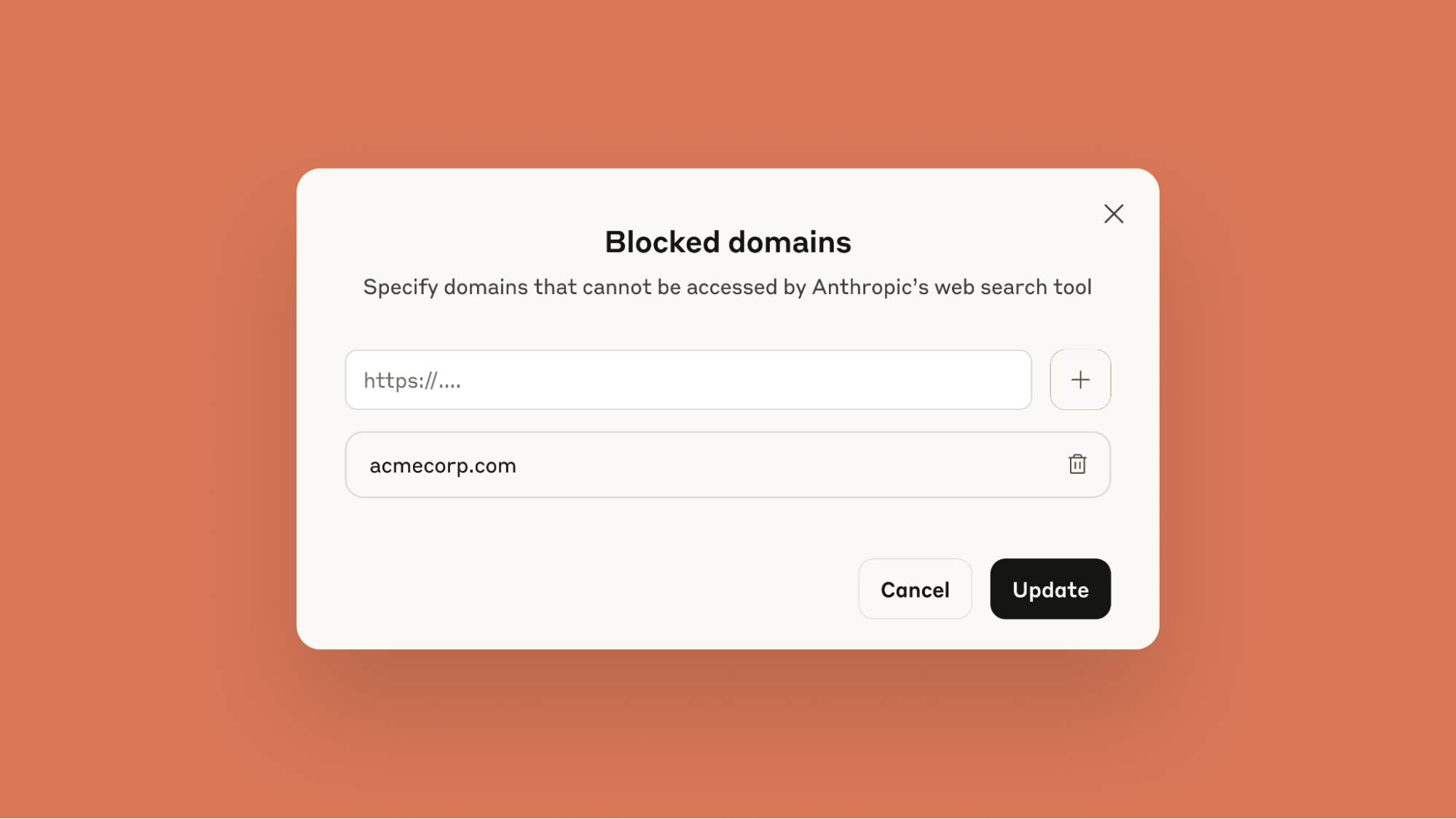
- Domain filtering and localized results
- Configurable limits on searches per request
- Dynamic filtering on supported models/tool versions
Strengths and considerations:
Retrieval integrates directly with Claude’s reasoning. Teams needing model-independent raw search results should consider standalone APIs.
Pricing and availability:
Web search costs $10 per 1,000 searches plus normal Claude token charges.
SERP Data
SERP APIs return structured search-engine results for applications such as SEO monitoring and local search analysis. Compare engine coverage, localization controls, execution speed, and pricing at scale.
| Alternative | Best for | Retrieval / Execution |
|---|---|---|
| SerpApi | Mature multi-engine SERP retrieval | Real-time + cached results |
| DataForSEO SERP API | High-volume localized SERPs | Queued or synchronous Live |
| SearchApi | Specialized Google result types | Real-time |
14. SerpApi: Best for Mature Multi-Engine SERP Data
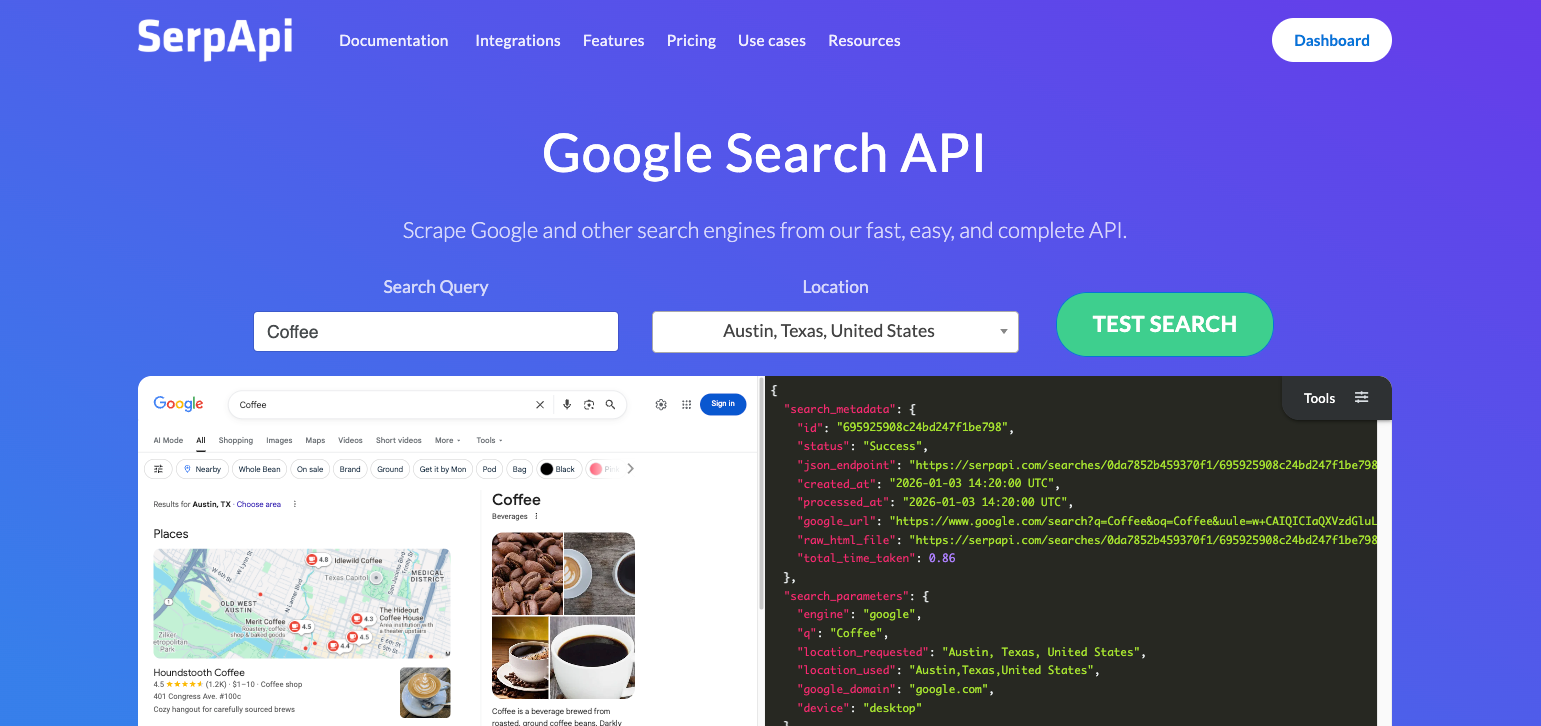
Recommended for:
Applications that need structured search-engine results across multiple search engines.
Why it fits:
SerpApi exposes search-engine results through dedicated APIs, including Google, Bing, DuckDuckGo, and other engines.
Key capabilities:
- Structured JSON and raw HTML
- Location, country, and language controls
- Desktop, mobile, and tablet results
- Specialized Google result types
- Production legal protection
Strengths and considerations:
Search-engine coverage is broad and the API exposes detailed SERP features. It also offers up to $2 million in protection for claims tied to how it collects public search data.
Pricing and availability:
A free plan includes 250 searches per month. Paid plans start at $25 per month for 1,000 searches.
15. DataForSEO SERP API: Best for High-Volume and Location-Specific Search-Engine Data
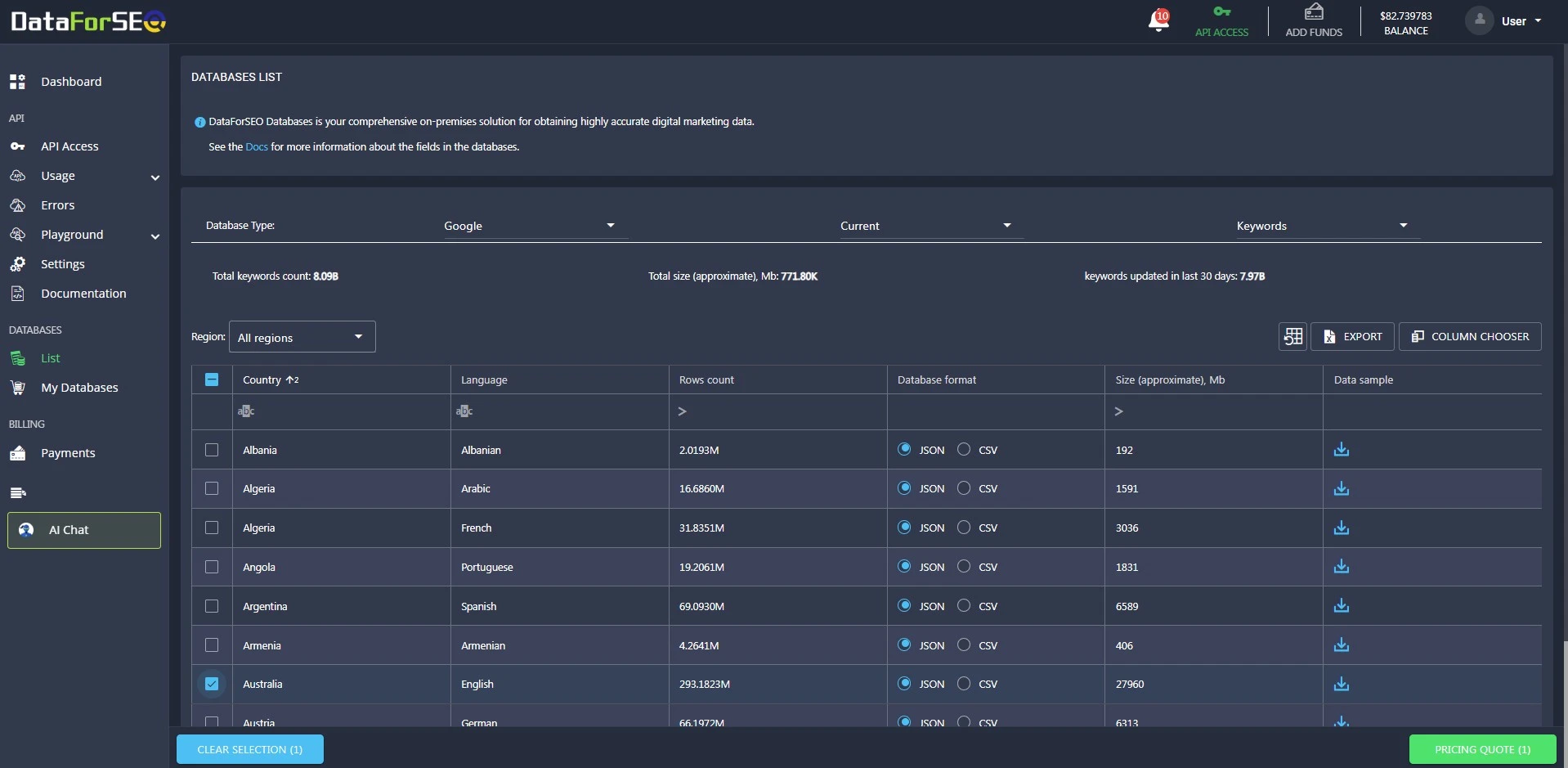
Recommended for:
Teams collecting large volumes of localized SERP data.
Why it fits:
DataForSEO supports multiple search engines with extensive location and language configuration.
Key capabilities:
- Standard (normal/high priority) and Live execution
- Location and language targeting
- Configurable result depth
- Structured SERP elements
Strengths and considerations:
Queued processing keeps per-SERP costs very low for large jobs, while Live trades higher cost for immediate results. Deeper result sets also increase cost.
Pricing and availability:
Standard processing starts at $0.0006 per 10-result SERP. Live starts at $0.002.
16. SearchApi: Best for Structured Google and Other Search-Engine Result Features
Recommended for:
Developers working primarily with Google SERPs and specialized Google result types.
Why it fits:
SearchApi turns Google and other search-engine results into structured API responses with detailed localization controls.
Key capabilities:
- Location, country, and language targeting
- Dedicated APIs for Google Local, Maps, Shopping, and News
- Structured SERP responses
- Zero Data Retention is available to Enterprise customers
- Legal Protection Guarantee on eligible plans
Strengths and considerations:
SearchApi charges only for successful requests and offers up to $2 million in protection for claims tied to its collection of public search data.
Pricing and availability:
Plans start at $40 per month for 10,000 searches. High-volume plans are also available.
How We Compared These Brave Search Alternatives
This shortlist was built from public API documentation, pricing pages, changelogs, and product pages as of August, 2026, using the Brave Search API capabilities and pricing above as the comparison baseline. We did not perform hands-on benchmark testing. All claims are sourced from official vendor documentation.
The comparison focuses on retrieval approach, returned data, page-content access, controls, availability, pricing, and key trade-offs. Each tool was evaluated based on the Brave Search use case it could replace. Pricing is left in the vendor’s published units when requests, credits, pages, or model tool calls are not directly comparable.
Choosing a Brave Search Alternative
For teams that keep reasoning inside their own application, Nimble Search API supports the retrieval layer with search, extraction, mapping, and crawling, including deeper retrieval from dynamic pages. When the workflow instead requires completed multi-source research, Nimble Web Search Agents add use-case-specific search, extraction, and reasoning with domain context and auditable Search Plans.
When the requirement is a more complex research task, Nimble Web Search Agents address a separate layer of the stack. They orchestrate search, extraction, and reasoning across sources for specific use cases, with domain context and auditable Search Plans helping teams control how research is carried out.
Explore Nimble’s Search API for retrieval workflows, or learn how Web Search Agents handle complex research.
FAQ
Answers to frequently asked questions
%201%20(1).webp)

.png)
.webp)
.avif)
.webp)
.webp)