









The Definitive Guide to Retail Pricing Intelligence


.avif)
Ilan Chemla
%20(1).webp)
The Definitive Guide to Retail Pricing Intelligence
Ilan Chemla


Most popular articles



Get structured, reliable data for your stack.
The Definitive Guide to Retail Pricing Intelligence
In the current retail landscape, every price, promotion, and inventory shift is technically visible across the digital shelf. However, the sheer volume of these market signals has outpaced the ability of most enterprises to interpret them systematically. Without a structured way to collect and compare these fragmented data points, retailers remain trapped in a reactive state, discovering competitive moves only after they have already impacted the bottom line. This gap between observable data and actionable insight leaves margins vulnerable and competitive positioning to chance.
Retail pricing intelligence is what transforms this observable market behavior into a consistent, comparable signal. Leveraging AI-driven models to process these vast data streams allows pricing teams to have a definitive understanding of their competitive position and enables decision-making based on accurate data.
The transition to automated, intelligent pricing analysis is becoming the industry standard; in fact, a recent survey found that 89% of retailers said AI-powered solutions have increased their annual revenue.
For these systems to function, e-commerce teams must replace static, batched datasets with a resilient stream of real-time market signals. Establishing a clear framework for how this data is utilized is the first step toward mastering the digital shelf. Here’s what you need to know about retail pricing intelligence, including five effective strategies you can implement today to gain a competitive advantage.
Retail Pricing Intelligence: What is it, and what can it do for you?
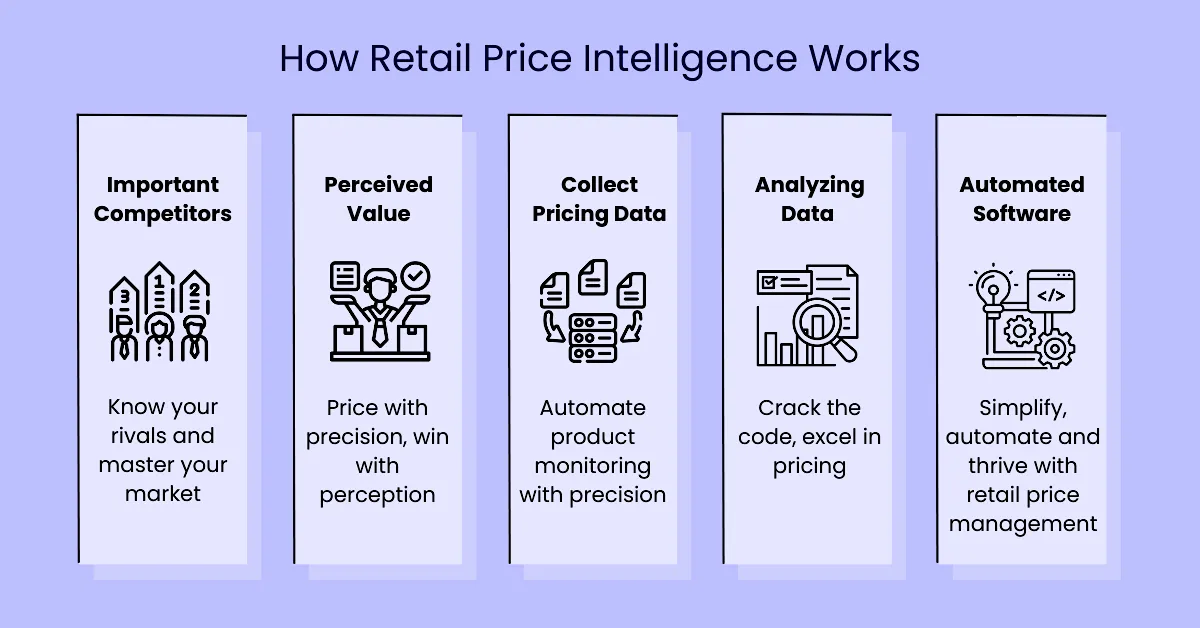
Retail pricing intelligence is the process of turning market signals into strategic moves. It involves collecting data from various sources, including competitor pricing, active promotions, inventory levels, and broader marketplace context, then analyzing it to give your teams a clear window into actual competitor behavior across every channel. The result is that you can make confident pricing decisions based on evidence rather than assumptions.
Effective pricing intelligence depends on real-time market data streaming to your pricing software tools, with update frequency aligned to how often prices change in the category. Real-time, regularly refreshed data is what allows pricing data to be used reliably by both human-driven workflows and AI-supported pricing models.
Retail pricing and merchandising teams leverage pricing intelligence to evaluate and adjust prices across e-commerce channels. Establishing a reliable intelligence flow removes the manual burden of data hunting, so they can focus on high-level evaluation and acting on price gaps that impact the bottom line.
Common Use Cases for Retail Pricing Intelligence
The most common and valuable use cases for pricing intelligence include:
- Monitoring competitor prices across all relevant retailers and marketplaces to maintain a clear view of your standing.
- Tracking promotions and effective prices, specifically where complex promotional mechanics materially affect your actual competitiveness.
- Strategic benchmarking of long-term price position relative to key competitors within a category, beyond day-to-day price fluctuations.
- Identifying margin risk or opportunities based on observed market price gaps that suggest you are leaving money on the table or losing volume.
- Improving digital shelf visibility to detect pricing inconsistencies or missed competitive moves before they impact your results.
Why Retail Pricing Intelligence Is Now Essential
Several key market factors now make retail pricing intelligence a requirement for maintaining market share:
- Total Price Transparency: Consumers compare prices across retailers instantly, making your relative standing visible to the entire market.
- High Volatility: Frequent price and promotion changes happen in minutes. Relying on outdated market information creates a risk of reacting to a reality that no longer exists.
- Promotional Complexity: The “list price” is rarely what a consumer pays. Without systematic tracking of mechanics like bundles or loyalty discounts, it is nearly impossible to assess your true effective price against the competition.
- Sustained Margin Pressure: In an era of high operational costs, the cost of a pricing error is magnified across large assortments. Pricing intelligence is required to protect margins while maintaining volume.
- Multi-Channel Consistency: Selling across direct-to-consumer (DTC) sites and third-party marketplaces requires context-aware pricing decisions to avoid channel conflict and support conversion optimization at the point of purchase.
The 6 Core Components of Retail Pricing Intelligence
These core components ensure your pricing decisions rest on a complete and accurate view of the market:
- Competitor Price Data: The foundational element of retail pricing intelligence consists of raw pricing information gathered directly from retailer websites and global marketplaces.
- Promotion and Discount Data: Beyond base list prices, identifying active offers and temporary markdowns reveals the actual "effective price" consumers pay.
- Product Matching: Meaningful pricing comparisons rely on logic that identifies the same or equivalent products across different competitors.
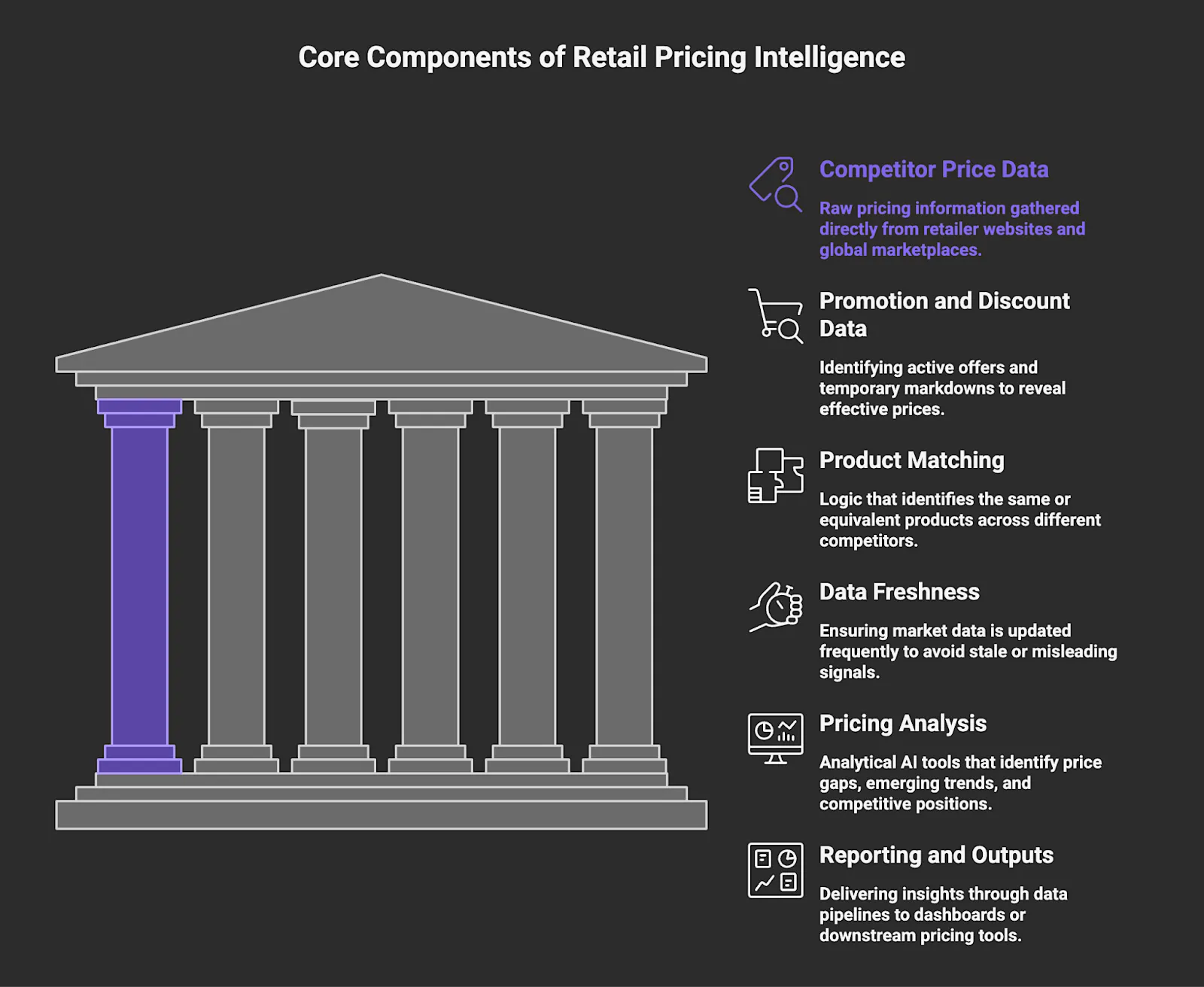
- Data Freshness: The update frequency of your market data must align with how often prices and promotions actually change in the category to avoid stale or misleading signals.
- Pricing Analysis: Analytical AI tools process the collected signals to identify price gaps, emerging trends, and your relative competitive position.
- Reporting and Outputs: The resulting outputs are delivered through data pipelines to dashboards or downstream pricing tools to help teams make informed decisions.
How does retail pricing intelligence work?
A retail pricing intelligence workflow follows these seven steps to ensure the delivery of consistent market signals:
Step 1: Define Scope and Intent
Begin by clarifying which specific categories or competitors require visibility. You must determine the exact business decisions the data will support, whether that is defending market share in high-volume categories or protecting margins on premium lines.
Step 2: Collect Competitive Data
Once the scope is defined, gather pricing signals from public sources. Manual collection is often impractical at scale. Instead, use an automated web data platform like Nimble to maintain the necessary data collection frequency and coverage without the fragility and ongoing maintenance burden of traditional scrapers.
Step 3: Store and Organize Data
Move the collected signals into a dedicated analytics environment. Centralizing this information allows it to be queried, compared over time, and reused across different business units.
Step 4: Match Products Across Sources
Align equivalent items from different retailers to enable meaningful comparisons and ensure that a price change on a competitor’s site is mapped correctly to the identical product in your own assortment.
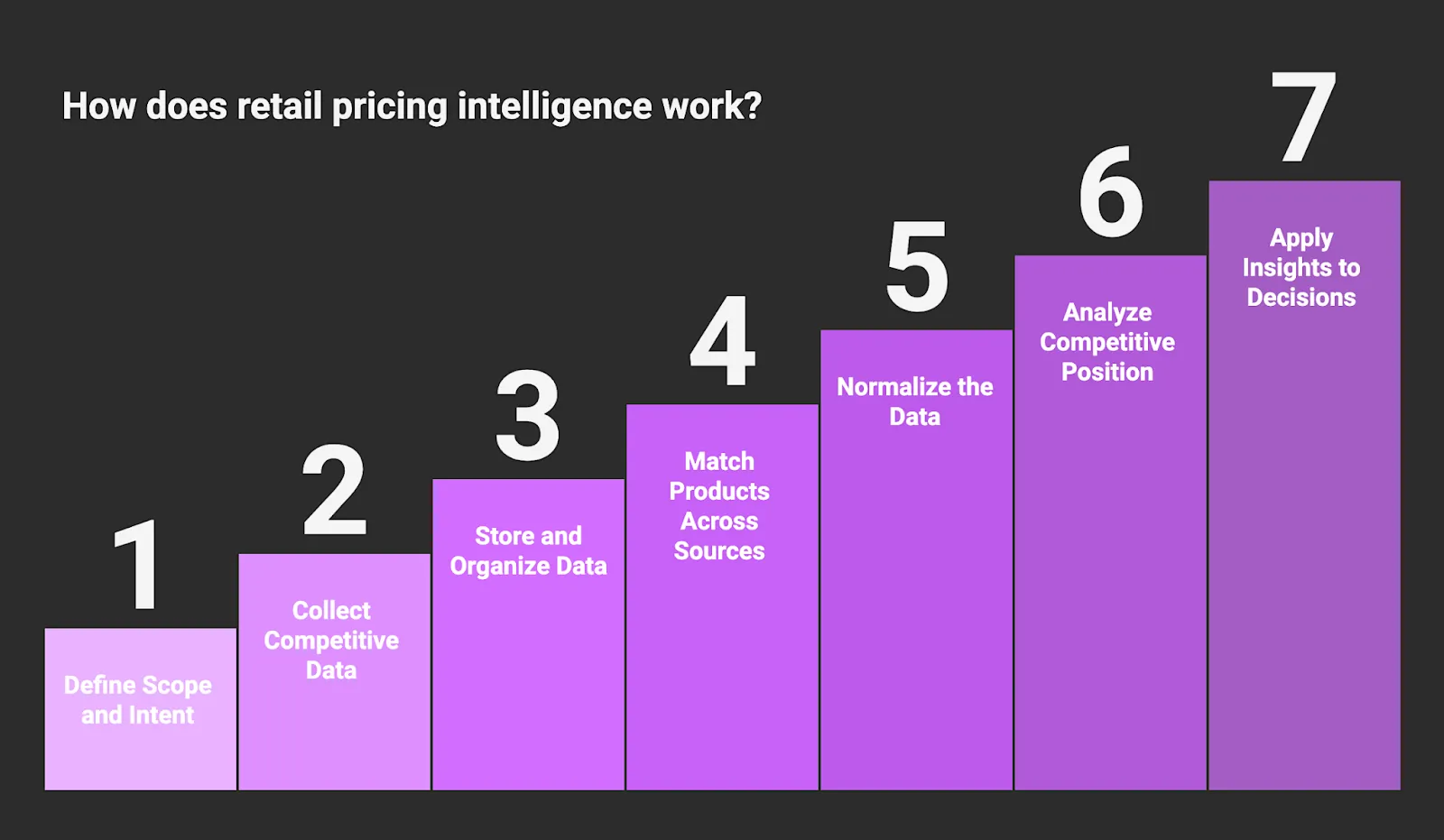
Step 5: Normalize the Data
To create a clean dataset ready for direct comparison, adjust the raw data so differences reflect actual price positioning rather than variations in units, packaging, or site structure.
Step 6: Analyze Competitive Position
Use analytics tools or statistical methods to identify pricing gaps and trends. The analysis reveals where you are currently over-priced or under-priced relative to your strategic targets.
Step 7: Apply Insights to Decisions
Feed the processed retail pricing intelligence into your existing pricing workflows or tools. The goal is to translate that data into adjusted price points or dynamic pricing rules that reflect current market reality.
5 Strategies for Effective Retail Pricing Intelligence
Here are five effective strategies to ensure your pricing intelligence leads to measurable business outcomes:
1. Define Intended Price Position by Category
Set specific competitive targets for different segments of your assortment. By defining these positions, you can remain hyper-competitive on “Value Signaling” items that drive traffic while maintaining higher margins on exclusive or long-tail products that are less price-sensitive.
This step prevents you from treating every product the same, which often leads to unnecessary margin erosion.
How to implement:
- Audit your assortment to identify your top 10% of high-volume products.
- Set a “Price Leader” target for these specific items to defend market share.
- Allow for a 5-10% price premium on specialized items where you offer superior availability or service.
- Identify “Blind” categories where consumers are less price-aware and prioritize margin over competitive matching.
2. Prioritize Effective Price Over List Price
Shifting your focus from the base MSRP (Manufacturer’s Suggested Retail Price) to the actual price a consumer pays ensures you are reacting to real market competition rather than decorative list prices. In many categories, ignoring coupons, loyalty discounts, and shipping costs means you will miss aggressive promotions that are successfully siphoning off your customers.
How to implement:
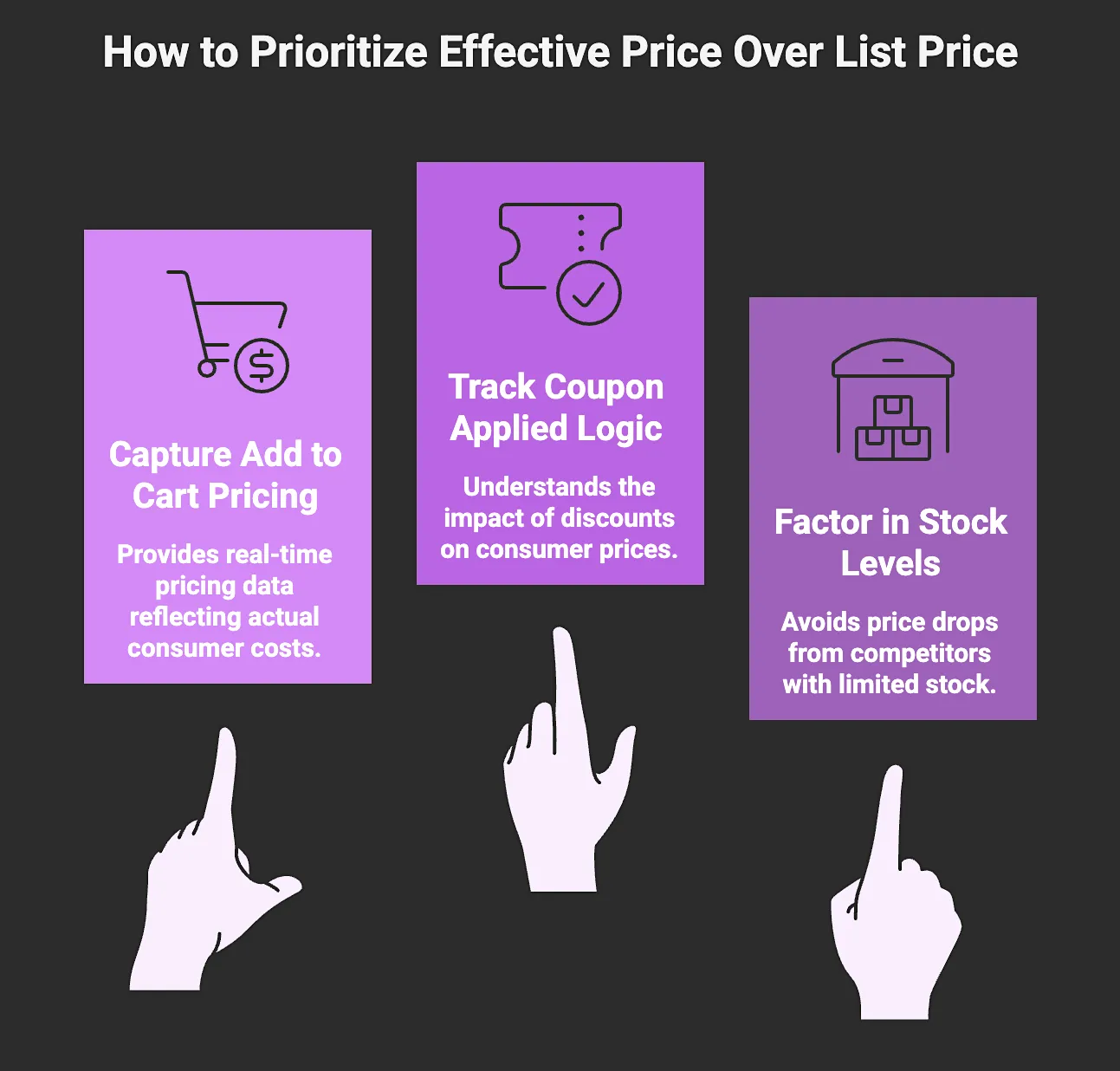
- Configure your data collection to capture “Add to Cart” pricing on competitor sites.
- Track “Coupon Applied” logic to understand the actual cost to the consumer.
- Factor in competitor stock levels. Ignore price drops from rivals who cannot fulfill the demand to avoid losing margin for no competitive gain.
3. Establish Operational Guardrails
Set hard floors and ceilings on price movements to prevent automated systems or reactive teams from dropping prices to unsustainable levels. Without these boundaries, a “race to the bottom” can occur where automated repricers continuously undercut each other until margins vanish and brand equity is damaged.
How to implement:
- Where applicable, implement a Minimum Advertised Price (MAP) alert within your pricing software.
- Establish a “Margin Floor” that automatically flags any suggested price below your break-even point.
- Require manual approval for any price change that exceeds a set percentage of the current price.
- Apply psychological rounding rules (e.g., snapping all outputs to $.99 or $.95) to ensure automated price changes do not result in “broken” or non-standard price points.
4. Align Monitoring Frequency with Volatility
Matching the cadence of your data collection to how often the price changes in a specific category optimizes your technical resources and decision accuracy. Collecting data too frequently on slow-moving items is wasteful, while collecting it too infrequently on volatile categories like consumer electronics means you are making decisions based on stale information.
How to implement:
- Categorize competitors and products into “High Volatility” and “Low Volatility” groups.
- Set automated systems, like Nimble’s Web Search Agents, to crawl high-volatility marketplaces every 2 to 4 hours.
- Schedule checks for stable specialty retailers at a lower frequency, such as every 24 to 48 hours.
- Trigger “On-Demand” crawls for specific high-stakes events like Black Friday or Prime Day.
- Analyze price trajectory over time to distinguish between 24-hour promotional spikes and permanent clearance markdowns before deciding to match.
5. Continuously Validate Data and Product Matching
Ongoing product matching and data validation ensure your pricing decisions are based on identical comparisons. This process maps your inventory to the correct competitor listings and verifies that every data point is a true match. Without consistent auditing, you risk reacting to false signals, like lowering a price to match a competitor’s bulk offer or refurbished unit. Proper validation gives you the confidence to move your prices at the speed of the market without eroding your margins on a bad match.
How to implement:
- Perform a weekly “Random Sample Audit” of at least 50 automated product matches.
- Verify “In-Stock” status alongside price; never match a price for a product that is currently unavailable at the competitor.
- Factor in regional price variations by using localized IP addresses for collection if your competitors use geo-fenced pricing.
- Leverage Nimble’s platform to access real-time, structured data that reduces the manual effort required for validation, error correction, and ongoing compliance.
Effective Retail Pricing Intelligence Requires Real-time Data
Retail pricing intelligence enables you to understand your actual competitive position by replacing assumptions with live market signals. It relies on consistent access to effective price data across every relevant channel. Integrating these signals into your daily workflow allows you to proactively defend margins and capture market share before competitors can react. But accurate retail pricing intelligence depends on data frequency and the ability to capture market changes as they happen.
Nimble’s web data platform enables retail pricing intelligence by providing real-time access to public pricing and promotion data through purpose-built Web Search Agents. It delivers structured, analysis-ready data that your teams can feed directly into existing analytics, BI, or pricing workflows. With fresh pricing intelligence readily available, you can move directly from analysis to action, adjusting prices at the speed of the market to ensure no margin is left on the table.
Book a Nimble demo today to transform your retail pricing intelligence into a real-time competitive advantage.
FAQ
Answers to frequently asked questions
.webp)
%20(2).webp)

.webp)
.webp)
.webp)
.webp)