









The Digital Shelf Data Trap: Why Leading CPG Brands Are Rebuilding Their Intelligence Infrastructure



Amaury Desrosiers
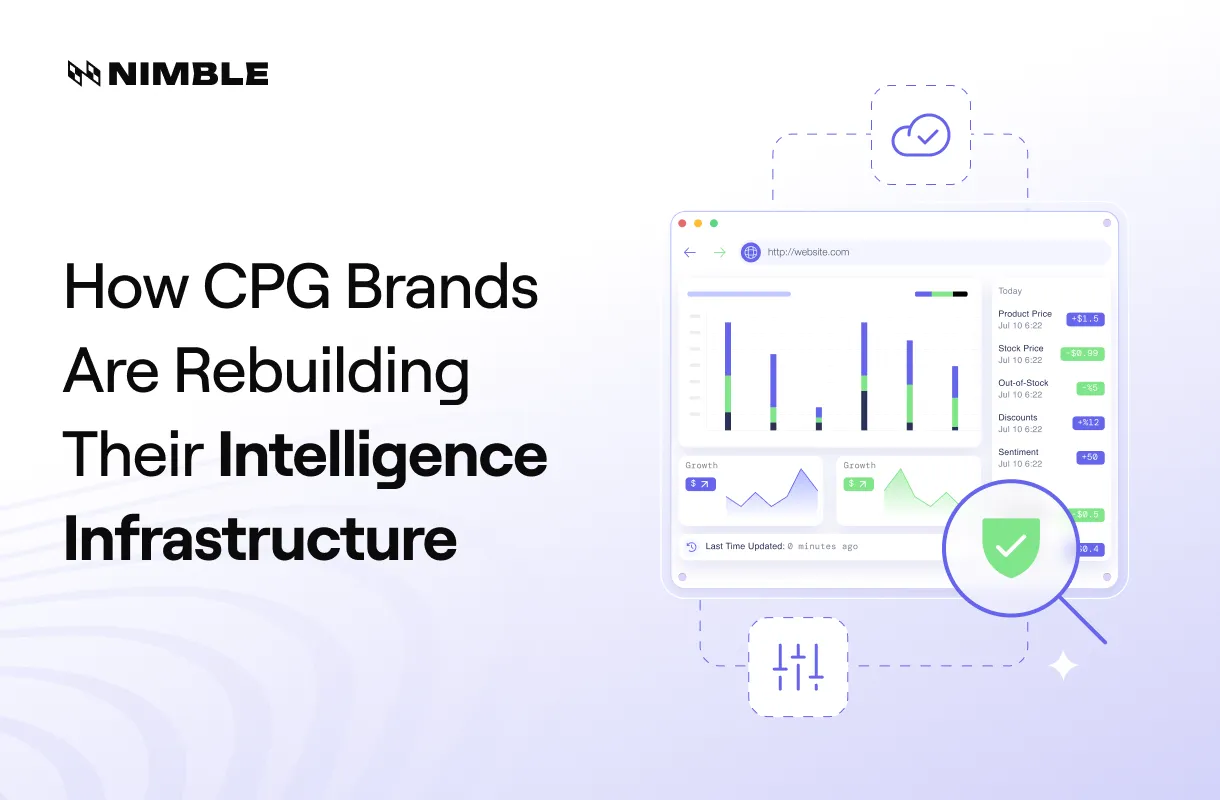
The Digital Shelf Data Trap: Why Leading CPG Brands Are Rebuilding Their Intelligence Infrastructure
Amaury Desrosiers
eCommerce accounts for 16.3% of total US retail sales and influences a far larger share of all purchasing decisions as consumers research online before buying in any channel. The first three results in a retailer's internal search capture nearly 70% of all clicks. And on-site reviews drive a 144% lift in conversion and 162% more revenue per visitor when shoppers engage with them.
CPG teams know these numbers. The frustration isn't a lack of awareness, it's a lack of reliable infrastructure to actually act on them.
The Hidden Tax of the Vendor Patchwork
Most large CPG organizations didn't plan to build a fragmented data stack. They made rational incremental decisions: a vendor for pricing, another for search rank, a third for content compliance, a fourth for reviews. Each made sense in isolation. Together they created something no one budgeted for: a patchwork where every feed arrives in a different schema, on a different cadence, with different retailer coverage and conflicting definitions of what "category" means.
The real cost isn't the vendor invoices. It's the analyst's time consumed trying to assemble a coherent picture from feeds that were never designed to talk to each other. Pricing lives in one system, search rank in another, content compliance in a third, each scoped differently, each covering a different retailer set. The data exists, but it arrives in fragments that can't be joined into a single view of performance. Teams end up with a collection of partial answers when what they need is one complete picture.
The Silent Failure Problem
Missing data has an obvious failure mode, someone notices. Bad data is far more dangerous.
When a scraper silently returns stale or malformed data, downstream models consume it. Analysts build reports on top of it. Decisions get made. The error surfaces days later, after the window to act has closed.
This failure mode spikes exactly when stakes are highest: during a competitor price move, a promotional window, a supply disruption. Brittle infrastructure doesn't fail evenly, it fails under load. And the window to respond to a stockout or a pricing shift is measured in hours, not days.
Speed matters. But speed without reliability isn't a capability, it's a liability.
Existing digital shelf analytics platforms were built around a fixed view of the world: a predefined set of retailers, a fixed data schema, a locked collection cadence. That rigidity worked when the competitive landscape was stable. It doesn't anymore.
Adding a retailer that wasn't in the original scope, a regional grocery chain, a new delivery platform, a fast-growing specialty channel, is rarely a configuration change. It's a project. Increasing collection frequency from weekly to daily, or daily to hourly during a tentpole event, requires a conversation, a timeline, often a contract amendment. Expanding the competitive set or adjusting the category scope to match an internal portfolio restructure? Another project.
The practical result is that brands are constantly operating with a digital shelf view that reflects the agreements they signed twelve months ago, not the market they're competing in today. Intelligence is always slightly behind reality, not because the data doesn't exist, but because the infrastructure wasn't designed to move with the business.
The Dashboard Trap
Most digital shelf intelligence is sold as a platform. You log in, see the vendor's dashboards, and work within the analytical frame the vendor designed. If you want a cut they don't support, you submit a feature request.
This model doesn't fit how enterprise CPG organizations actually operate. Their data stack is built around a cloud data warehouse, Snowflake, Databricks, BigQuery. Internal teams build on top of it using Looker, Tableau, or AI tools like Snowflake Cortex. A vendor dashboard is a dead end: data that can't be joined with internal sales data, can't feed a predictive model, can't be used to run causal analysis linking digital shelf signals to revenue outcomes.
What these teams actually need is raw, structured data delivered into their own environment, via API feed into Snowflake or direct file delivery to S3, on a cadence they control, in a schema they can depend on, with unambiguous data ownership. That's increasingly not a preference but a procurement requirement.
What the New Architecture Looks Like
Organizations that have moved past these problems share a consistent pattern.
Collection is handled by web intelligence agents, autonomous systems that navigate retailer environments, handle dynamic page rendering, adapt to layout changes, and extract structured data without brittle dependencies on specific page elements. These agents work from the brand's own item ID lists, pulling price, availability, search position, content, reviews, and promotional signals across major retailers and regional banners for any category.
Data is delivered as structured feeds, consistent schema, clear ownership, into the organization's cloud environment. Daily as standard; hourly during key retail events. Collection methodology is transparent and defensible to retail partners and procurement alike.
Because the data lands in the brand's own warehouse, the analytics layer is whatever the team already uses. The vendor provides the intelligence. The organization retains full control over how it's applied.
This is the architecture Nimble was built to support, and it's what distinguishes a durable digital shelf program from one that breaks at the worst possible moment.
The Agentic Commerce Layer
One dimension most digital shelf conversations haven't absorbed yet: AI agents are becoming the first shelf consumers encounter.
Adobe Analytics reported that AI-driven referrals to retail sites surged 693% year-over-year during the 2025 holiday season. When a shopper asks an AI assistant for a product recommendation, the response isn't based on a traditional search index. It's based on structured signals: price, availability, attributes, review volume, content completeness, seller reliability. Products that aren't accurately and consistently represented in the data these AI systems draw from simply won't be surfaced.
The brands building clean, high-frequency, structured digital shelf data today are also, often without intending to, building the foundation for winning on AI-mediated discovery tomorrow. The ones that aren't are accumulating a compounding disadvantage across both surfaces at once.
The question isn't whether the current infrastructure is working. Most teams already know it isn't. The question is whether the rebuild happens before or after the next key retail moment exposes exactly how fragile it is.
SOURCES :
1. US Census Bureau — Quarterly Retail E-Commerce Sales, Q2 2025: https://www.census.gov/retail/ecommerce.html
2. Backlinko / Algolia — eCommerce search click-through rate research: https://backlinko.com/google-ctr-stats
3. Bazaarvoice Shopper Experience Index — UGC conversion and revenue lift: https://www.bazaarvoice.com/blog/user-generated-content-statistics-to-know/
4. Adobe Analytics — AI-driven retail referral traffic, 2025 holiday season: https://business.adobe.com/blog/ai-driven-traffic-surges-across-initiatives
FAQ
Answers to frequently asked questions

.webp)

%20(2).webp)

.webp)
.webp)
.avif)
.webp)