







13 Best AI Web Scrapers
13 Best AI Web Scrapers



Charlie Klein
13 Best AI Web Scrapers
13 Best AI Web Scrapers
Charlie Klein


Most popular articles
Get structured, reliable data for your stack.
AI web scrapers use artificial intelligence to convert public web content into structured data for AI systems, analytics, and automated workflows.
CategoryTools and best fitEnterpriseNimble for live web intelligence and structured data pipelines, Diffbot for automated layout classification, Import.io for managed, self-healing data pipelinesDeveloperKadoa for unstructured data transformation, Firecrawl for LLM-ready Markdown, ScrapeGraphAI for Python-based workflows, AgentQL for semantic browser interaction, Reworkd for autonomous extraction agentsNo-code and lightweightBrowse AI for website monitoring, Octoparse for scheduled visual extraction, Thunderbit for spreadsheet enrichment, Simplescraper for instant API generation, AIScraper for prompt-driven data extraction
The right choice depends on freshness, scalability, output quality, integration control, and maintenance requirements.
AI engineers are increasingly tasked with building autonomous agents and applications that operate on current web data. However, the web contains untamed information sitting inside human-facing pages characterized by shifting layouts, dynamic rendering, and inconsistent structures.
The global artificial intelligence market is skyrocketing past $600 billion with rapid enterprise adoption, and manual data wrangling is a bottleneck that cannot scale for modern development pipelines. The problem with this is that the rules have to be hard-coded. AI web scrapers use AI to understand the page's content.
More advanced Web Data Agents go further by autonomously navigating public websites, extracting relevant information, validating the results, and delivering structured web data to downstream systems.
Given the wide range of architectures, from enterprise data platforms and developer-first scraping APIs to no-code extraction utilities, navigating the market requires careful evaluation. This article compares 13 web scrapers for AI across categories so you can shortlist the right solution based on scale, control, output quality, and production readiness.
What are AI web scrapers, and why are they important?
AI web scrapers are tools that use artificial intelligence to automate the extraction of web data from websites. They take the relevant page information and convert it into structured formats like JSON, CSV, Markdown or tables.
These solutions use prompts, large language models, visual recognition, and AI-assisted extraction, rather than the traditional scraping based on brittle fixed selectors. This method removes the need for manual setup and ongoing maintenance, not to mention the time-consuming data cleaning of dynamic content and shifting page layouts.
The main users of AI web scrapers are AI engineers, data engineers, crawler specialists, data teams, analysts and business professionals. These tools are used for competitive intelligence, market research, lead generation, pricing analysis, SEO monitoring, and retrieval augmented generation workflows.
In agentic applications, MCP can connect AI agents to external data sources and tools, allowing models to retrieve information and interact with connected systems during a workflow.
They matter because static training datasets and cached search indexes lack real-time context. By bridging that gap, these tools turn public web pages into structured, analysis-ready inputs for enterprise dashboards, applications, and autonomous agents.
3 Types of AI Web Scrapers
Enterprise AI Web Data Platforms
Enterprise AI web data platforms are comprehensive infrastructure solutions designed for large-scale operations that require continuous, high-volume data streams. These services handle the full data pipeline, with massive concurrency, tricky proxy rotation, and automatic unblocking at scale. They feed real-time market signals directly into data lakes or AI models without infrastructure bottlenecks.
Built-in security and enterprise governance features meet stringent corporate regulations. This is the option that teams go with if they value reliability, predictable throughput, and deep technical support.
Leading platforms in this category also use Web Data Agents to navigate, extract, validate, and deliver structured public web data with less engineering overhead than traditional scraping stacks.
Developer AI Web Scrapers
Developer-focused AI scraping tools provide flexible APIs, software development kits, and modular libraries tailored for engineering teams. The solutions provide developers with fine-grained control over extraction logic, enabling them to embed scraping directly into custom agent frameworks, retrieval-augmented generation architectures, and backend applications.
Instead of wrestling with heavy infrastructure interfaces, engineers work with programmatic endpoints that turn raw web content into clean JSON or Markdown. This approach works best for projects that require close integration of code, custom routing logic, and dynamic scaling.
As AI applications become more autonomous, developers also need orchestration frameworks that coordinate search, retrieval, reasoning, and execution across multiple tools.
No-Code AI Web Scrapers
No-code AI web scrapers offer visual interfaces and point-and-click configuration panels, enabling non-technical professionals to extract structured data without writing code. Business users, market researchers and analysts can create automated scraping workflows, schedule recurring extractions and export data directly into spreadsheets or business intelligence dashboards in minutes.
These platforms are ideal for users who need quick insights without relying on engineering resources, as they use visual recognition and AI assistance to automatically map page elements.
Top Picks at a Glance
- Nimble: Recommended for enterprise-grade Web Data Agents and live web intelligence
- Firecrawl: Recommended for LLM-ready Markdown extraction
- ScrapeGraphAI: Recommended for open-source Python workflows
- Browse AI: Recommended for no-code monitoring
- Octoparse: Recommended for visual, scheduled extraction
Comparison Table: 13 Best AI Web Scrapers
ToolCategoryInterfaceOutput FormatsBest-Fit Use CaseNimble Web Search AgentsEnterpriseAPI / MCP ServerSchema-defined JSONLive web intelligence and structured, analysis-ready web data pipelinesDiffbot ExtractEnterpriseAPI / DashboardJSONAutomated layout classification and unstructured text parsingImport.ioEnterpriseDashboard / APIJSON / CSV / Analytics stacksManaged enterprise data pipelines and self-healing extractionKadoaDeveloperPlatform / Extension / APIStandardized tables / WebhooksUnstructured data transformation and maintenance-free web harvestingFirecrawlDeveloperAPI / Open-source libraryClean Markdown / JSONTurning entire websites into clean Markdown and LLM-ready inputsScrapeGraphAIDeveloperPython Library / Cloud APIJSON / Structured textPython-based graph logic and modular LLM scraping pipelinesAgentQLDeveloperSDK / Query LanguageStructured DOM dataAI agent browser interaction and query-language-based element selectionReworkdDeveloperPlatform / APIStructured JSONAutonomous data extraction agents and rapid workflow prototyping
13 Best AI Web Scrapers
1. Nimble Web Search Agents
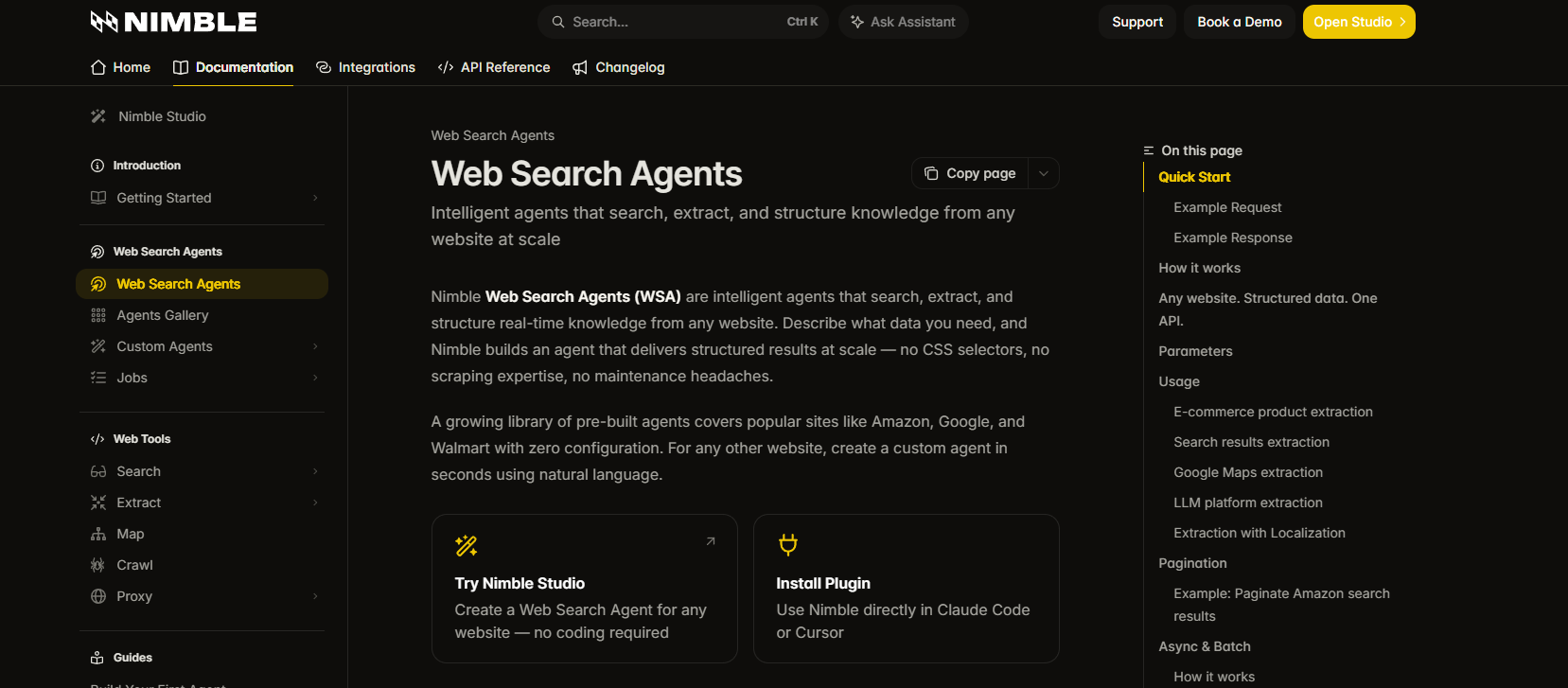
Nimble is the Web Data Agent Platform for AI engineers and data teams that need current, structured public web data at enterprise scale. Its purpose-built Web Data Agents autonomously navigate websites, extract relevant information, validate the results, and deliver analysis-ready outputs to AI applications and production data pipelines.
It queries the live web rather than relying on pre-built indexes, using managed browser automation, proxy orchestration, and unblocking infrastructure to reliably access dynamic public websites. These infrastructure layers operate behind the platform, reducing the engineering work required to maintain reliable web data collection at scale.
Through Nimble's hosted MCP server, AI assistants can access Nimble's live web search and extraction capabilities and receive structured JSON outputs. This makes the platform particularly well-suited to workflows where current web data matters and the results need to arrive in a structured, analysis-ready format.
Key Features
- Web Data Agents that autonomously navigate, extract, validate, and deliver structured web data
- Live web ingestion that sends requests directly to live web pages, not stale cached indexes
- Conversion of raw HTML to JSON payloads in real-time as per the schema for agent consumption
- Managed browser, proxy, and unblocking infrastructure that reduces operational overhead
- Structured, analysis-ready outputs for RAG workflows, analytics platforms, data lakes, and autonomous agent loops
- Enterprise governance for the compliant collection of public web data
“Nimble has become our default platform for collecting public web data. We use a combination of Nimble IP and the Web API to route requests through residential proxies and reliably unlock sites that were very unstable with other providers.”
Recommended for live web intelligence and structured web data pipelines.
2. Diffbot Extract

Diffbot Extract uses computer vision and natural language processing to analyze web pages without requiring custom scraping rules. It automatically categorizes content types, such as articles, products, or discussions and normalizes the extracted details into clean JSON records, making it ideal for large-scale document and content processing.
Key Features
- Computer vision interpretation of layout structures for human-like page classification
- Zero-rule extraction for automatic processing of articles, product catalogues and discussions
- Multi-language support is enabled by visual and semantic parsing models
- Normalised JSON outputs for easy integration into downstream applications
“Diffbot makes the difficult task of managing data and extracting useful information much easier. They provide access to a seemingly infinite amount of company and contact information and are continuously improving their user interface to add even more value.”
Recommended for automated layout classification and unstructured text parsing.
3. Import.io
Import.io offers both a self-service configuration platform and a fully managed service that handles end-to-end data delivery. Its AI-assisted extractors are designed to detect changes in website layout and automatically remap extraction logic, helping to reduce downtime and ongoing maintenance for business-critical data pipelines.
Key Features
- Dual Delivery Model Options: Self-service Extractor Building or Full Managed Pipeline Ownership
- Auto-correcting extraction logic that self-heals when the website layout changes
- Built-in scheduling, automated alerts and continuous monitoring for production stability
- Direct data sync with analytics stacks, data warehouses and BI tools like Tableau
“I find Import.io to be predictable and trustworthy, delivering clean, structured outputs without needing constant attention. What I like the most is that it simply frees up a lot of time and mental overhead. It's particularly useful when you need repeatable data at scale rather than one-off extractions.”
Recommended for managed enterprise data pipelines and self-healing extraction.
4. Kadoa

Kadoa is an AI-powered platform that converts complex, unstructured web content into tabular data in a structured format without any manual coding. Its workflow tools support single-page extraction, paginated lists, and list-detail navigation, helping teams collect structured data across dynamic websites.
Key Features
- Autonomous multi-page crawling and dynamic interaction handling without human intervention
- Self-healing architecture that automatically adjusts to structural changes on target websites
- Point and click schema definition chrome extension workflow creator
- Native pipeline outputs to Google Sheets, cloud storage drives, and auto webhook triggers
Recommended for unstructured data transformation and maintenance-free web harvesting.
5. Firecrawl
Firecrawl collapses complex web-crawling, search, and scraping routines into a unified API designed specifically for AI applications. It converts messy page structures into high-density Markdown or clean JSON arrays, allowing development teams to feed live internet text directly into large language models.
Key Features
- Multi-level domain mapping and deep crawling via simple parameter configurations
- Automated conversion of raw HTML into clean Markdown or structured JSON
- Dedicated parse endpoints capable of processing PDFs, office documents, and structured files
- Open-source library support enabling private, self-hosted deployment options
“Great if you want to give AI the ability to scrape pages with a headerless scraper, very complete AI and a dashboard to manage results. Nice UI, clear docs. Great to white-label as an API in your product.”
Recommended for turning entire websites into clean Markdown and LLM-ready inputs.
6. ScrapeGraphAI

ScrapeGraphAI is an open-source python library and cloud API that leverages direct graph logic and large language models to build flexible scraping workflows. Prompts can build custom pipelines that can pull information from individual pages, multi-source search results, or local documents.
Key Features
- SmartScraperGraph, SearchGraph modular graph structures for custom data extraction flows
- Flexible LLM integration with support for: - OpenAI - Groq - Azure - Gemini - Local models with Ollama
- Multi-page parallel processing for faster large data collection tasks
- A dual execution model of a self-hosted open source library or a managed cloud API
“ScrapeGraphAI is the most powerful and reliable service to grab content from the web. We use it every day in our automations and it just works. All of the other services we tried do not get data consistently”
Recommended for Python-based graph logic and modular LLM scraping pipelines.
7. AgentQL

AgentQL introduces a semantic query language designed to allow AI agents to interact with web pages reliably, regardless of underlying DOM alterations. It allows developers to target elements using natural language concepts rather than brittle XPaths or CSS selectors.
Key Features
- A plain language descriptive semantic query language for web elements discovery
- Frontend design changes and resilience against randomised element IDs
- Integration with standard automation drivers and agent frameworks.
- Real-time interaction management for complex JavaScript-intensive web applications
Recommended for AI agent browser interaction and query-language-based element selection.
8. Reworkd

Reworkd uses AI agents to understand web pages and generate extraction logic for the information users request. Its platform is also designed to detect website changes and repair extraction workflows automatically, reducing manual maintenance.
Key Features
- Natural language operational goals-driven autonomous agent generation
- Built-in execution loops chaining together search, navigation and extraction
- Flexible integration paths for custom software environments and databases
- Fast prototyping framework for less manual scripting configuration
Recommended for autonomous data extraction agents and rapid workflow prototyping.
9. Browse AI
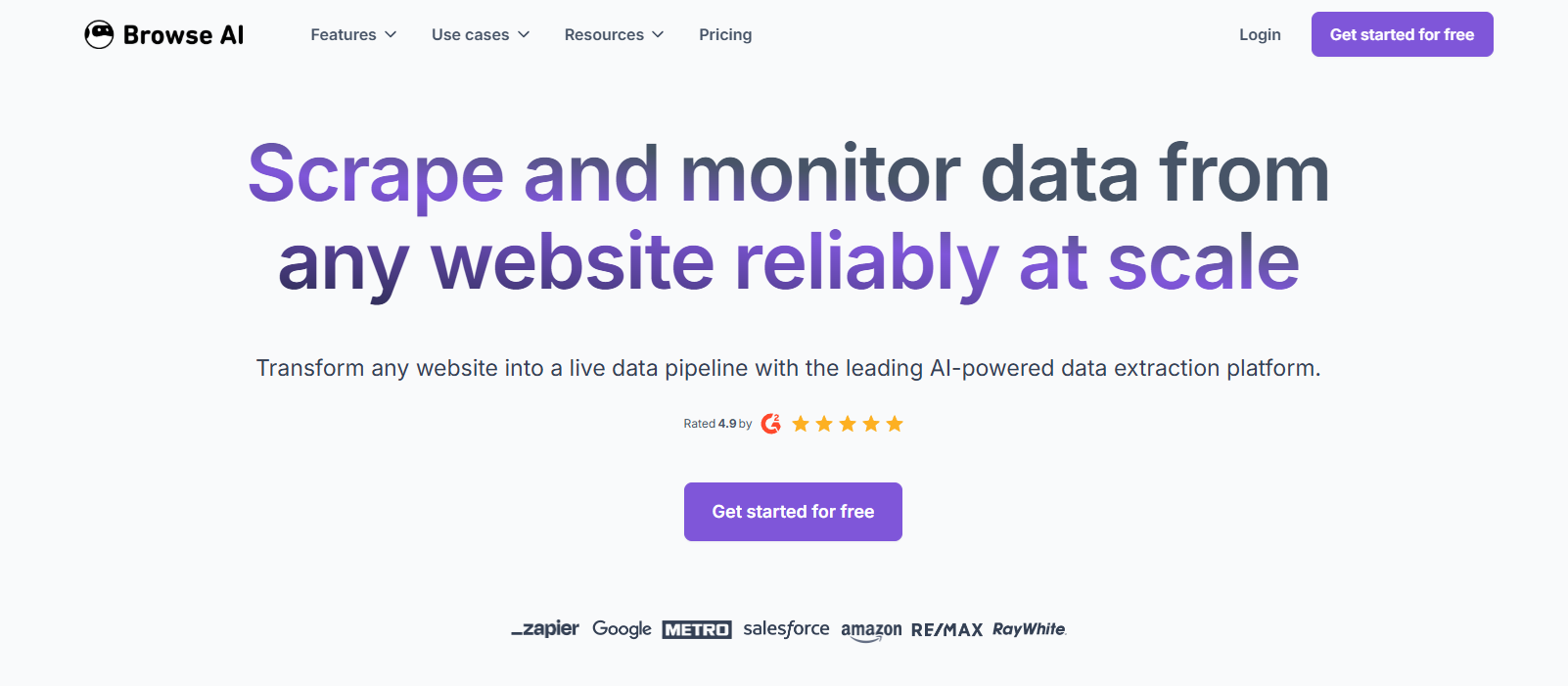
Browse AI enables users to train a robot on any website in minutes using a visual point-and-click interface. It is built for business analysts and non-technical teams who need to monitor web pages for changes and extract structured data on recurring schedules.
Key Features
- Point-and-click visual recorder. Maps data fields without code
- Automated monitoring notifies users of page data changes.
- Recurring extractions on an hourly, daily or weekly basis with scheduling options built in
- Direct integration connectors to Google Sheets, webhooks & Zapier automation flows.
“BrowseAI makes web automation surprisingly simple. Training a robot takes just a few minutes, and it can handle everything from scraping product listings to monitoring live data updates.”
Recommended for no-code monitoring, data extraction, and visual change tracking.
10. Octoparse

Octoparse is web scraping software for Windows with a user-friendly visual workflow designer for handling both simple and advanced data extraction tasks. It manages cloud execution and proxy management for users dealing with huge volumes of web records behind the scenes.
Key Features
- Visual drag-and-drop workflow designer to create complex scraping logic without coding
- Extraction tasks running on cloud-based execution servers, independent of local hardware
- Automatic captcha solver and IP rotator for protected websites
- Data exports can be scheduled to SQL databases, Excel or CSV.
“Octoparse is a very powerful tool for data extraction without the need for programming. Its visual interface makes it easy to configure tasks and automate scraping.”
Recommended for visual large-scale web scraping and scheduled data warehousing.
11. Thunderbit

Thunderbit is a smart web scraping and workflow assistant that pulls tables, lists and contact data right off of web pages and into spreadsheets. It applies AI to interpret sloppy page content and clean it into structured formats on the fly.
Key Features
- One-click table and list extraction optimized for spreadsheet integration
- AI-driven field detection that cleans and normalizes data automatically
- Web automation features for handling repetitive form-filling and clicking tasks
- Lightweight browser extension interface for immediate, on-demand data gathering
“I find Thunderbit very easy to use, especially thanks to the pre-built templates and AI analysis that streamline my tasks to just a few clicks. The Chrome extension is a great feature that makes solving issues quick and efficient.”
Recommended for AI-powered spreadsheet enrichment and browser automation tasks.
12. Simplescraper AI Extraction

Simplescraper transforms any website into an instant API or webhook with an easy-to-use visual interface and AI-powered extraction features. This is great for developers and creators who want quick, low-friction data collection without setting up a lot of infrastructure.
Key Features
- Generate webhook and API endpoint from target web pages instantly
- AI-Assisted Schema Generation and Property Naming for Rapid Extractions
- Cloud based scheduling for auto refresh of data feeds.
- Simple installation process for quick deployment and testing
Recommended for lightweight API generation and instant URL parsing.
13. AIScraper
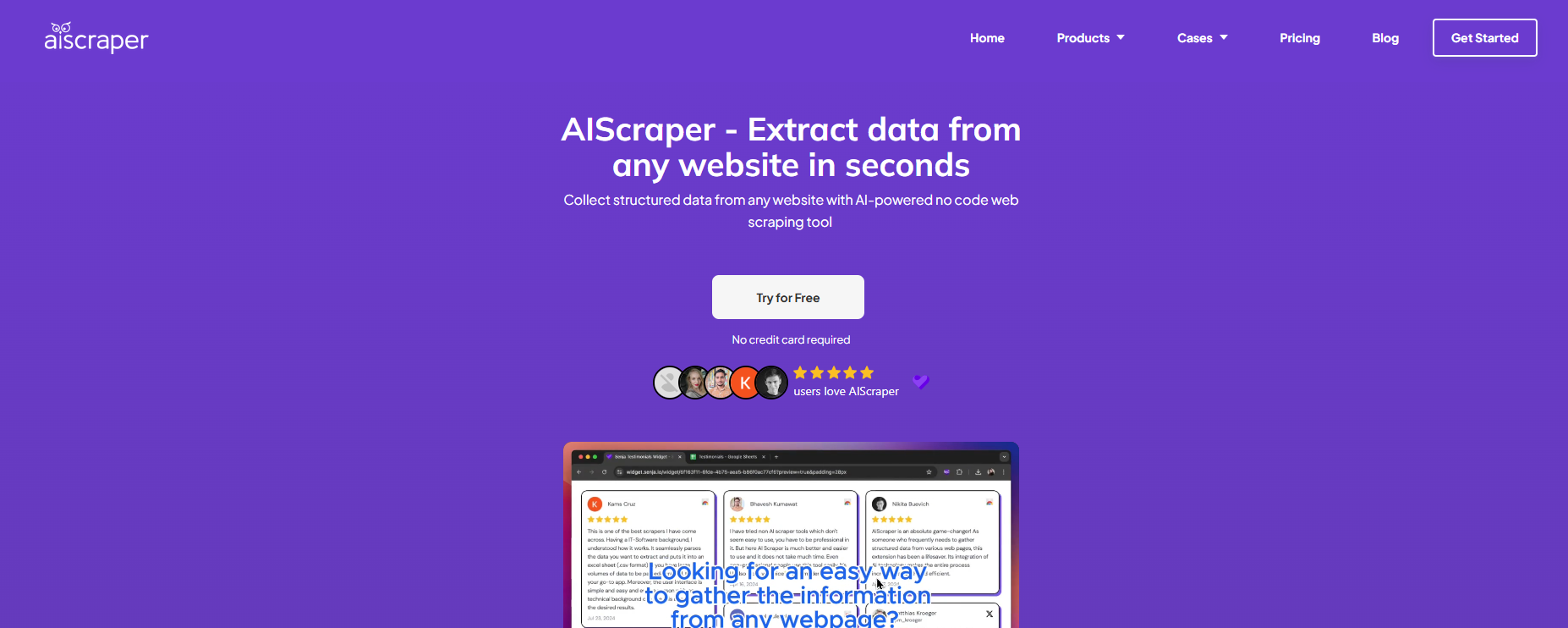
AIScraper uses language models to flexibly parse text from web pages based on simple user directives. You can easily extract certain data points from unstructured web documents, without configuring custom rules or scrapers.
Key Features
- Prompt-driven extraction logic that interprets data requirements instantly
- Clean handling of unstructured text and variable web layouts
- Fast, ad-hoc data retrieval tasks with minimal configuration setup
- Direct export options for immediate use within your analytical workflows
Recommended for automated prompt-driven data extraction and quick web lookups.
How We Compared These Tools
We have compared these tools on similar criteria so that you can easily shortlist the best fit. Our assessment is based on information available in the public domain as of May 2026, including official documentation, pricing information, release notes and trusted third-party reviews.
What We Reviewed
- Vendor documentation, feature pages, and implementation guides
- Pricing pages, plan limits, and packaging notes
- Release notes and changelogs, where available
- Security and compliance materials, where relevant
- Independent comparisons and third-party user reviews
How We Compared Tools
We looked at core capabilities, ease of adoption, integrations, governance controls, reporting and overall value. Hands-on tests were not run for all tools. Where documentation was lacking or reviews were contradictory for a capability, we did not make strong claims and noted the uncertainty.
Furthermore, we split the tools into distinct categories to reflect their architectural purpose:
- Enterprise AI Web Data Platforms. Public documentation, scalable infrastructure, proxy management, compliance, production readiness.
- Developer AI Scraping Platforms: Reviewed based on public APIs, SDK support, extraction techniques, output formats and AI-enabled features.
- No-code AI Web Scrapers: Ranked on setup flows, monitoring capabilities, scheduling features, export options, and user-facing documentation.
Equipping Your AI Stack with Real-Time Web Intelligence
Selecting the right AI web scraper ultimately comes down to matching your architecture's scale, infrastructure requirements, and workflow complexity. Navigating these options ensures your pipelines remain resilient against changing layouts and unpredictable web structures.
For enterprise AI systems, extraction alone is not enough. Teams need a reliable web intelligence layer that can continuously access public web content, navigate changing websites, validate results, and deliver structured data directly into production workflows.
Nimble is the Web Data Agent Platform that transforms the live web into structured, analysis-ready intelligence for AI systems. Its Web Data Agents combine real-time web access, autonomous navigation, structured extraction, validation, and enterprise-grade infrastructure within one managed platform. AI engineers can use live web data via the Extract API, Search API, or deploy Web Data Agents, depending on the workflow.
Start scaling with Nimble Web Data Agents and turn public web data into structured intelligence for your AI applications. Book a demo today.
FAQ
Answers to frequently asked questions



.webp)

.webp)
.webp)
.avif)