







AI Data Pipeline: Components, Tools, and Examples
AI Data Pipeline: Components, Tools, and Examples



Charlie Klein
AI Data Pipeline: Components, Tools, and Examples
AI Data Pipeline: Components, Tools, and Examples
Charlie Klein


Most popular articles
Get structured, reliable data for your stack.
Abstract
- An AI data pipeline is an automated system that prepares and delivers dependable data for models, agents, retrieval systems, and analytics.
- It coordinates ingestion, cleaning, enrichment, training, deployment, and feedback as a continuous production lifecycle.
- Unlike traditional analytics pipelines, it must support unstructured inputs, changing data, model-specific transformations, and real-time inference needs.
- Its effectiveness depends on freshness, validation, orchestration, monitoring, and reliable delivery across RAG, research, pricing, retail, and market intelligence workflows.
- Even advanced models cannot compensate for incomplete, outdated, or poorly prepared data.
The data layer in AI determines everything downstream. Data has to be collected from multiple sources, cleaned, validated, transformed, and kept current. For AI engineers building production agents, RAG systems, and inference services, stale or unstructured inputs can undermine accuracy before a model ever runs.
Industry research shows fragmented, unstructured data is the biggest obstacle to AI success, cited by 45% of companies. AI data pipelines help solve this engineering challenge by automating the journey from raw data to AI-ready inputs. They continuously move, transform, validate, and deliver the data that powers machine learning models, AI agents, analytics platforms, and retrieval systems.
What is an AI data pipeline?
An AI data pipeline gets data from where it lives to where your AI can use it. Instead of manually collecting data, writing one-off transformation scripts, and fixing broken workflows, it automates the process. Raw data moves through a series of stages until it is ready for model training, inference, retrieval, analytics, or another AI workload.
Data can come from databases, SaaS applications, APIs, IoT devices, internal documents, or the public web. The pipeline brings these sources together, cleans and validates the data, reshapes it into consistent formats, and delivers it to downstream systems. Depending on the architecture, this may occur as a scheduled batch job or as a stream that keeps an AI agent or recommendation engine up to date.
For AI engineers and data teams, the main benefit is repeatability. Instead of rebuilding data preparation whenever a model changes or a new source is introduced, teams create workflows that run reliably at production scale.
In specialized fields, a strong data foundation allows teams to connect fragmented information and apply AI across complex research and operational workflows.

AI Data Pipelines vs. Traditional Data Pipelines
Traditional Data PipelineAI Data PipelinePrimary purposeMoves data into business intelligence platforms, dashboards, reports, and analytics systems.Delivers AI-ready data to machine learning models, AI agents, RAG systems, vector databases, and inference services.Data typesPrimarily handles structured data from transactional databases and business applications.Handles structured, semi-structured, and unstructured data, including documents, images, web pages, logs, and multimedia content.Data movementTypically runs on scheduled ETL or ELT jobs at fixed intervals.Supports scheduled batch processing and real-time streaming depending on application latency and freshness requirements.DestinationBusiness intelligence tools, data warehouses, reporting platforms, and dashboards.Machine learning pipelines, feature stores, vector databases, AI agents, LLMs, APIs, and inference endpoints.Operational focusOptimized for reporting accuracy, historical analysis, and business metrics.Optimized for delivering current, reliable, and context-rich data that AI systems can use consistently in production.
6 Core Components of an AI Data Pipeline
1. Data Ingestion and Collection
Everything starts with getting data into the pipeline. Depending on the use case, that may mean ingesting records from operational databases, calling third-party APIs, processing internal documents, streaming IoT data, or collecting information from the public web.
Pipelines typically support batch ingestion, where data is collected on a schedule, and streaming ingestion, where events are processed as they happen.
For AI engineers, this stage determines what evidence a model or agent can access, how fresh it is, and whether the data is complete enough for training, retrieval, or inference.
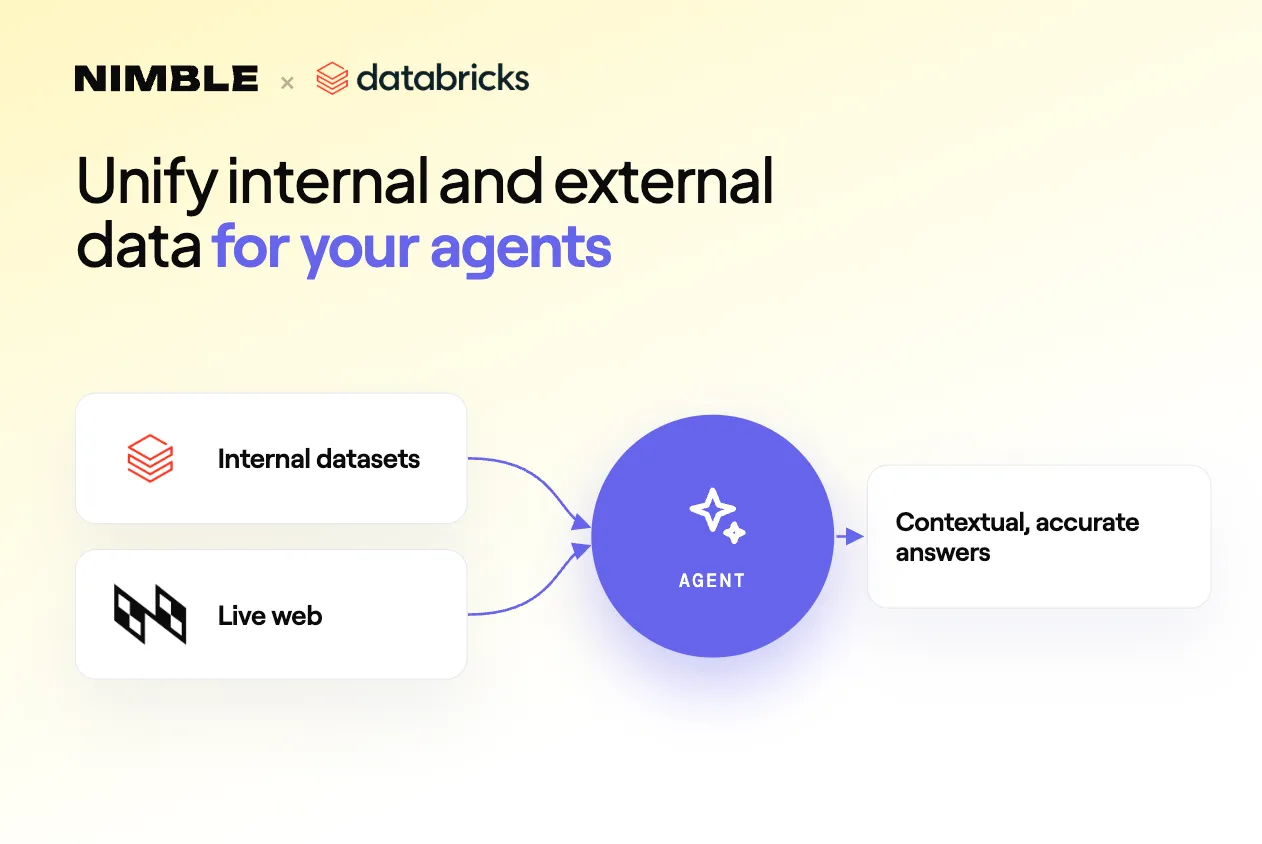
AI pipelines increasingly combine internal enterprise data with continuously changing public web data. Nimble's Web Search Agents provide that external data layer by retrieving, validating, and structuring public web information before it enters downstream AI workflows.
Unlike traditional search APIs or web scrapers, Web Search Agents autonomously navigate public websites, render dynamic pages, extract domain-specific fields, validate outputs, and return structured data that can move directly into AI pipelines.
2. Data Preparation and Cleaning
Raw data is almost never ready for AI. Formats differ, values are missing, records are duplicated, timestamps do not match, and unstructured documents often contain more noise than useful information.
This stage handles validation, standardization, deduplication, missing-value treatment, schema normalization, and parsing unstructured content into consistent formats. The goal is data that every downstream model, agent, or retrieval system can interpret consistently.
3. Feature Engineering and Enrichment
Even after cleaning, data may not be in the form a model learns from most effectively. Feature engineering transforms prepared data into useful representations, while enrichment adds context that can improve performance.
This may involve generating numerical features, creating embeddings for semantic search, joining external datasets, or storing reusable features in a feature store. It is also where live external signals can be combined with internal data to give models and agents a more current context.
4. Model Training and Validation
Once the data is ready, it can be used to train machine learning models. During training, the model learns patterns from historical data, but those patterns must be tested before production use.
Validation compares performance against unseen data and may measure accuracy, precision, recall, latency, or other application-specific metrics. It also includes tuning parameters, comparing model versions, and checking that improvements generalize beyond the training set.
For AI systems, validation may also assess groundedness, retrieval quality, citation accuracy, tool-use success, and whether answers are supported by current evidence.
5. Deployment and Inference
A trained model becomes useful when it can respond to new data. Deployment moves the model into production, while inference applies it to incoming requests, such as generating recommendations, answering questions, detecting fraud, or classifying documents.
Some workloads run inference in batches, while others use APIs or event-driven services. This is where AI begins delivering measurable business value.
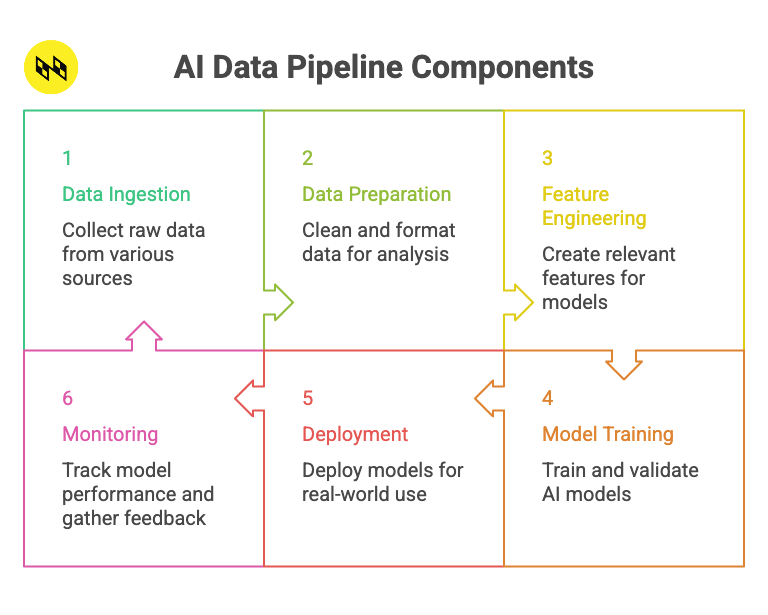
6. Monitoring and Feedback Loops
An AI data pipeline does not stop after deployment. Data changes, user behaviour evolves, and real-world conditions shift, which can reduce model performance even when the code remains unchanged.
Monitoring helps teams detect data drift, model drift, prediction errors, and pipeline failures before they become business issues. Production feedback can then support retraining, feature refinement, and data-quality improvements.
Monitoring should also cover source freshness, extraction success, schema consistency, blocked requests, and whether live data reaches downstream agents in the expected format.
AI Data Pipeline Tools
Building an AI data pipeline means combining specialized tools that each handle a different part of the data lifecycle, from collecting information to monitoring model performance in production. The exact stack will vary, but most AI teams end up using tools from the categories below.
Ingestion and Streaming
Ingestion tools bring data into the pipeline from databases, APIs, cloud storage, SaaS applications, and files, while streaming platforms process new events as they happen.
For external web data, Nimble’s Web Search Agents retrieve data directly from public websites at request time and return structured results that AI systems can use directly. This helps reduce the risk of agents producing plausible but outdated answers.
Examples: Apache Kafka, Airbyte, Fivetran
Storage and Lakehouse
Storage platforms hold raw data, processed datasets, embeddings, and AI-ready outputs. Lakehouses support structured and unstructured data at scale while combining analytics, machine learning, governance, access control, and efficient querying.
As research agents gain access to more tools and data sources, the controls supporting them must govern how they retrieve information and interact with connected systems.
Examples: Snowflake, Databricks, Amazon S3, Google Cloud Storage
Transformation and Feature Engineering
Transformation tools clean, standardize, join, and reshape data, while feature engineering tools create model-ready inputs.
For generative AI, this may include parsing documents, chunking content, generating embeddings, enriching metadata, and combining datasets. Structured, validated web data can reduce the need for custom parsing and additional LLM processing.
Examples: dbt, Apache Spark, Feast
Orchestration
Orchestration tools coordinate workflows, manage dependencies, retry failures, and provide visibility across the pipeline. They are especially useful when combining batch jobs, streaming updates, multiple sources, and model workflows.
Examples: Apache Airflow, Dagster, Prefect
MLOps, Evaluation, and Monitoring
MLOps platforms manage model versions, deployments, and experiments, while evaluation and monitoring tools track data and model performance. Teams use this layer to detect data drift, model drift, pipeline failures, and other issues before they reduce production performance.
Examples: MLflow, Weights & Biases, Galileo
5 AI Data Pipeline Examples
1. Retrieval-Augmented Generation (RAG) Pipeline
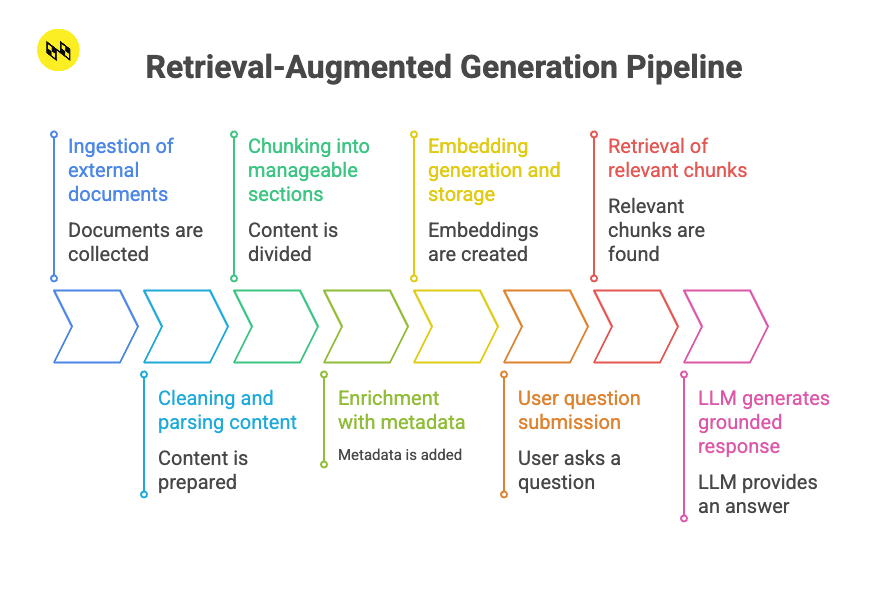
A RAG pipeline continuously prepares knowledge so an LLM can retrieve relevant information at inference time instead of relying only on what it learned during training. This allows AI applications to answer questions using current, trusted information drawn from documents, knowledge bases, or other external sources.
Internal documents, websites, or knowledge repositories are ingested into the pipeline. The content is cleaned, parsed, chunked into manageable sections, and enriched with metadata before embeddings are generated and stored in a vector database. When a user submits a question, the pipeline retrieves the most relevant chunks and passes them to the LLM as context, allowing it to generate a grounded response.
RAG pipelines improve factual accuracy, reduce hallucinations, and keep AI applications up to date without requiring constant model retraining. They're widely used for enterprise search, customer support assistants, internal knowledge management, and documentation copilots.
2. AI Search and Research Agent Pipeline
Research agents need access to information that changes every day. This type of pipeline gives AI agents a structured way to retrieve, process, and reason over live public web data instead of relying solely on static model knowledge or outdated search indexes.
An AI agent receives a research task, for example, investigating a competitor or summarizing a market trend. The retrieval component or Web Search Agent queries relevant public sources, after which the pipeline validates, transforms, and routes the retrieved data to downstream systems.
Organizations use these pipelines when decisions depend on current information rather than historical knowledge. Common applications include competitive intelligence, company research, market analysis, investment research, and due diligence. Platforms such as Nimble's Web Search Agents help automate the retrieval and structuring of live public web data so agents spend less time gathering information and more time reasoning over it.
3. Retail Pricing Intelligence Pipeline
Retail pricing pipelines continuously monitor competitors' pricing, promotions, product availability, and assortment changes, ensuring pricing teams and AI systems always have an up-to-date view of the market. Rather than relying on periodic manual checks, the pipeline turns external retail activity into structured pricing intelligence.
The pipeline continuously collects product listings, prices, promotions, stock availability, and other competitive signals from retailer websites and marketplaces. That data is cleaned, standardized across different retailers, enriched with historical pricing or internal sales data, and delivered into pricing models, BI dashboards, or optimization systems that support pricing decisions.
Organizations use these pipelines to detect competitor price changes quickly, support dynamic pricing strategies, improve promotional planning, and protect margins. Because the pipeline depends on fresh public web data, platforms such as Nimble are often used to acquire and structure that information before it enters downstream analytics or AI workflows.
4. Digital Shelf Analytics Pipeline
A digital shelf analytics pipeline continuously monitors how products appear across retailer websites and online marketplaces. It brings together information such as pricing, availability, product content, ratings, reviews, and assortment to give brands a unified view of digital shelf performance across channels.
The pipeline collects product listings and digital shelf data from multiple retail websites and marketplaces. Product information is then normalized so the same SKU can be compared across retailers, enriched with internal sales or historical performance data, and delivered into BI dashboards, merchandising platforms, or AI applications that monitor digital shelf performance.
Organizations use digital shelf pipelines to spot pricing inconsistencies, out-of-stock products, missing content, and assortment gaps before they affect revenue. They also support merchandising and marketing teams, as well as competitive intelligence programs, by providing a consistent view of how products perform across the online retail landscape.
5. Financial Market Intelligence Pipeline
A financial market intelligence pipeline continuously gathers publicly available information to help analysts, investors, and AI systems understand changing market conditions. Instead of relying on a single news source or dataset, it combines information from multiple external sources into a structured, analysis-ready view.
The pipeline ingests company announcements, regulatory filings, financial news, earnings releases, and other public web data. That information is cleaned, standardized, and enriched before being delivered to forecasting models, research platforms, AI agents, or analytics tools that support investment and business decision-making.
Organizations use these pipelines to monitor markets as they evolve rather than waiting for periodic reports. They support investment research, competitive analysis, risk assessment, and corporate intelligence by helping AI systems and analysts work from current, structured information instead of fragmented public sources.

How Nimble Supports AI Data Pipelines
AI data pipelines provide the operational foundation that keeps AI systems supplied with dependable information. Every stage plays a role in improving data quality, whether that's validating incoming records, enriching datasets, generating features, or monitoring for drift after deployment. A sophisticated model cannot compensate for a poorly designed data pipeline. In production, the reliability of AI depends just as much on how data is collected, prepared, and delivered as on the model itself.
As AI systems increasingly depend on changing public web information, external data acquisition has become a core part of the AI stack. Nimble's Web Search Agents provide a production-ready web data layer, delivering validated, structured information that integrates directly into AI pipelines without the operational burden of custom scraping infrastructure.
This lets AI engineers integrate current web intelligence into agents, RAG applications, pricing systems, digital shelf analytics, and market intelligence workflows without maintaining custom scrapers, browser automation, proxy infrastructure, or downstream parsing chains.
The result is a more dependable production data layer: fresher inputs, less engineering overhead, fewer transformation steps, and data that can move directly into AI reasoning, retrieval, model, and analytics workflows.
Book a demo to see how Nimble’s Web Search Agents deliver live, structured web data directly into production AI pipelines.
FAQ
Answers to frequently asked questions
.webp)
.png)


.webp)
.webp)
.webp)
.avif)