

We analyzed 200k agentic web search queries for PII. Here’s what we found
How often agents send personal data and company secrets to search providers, and what leaves when they do.



Charlie Klein
We analyzed 200k agentic web search queries for PII. Here’s what we found
How often agents send personal data and company secrets to search providers, and what leaves when they do.
Charlie Klein
AI agents can leak company secrets and personal data simply by searching the web. When agents write their own search queries, they can pull sensitive details from internal systems and send them to third-party search providers without anyone noticing.
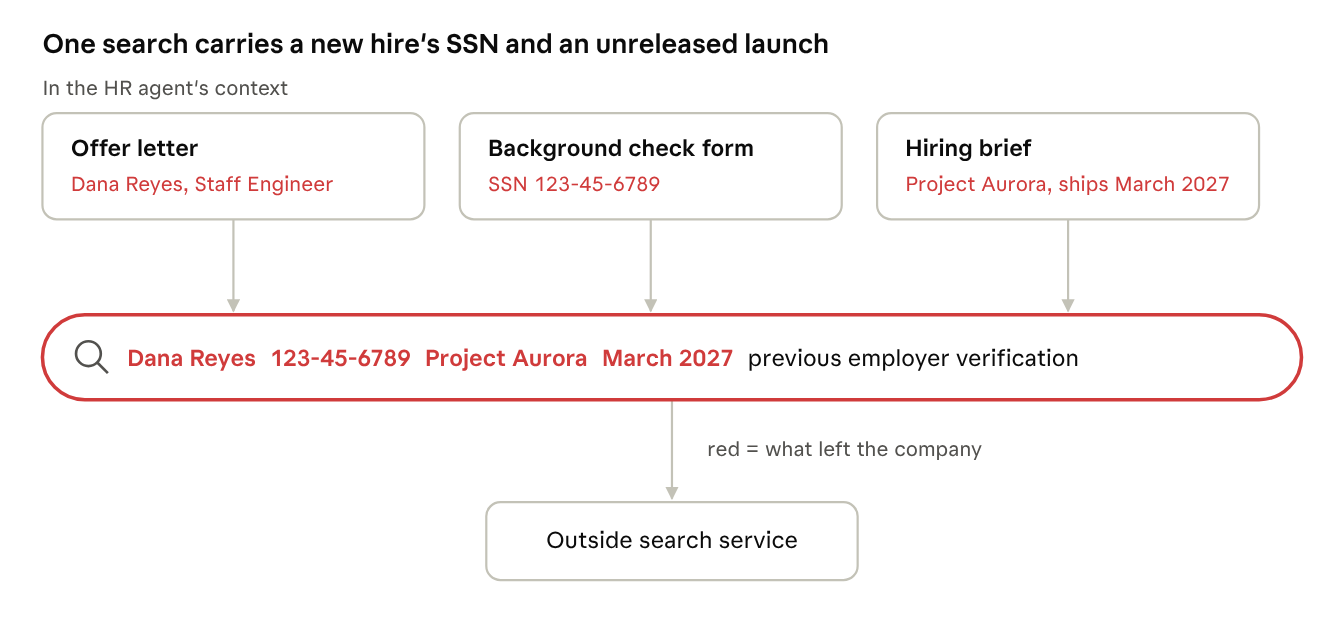
Picture an HR agent finishing the paperwork for a new hire. To verify the candidate's past employer, it searches the web. A query built from that context can carry the person's full name, their SSN, the product they are being hired to build and when it ships. There is no malicious intent from the agent doing this, but one search has just sent a person's identity and a company secret to a third party with nobody's approval or knowledge.
We wanted to know how often this actually happens, and what leaves when it does. So we analyzed 200,000 real search queries written by agents in production, across a wide range of organizations and use cases. Every query was classified automatically in an isolated environment; no person read them, and only aggregate counts came out.
What counts as a leak
We looked for two kinds of information that a company would not expect its agents to hand to an outside service:
- The company's own confidential information. Internal project codenames, unreleased products and deals, client and contract details, internal metrics and systems, and, at the extreme, credentials.
- Personal data. Non-public information that identifies a private individual: a name tied to an employer, role or city, a personal identifier such as a home address or phone number, or sensitive details such as a personal email, ID number, or health or financial information.
How often it happens
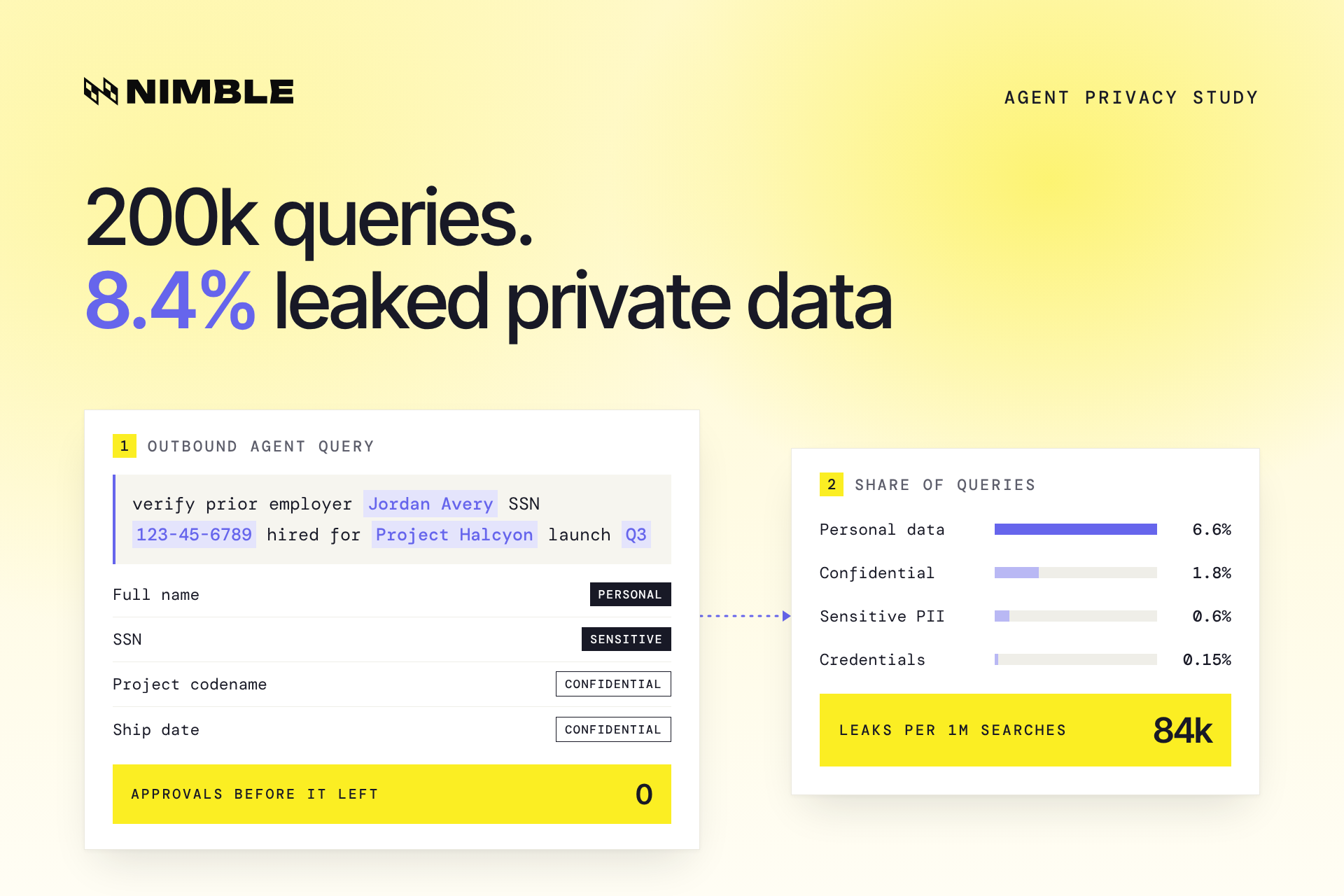
Most agent searches are exactly what you'd hope: questions about products, markets, documentation and news, with nothing private in them. But a meaningful share is not. About 1 in 12 queries (8.4%) carried personal data, company secrets, or both.
| What leaked in the query | Share of queries | About |
|---|---|---|
| Personal data about an identifiable individual | 6.6% | 1 in 15 |
| Sensitive personal data (personal email, home address, phone, ID numbers) | 0.6% | 1 in 170 |
| The company's confidential information | 1.8% | 1 in 55 |
| Credentials or internal system addresses | 0.15% | 1 in 667 |
At enterprise scale, small rates become large numbers. A company whose agents run one million searches a month would, at these rates, send roughly 84,000 queries carrying personal or confidential data to outside services every month, including hundreds of live credentials and internal system addresses.
Once a query leaves, the company loses control of it. It can sit in a search provider's logs, be retained for an unknown period, or be passed on to the upstream engines that provider uses, creating regulatory, security and competitive risks.
What these queries look like
To understand the patterns, we grouped the flagged queries by what leaked and how. The examples below are illustrative: each follows a pattern identified repeatedly, with every identifying detail replaced.
The work secrets
Agents rarely paste a password into a search box. Instead, they carry over the details of whatever they're working on: product plans, client deals, internal systems.
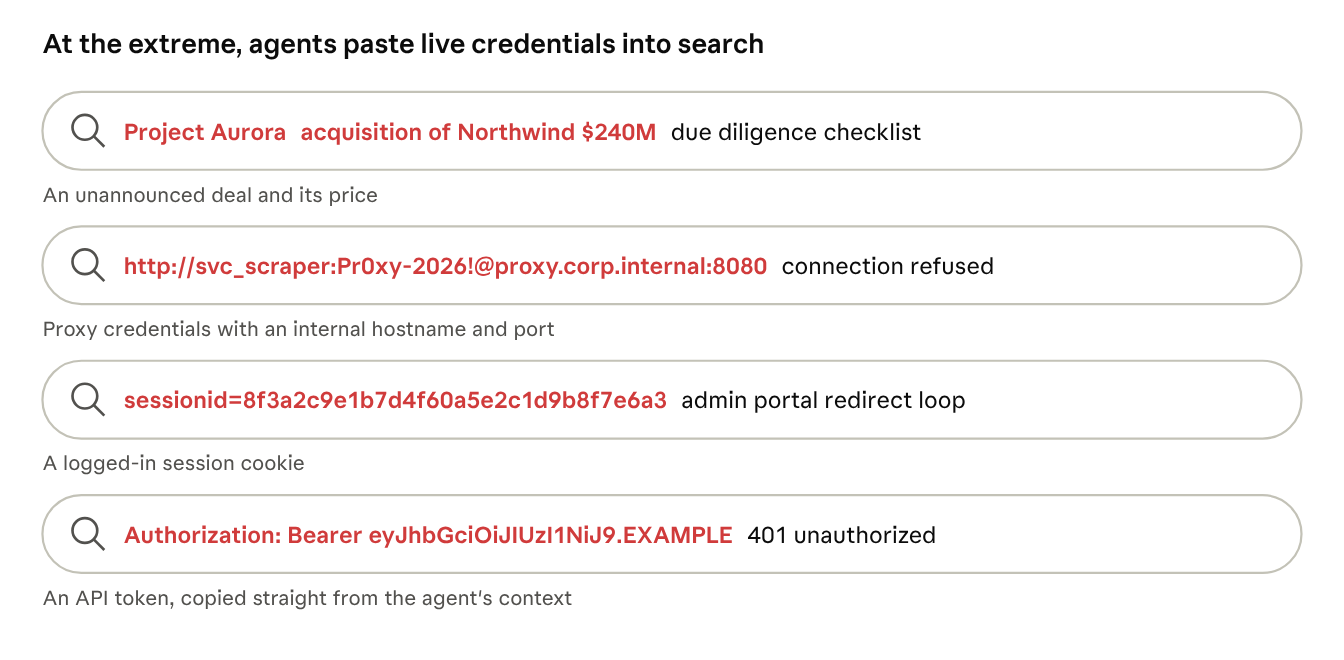
About half of these cases involved internal project codenames or unreleased products, often next to dates, prices or revenue figures. About a third exposed internal systems and operations, such as hostnames, internal error messages and dashboards with spending figures. About one in eight carried client or contract details.
In extreme cases there was even more sensitive data: proxy credentials paired with an internal hostname and port, a session cookie, a service key and an API token. Each was copied straight from the agent's context into a search box.
People, not just companies
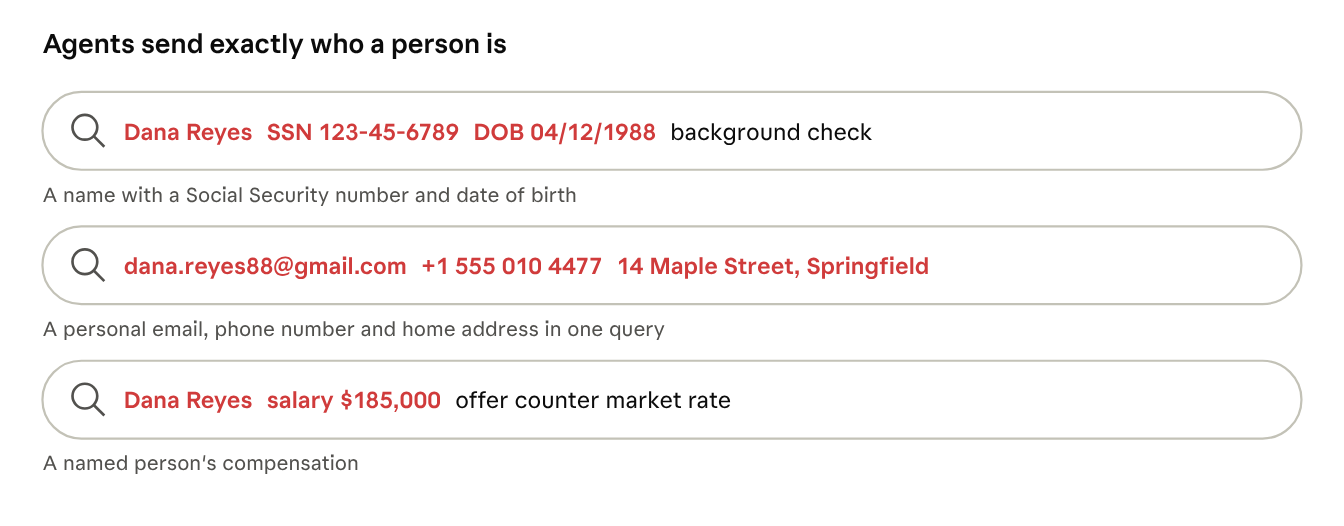
Roughly 1 in 5 queries searching for people included a personal identifier. We identified social security numbers, phone numbers, and home addresses searched in multiple different formats.
Why this happens
Agents know specific queries return better results, so it's trying to do its job well by including the specific name, project or error message it was given. Instructions like "never share customer data" don't reliably hold: over a long task they can fall out of the context window, or simply lose out to the goal of finding a good answer.
Guardrails help, however they only block what you tell them to look for. Nobody can list every secret in advance, and you can't block a leak you don't know is happening. Since each team typically picks its own search tool, there is rarely a single point where a policy could catch it.
How we solve it
Nimble treats every agent search as outbound data. You set the rules once, and they are enforced across every agent query, meaning you keep full control over what leaves the company.
It starts before the query ever leaves. Every search an agent sends passes through Nimble first, where personal data is scrubbed out: names tied to identities, ID numbers, emails, phone numbers and addresses. The search still runs and the agent still gets its answer, but the outside service never sees who it was about.
- One policy for every agent. Account level controls set once at an account level.
- Sensitive data stays in. Personal data, credentials and secrets are stripped from queries before they leave.
- Full visibility. See what every agent searched, across every team.
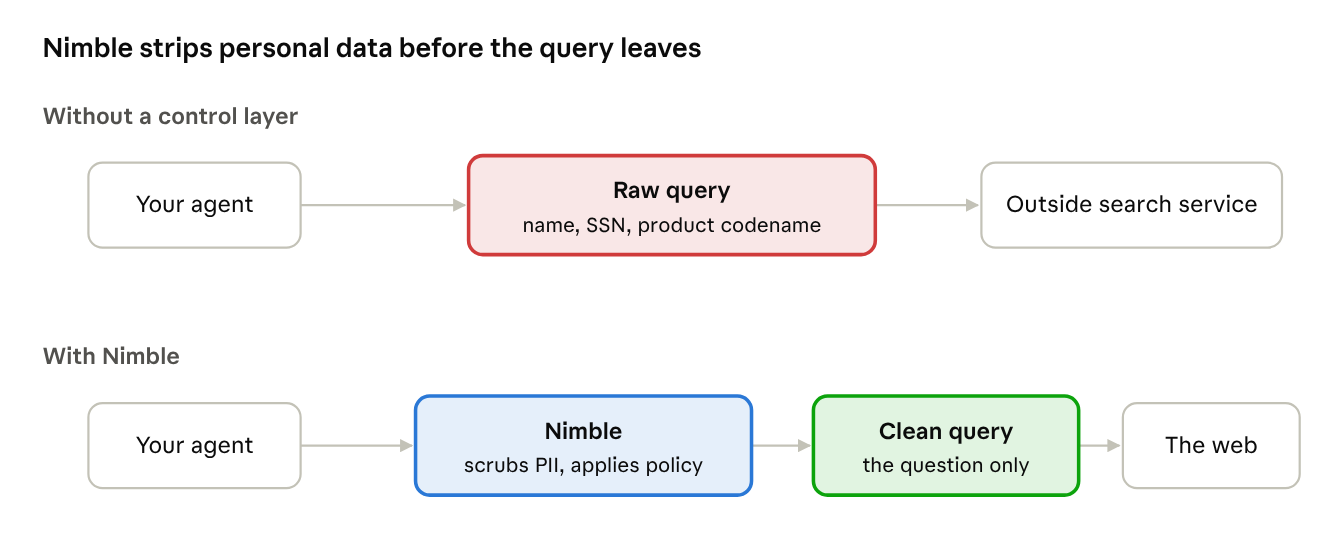
This way, your agents get the answers they need, but your search provider never gets your secrets.
FAQ
Answers to frequently asked questions