









Top 14 SEO Analysis APIs for 2026 by Use Case
Top 14 SEO Analysis APIs for 2026 by Use Case



Charlie Klein
.webp)
Top 14 SEO Analysis APIs for 2026 by Use Case
Top 14 SEO Analysis APIs for 2026 by Use Case
Charlie Klein


Most popular articles


Get structured, reliable data for your stack.
Top 14 SEO Analysis APIs for 2026 by Use Case
Abstract
An SEO analysis API is a programmatic interface that returns structured search intelligence, such as rankings, backlinks, SERP features, content signals, or technical site data, directly into your own systems on demand. Rather than pulling data manually from a dashboard, technical teams use these APIs to query search data at scale and feed it into pipelines, models, content operations, competitive monitoring, and AI agents.
Top SEO Analysis APIs for 2026 include:
- Nimble
- DataForSEO
- Authoritas API
- Ahrefs API
- Majestic API
- Moz Links API
- BrightEdge
- seoClarity API
- SE Ranking API
- Keyword.com API
- AccuRanker API
- Serpstat API
- Google Search Console API
- Google PageSpeed Insights API
AI-generated search experiences are changing how teams monitor search visibility. Traditional SERPs, Google AI Overviews, AI Mode, and answer engines such as ChatGPT and Perplexity increasingly require separate monitoring and analysis workflows. The teams winning in SEO are the ones treating it as a data engineering problem.
Recent research shows SEO campaigns can generate over 700% ROI in some industries, which makes the quality and speed of search data collection a genuine competitive differentiator. SEO analysis APIs pull structured search intelligence directly into the pipelines and workflows your team already operates. However, rank tracking, backlink analysis, live SERP collection, and AI search visibility are each a different data problem, so choosing the right SEO analysis API depends on how your team plans to operationalize search data inside your stack.
What are SEO Analysis APIs?
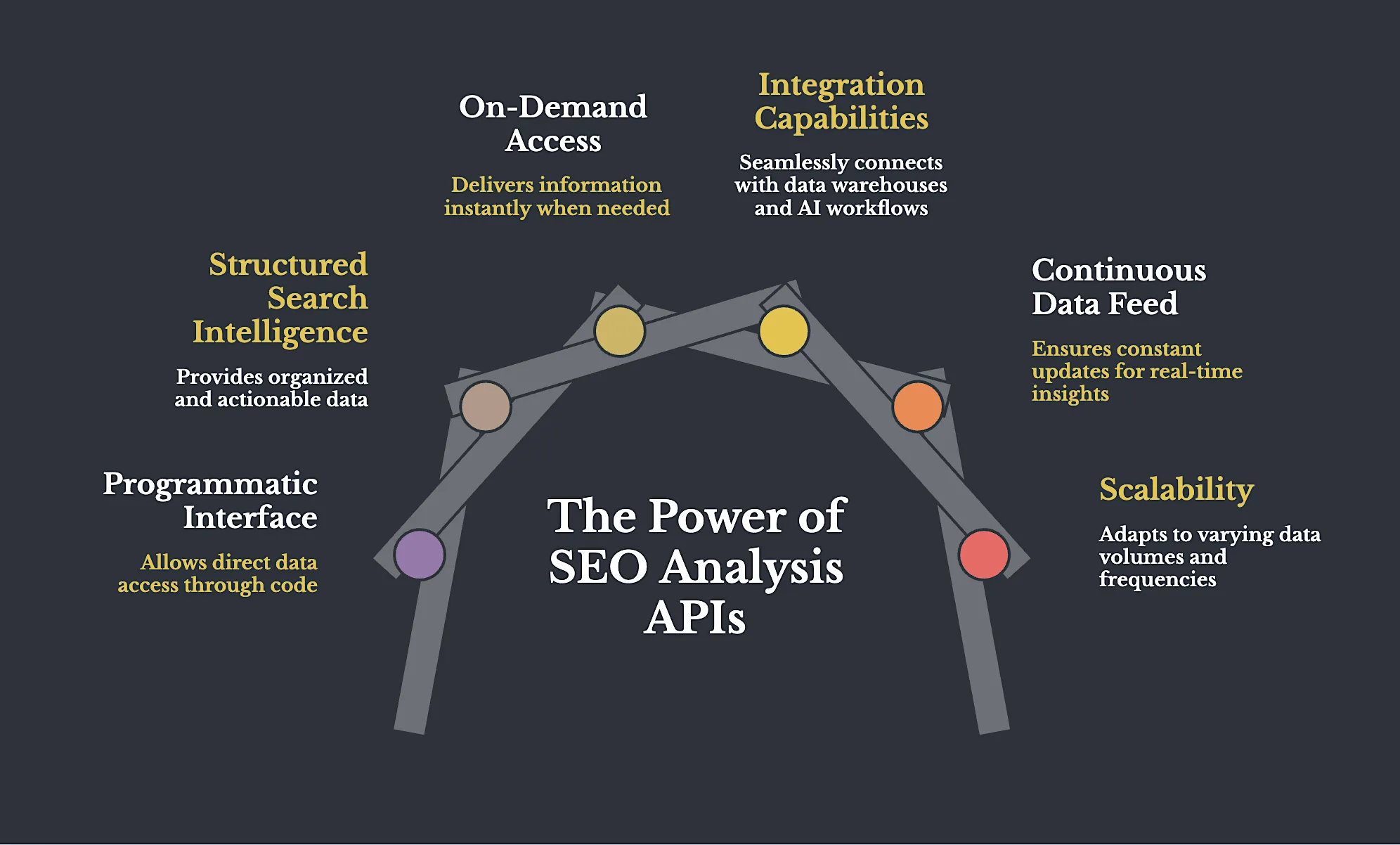
An SEO analysis API is a programmatic interface that returns structured search intelligence on demand. Rather than logging into a tool and pulling a report on a fixed schedule, your team queries the data directly, and it lands wherever you need it, whether that is a data warehouse, an analytics pipeline, or an AI agent workflow.
SEO analysis APIs have become essential for technical teams because of how they deliver data. Legacy SEO tools are largely built around human workflows and update on fixed schedules, which creates a fundamental mismatch for data and AI teams that need search intelligence continuously fed into models, pipelines, and agents. SEO analysis APIs treat search data as a queryable layer your systems can access on their own terms, at the volume and frequency your infrastructure requires.
However, SEO analysis APIs are not the right fit for every team. If you manage a single site with stable traffic and report on a monthly cadence, a standard dashboard tool will serve you well. An API integration makes sense when your team has the technical capacity to build and maintain it, and when the use case genuinely requires programmatic access to search data at scale.
Key Terms
For teams evaluating their options, these terms are essential to understanding before you start comparing tools:
- Data type coverage refers to the range of SEO data the API returns, including SERP results, keywords, backlinks, content signals, and technical audit data.
- Search coverage refers to which engines and AI surfaces the API supports, including Google, Bing, AI Overviews, AI Mode, and LLM platforms like ChatGPT and Perplexity.
- Pricing model describes how you pay, whether that is pay-as-you-go per query, a fixed subscription, or a custom enterprise contract.
- MCP and agent support indicate whether the provider offers a Model Context Protocol (MCP) server for direct integration into AI agent workflows.
- Documentation quality covers the availability of SDKs, client libraries, and implementation guides, which directly affect how quickly your team can get up and running.
Top Picks at a Glance
APIs for Live SERP & Search Intelligence
- Recommended for engineering teams building live SEO intelligence pipelines and AI agent workflows: Nimble
APIs for Backlink Intelligence
- Recommended for backlink authority auditing at the largest available index scale: Ahrefs API
APIs for Enterprise SEO Operations
- Recommended for enterprise share-of-voice and AI Overview citation monitoring at scale: BrightEdge
APIs for Rank Tracking & Search Visibility
- Recommended for tracking brand visibility inside AI-generated search results: SE Ranking API
APIs for Technical SEO & Site Auditing
- Recommended for first-party Google query and indexation data at scale: Google Search Console API
Top 14 SEO Analysis APIs for 2026 by Use Case
The following 14 APIs are organized by the SEO data problem they are best suited to solve. Within each category, tools were evaluated on the criteria most relevant to technical buyers making integration decisions, and a comparison table is included for each use case.
SERP & Search Intelligence APIs
These SEO Analysis APIs are built for teams that need real-time search result collection, structured SERP data extraction, and pipeline-ready search intelligence. The evaluation focus for this category was breadth of search engine and AI surface coverage at the API level, how the data is structured and delivered, and whether the tool supports agent workflows and high-throughput querying at scale.
1. Nimble – Recommended for engineering teams building live SEO intelligence pipelines and AI agent workflows
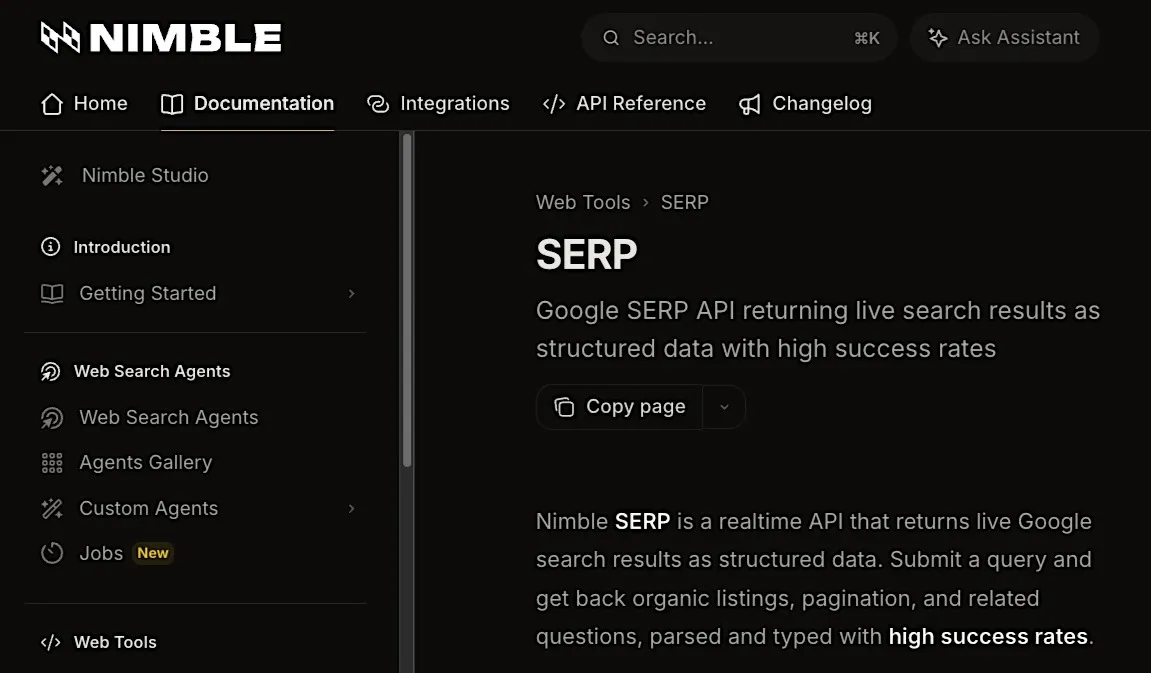
Built for engineering teams creating AI-native SEO intelligence pipelines, Nimble delivers live search data, structured outputs, and managed web data infrastructure in one platform.
- The SERP API returns live Google search results as structured data, while Nimble’s broader web data platform handles rendering, proxy orchestration, extraction, and reliable delivery at scale.
- The SEO Intel skill extends Nimble’s live data layer into natural-language SEO workflows, including AI visibility monitoring and competitive analysis. It helps teams move from live SERP collection to structured SEO intelligence without building custom web scrapers or stitching together disconnected tools.
Together, Nimble’s SERP API and SEO agent skill cover the two core requirements of any AI-native SEO pipeline: reliable structured data ingestion and live web access for autonomous agents.
Key Features
- Unified platform for live SERP collection, AI visibility analysis, competitive research, and structured SEO reporting.
- Live Google SERP data returned as structured JSON, with managed infrastructure for rendering, access, and scale.
- High-throughput scaling with dedicated and rotated residential proxies and ZIP code-level geo-targeting
- SEO Intel turns live SERP and page data into structured SEO reports for AI visibility, competitive analysis, and technical SEO workflows.
- Structured outputs can be delivered into analytics and AI workflows, including destinations such as Snowflake, Databricks, or S3 where configured.
Nimble is designed for compliant public web data collection, with workflows that prioritize publicly available data, validation, and reliable delivery rather than brittle DIY scraping.
Review
“The technology at Nimble is very effective at scale (we make millions of requests per month) and works for a good number of our use cases. Nimble packs a lot of features and power behind their API, and it's pretty easy to use out of the box.”
2. DataForSEO – Recommended for building custom SEO analysis pipelines entirely via API across multiple search engines
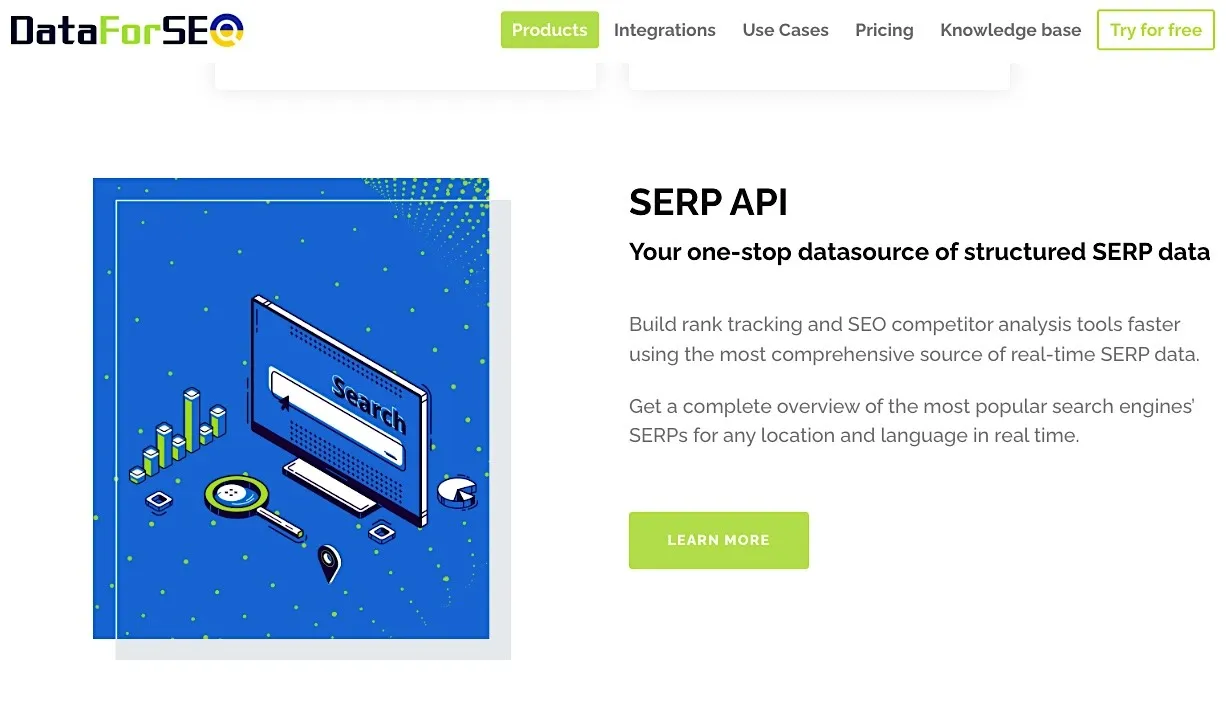
DataForSEO is a pure API platform with no dashboard product, designed for developers and data teams building SEO tooling from scratch. It offers one of the broadest data type footprints, covering SERP, keyword research, backlinks, on-page analysis, domain analytics, content analysis, and AI optimization data through a modular endpoint structure.
Key Features
- Built on a continuously updating database of 8 billion+ Google keywords and 577 million SERPs
- Multi-engine coverage, including Google, Bing, Yahoo, Baidu, YouTube, and Amazon
- Official MCP server with support for Claude Desktop, LangChain, and n8n
- Extensive public documentation with client libraries across multiple languages
Review
“We were impressed by how responsive the team at DataForSEO was and by the comprehensive nature of the APIs available.”
3. Authoritas API – Recommended for analyzing what content format Google favors for a given keyword
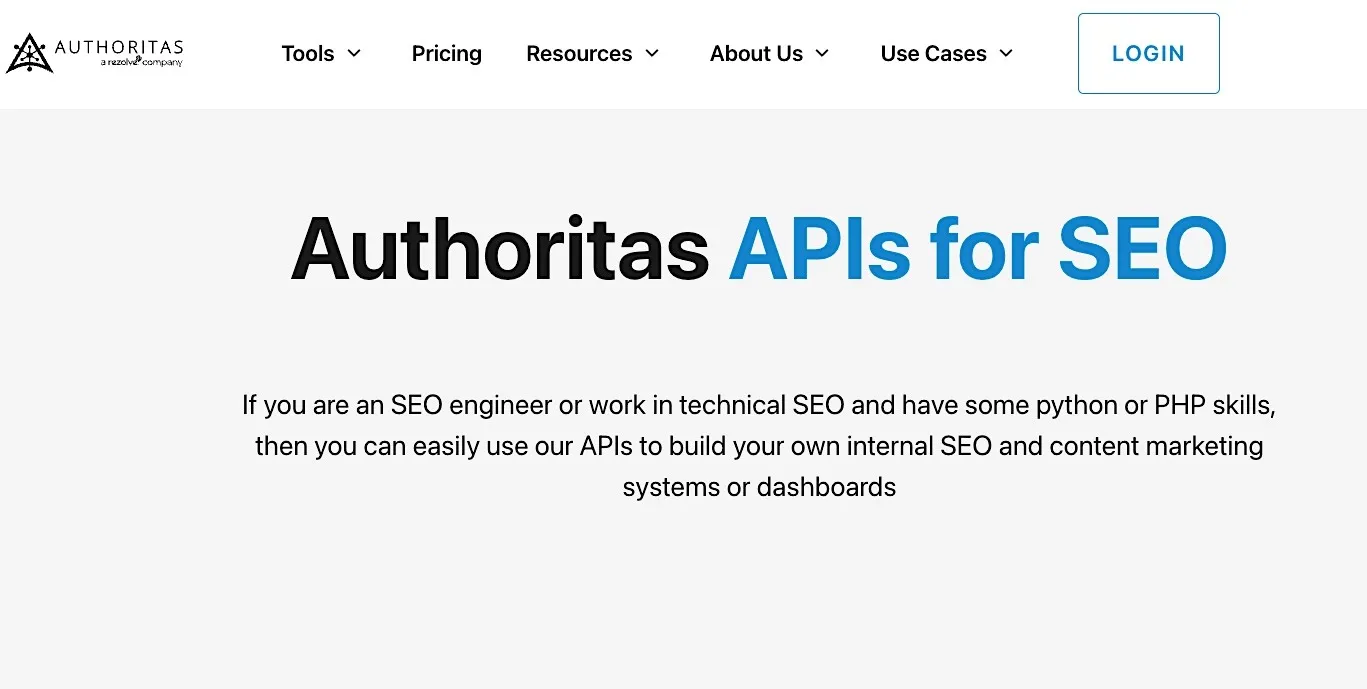
Authoritas is an enterprise SEO platform with a dedicated API layer that gives technical teams programmatic access to SERP analysis, keyword data, content format intelligence, and technical site data. Its strongest differentiator at the API level is its Page Structure Content API, which surfaces what content types and formats search engines are rewarding for a given query, making it particularly useful for content strategy workflows that need to be driven by live search data rather than assumptions.
Key Features
- SERP feature analysis across 40+ universal SERP features that identify which content formats and result types search engines surface per query
- Page Structure Content API for identifying page type, content format, and on-page signals of the top 10 ranking URLs for any keyword
- AI Overview tracking, including expanded AIO snapshot capture and all ranking generative URLs
- Google BigQuery and Looker Studio integrations for pipeline-ready delivery
Review
“The platform allows me to monitor performance across multiple search channels, track rankings, and analyze content opportunities all in one place.”
Backlink Intelligence APIs
These APIs are best used for link analysis, authority scoring, backlink auditing, and competitive link intelligence. For this category of SEO Analysis APIs, we evaluated the size and freshness of the underlying link index, what authority and trust metrics are available programmatically, and how well the API supports bulk analysis workflows for data and analytics teams.
4. Ahrefs API – Recommended for backlink authority auditing at the largest available index scale
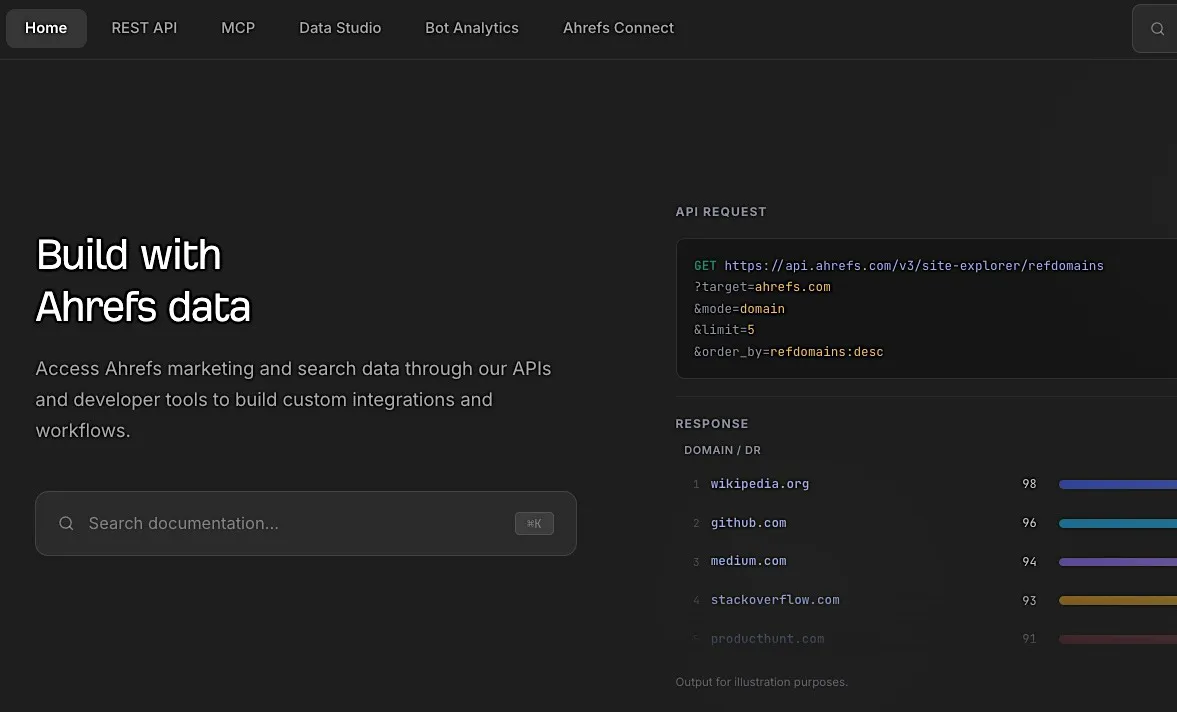
Ahrefs operates one of the largest backlink indexes in the industry. Its v3 API gives users on eligible paid plans programmatic access to that data for building custom integrations, dashboards, and reporting workflows. The API covers organic and backlink data from Site Explorer, keyword data including search volume and difficulty, and rank tracking project management endpoints.
Key Features
- Rank tracker project management endpoints for bulk keyword tracking workflows
- Metrics available for up to 100 targets per request
- Brand Radar provides overview stats, historical performance charts, and prompts with citations across multiple AI agents
- API key authentication for direct API access, with OAuth available for Ahrefs Connect integrations and unit-based consumption pricing
Review
“Powerful functionality, with keyword research options across numerous tabs and filters, plus AI visibility measured through the built-in Brand Radar.”
5. Majestic API – Recommended for auditing the topical alignment of a site's backlink profile
Majestic is a specialist backlink intelligence platform whose primary differentiator is its proprietary Trust Flow and Citation Flow metrics, which score the quality and topical relevance of a site's link profile rather than just counting links. The API gives access to both its Fresh and Historic indexes, making it well-suited for auditing the topical alignment of backlink profiles over time.
Key Features
- Topical Trust Flow data for mapping the subject matter alignment of a site's backlink profile
- Bulk backlink retrieval and referring domain analysis endpoints
- API server returns responses in either XML or JSON
- OpenApps license available for reseller and white-label data use cases
“The Link Graph means I can look right into link networks. It's much more digestible than a large list of sites and pages.”
6. Moz Links API – Recommended for Domain Authority benchmarking in client-facing reporting workflows

Moz's Links API provides programmatic access to its proprietary Domain Authority, Page Authority, and Spam Score metrics alongside backlink data. It's a widely used data source for agencies building client-facing SEO dashboards and reporting tools. The API supports batch URL submission for bulk DA and PA lookups, which is particularly useful for link prospecting and outreach qualification workflows.
Key Features
- Backlink data, including referring domains, anchor text, and link metrics
- SERP data endpoint returns top-ranking URLs and associated authority metrics
- Analyzes link profiles and provides competitor benchmarking
- Standalone API plans are available without requiring a full Moz Pro subscription.
Review
“We can connect to Moz API, make a single request, and get all the link data that our customers need to analyze a keyword and build better content.”
APIs for Enterprise SEO Operations
These SEO analysis APIs support large-scale SEO governance, workflow orchestration, and enterprise reporting infrastructure. The evaluation focus for this category looked at what data types are accessible specifically through the API as opposed to only through the platform UI. We also analyzed the potential integration and onboarding overhead for data engineering teams working inside existing enterprise stacks.
7. BrightEdge – Recommended for enterprise share-of-voice and AI Overview citation monitoring at scale
BrightEdge is an enterprise SEO platform with an API layer and a recently launched MCP server that gives AI agents and assistants direct access to its ranking, traffic, and competitive intelligence data. It’s a good fit for large brands and agencies that need to monitor search visibility at scale across traditional SERPs and AI surfaces, including Google AI Overviews.
Key Features
- Keyword rankings, traffic data, and competitor insights are accessible via API and MCP.
- AI Overview citation monitoring, share-of-voice tracking, and adjacent visibility signals such as AI ad visibility at enterprise scale
- MCP server supporting ChatGPT, Claude, Copilot, and SSE-compatible agent platforms
- Integration with Google Analytics, Adobe Analytics, and other web analytics platforms via BrightEdge Connect
Review
“This is the first time we’ve been able to watch a vendor demonstrate enterprise-level reporting with complete confidence and without footnotes or caveats.”
8. seoClarity API – Recommended for enterprise-scale SEO split testing and near-duplicate content detection
seoClarity positions its API layer, SEO Data Services, as a dedicated data tier for enterprise teams with BI pipelines, custom dashboards, or internal tooling that need to operationalize SEO data at scale. The API surface includes endpoints for domain research, ranking data, keyword research, and content analysis, alongside an MCP server that feeds real-time search performance data into AI environments.
Key Features
- Domain Research, Ranking Data, Keyword Research, Content Analysis, Content Gaps, backlink data, and Real-Time Crawl APIs for enterprise BI and reporting workflows
- Twenty-four months of trended search volume data, True Rank, or Web Rank metrics are available
- AI search visibility tracking, including prompt research, sentiment signals, and accuracy monitoring
- SOC 2 audit compliant security
Review
“seoClarity has been my go-to platform for SEO tracking and monitoring for the past few years.”
Rank Tracking & Search Visibility APIs
This type of SEO Analysis API is more focused on keyword monitoring, ranking changes, SERP feature tracking, and visibility measurement across locations, devices, and emerging search experiences. In ecommerce, those search experiences increasingly extend beyond traditional rankings into AI-driven product discovery and personalization, where recommendations, product visibility, and search relevance shape how users find products online.
For this use case, we looked closely at the range of search engines and AI surfaces covered at the API level, how frequently rank data is refreshed, and whether updates can be triggered on demand rather than on a fixed schedule.
9. SE Ranking API – Recommended for tracking brand visibility inside AI-generated search results
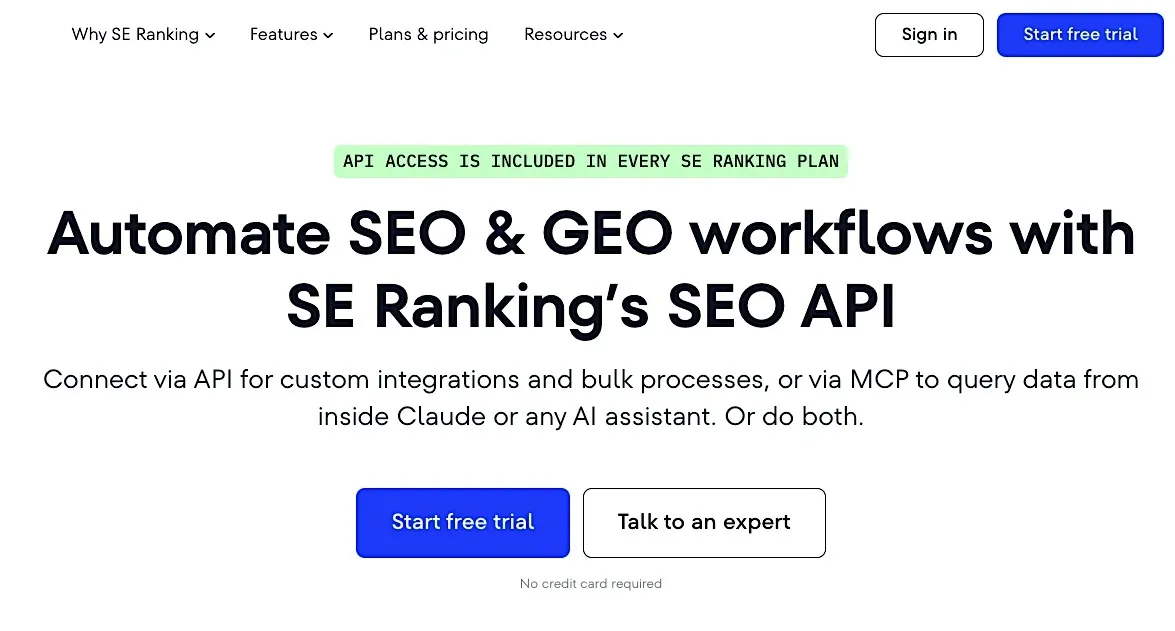
SE Ranking has built one of the most comprehensive API surfaces in the rank tracking category. Its coverage extends beyond traditional search engines to include AI search visibility tracking across Google AI Overviews, AI Mode, ChatGPT, and Perplexity. The API supports keyword rankings, backlink analysis, technical site audits, domain analysis, and LLM engine performance tracking through a well-documented REST interface.
Key Features
- LLM engine analysis for tracking brand presence, share of voice, and AI traffic trends across leading AI platforms, which supports zero-click search optimization
- Domain analysis API covering traffic, competitor overlap, and keyword gaps across 188 regions
- Supports bulk, large-scale research and audits through API endpoints, subject to plan, credit, and rate limits.
- Technical site audit API with structured reports on health scores, issues, and affected URLs
Review
“What I like most about SE Ranking is how easy it is to manage multiple SEO projects in one place. The interface is intuitive, so setting up keyword tracking, running audits, and monitoring rankings doesn’t take much time.”
10. Keyword.com API – Recommended for rank trend analysis and AI search visibility tracking in agency reporting pipelines
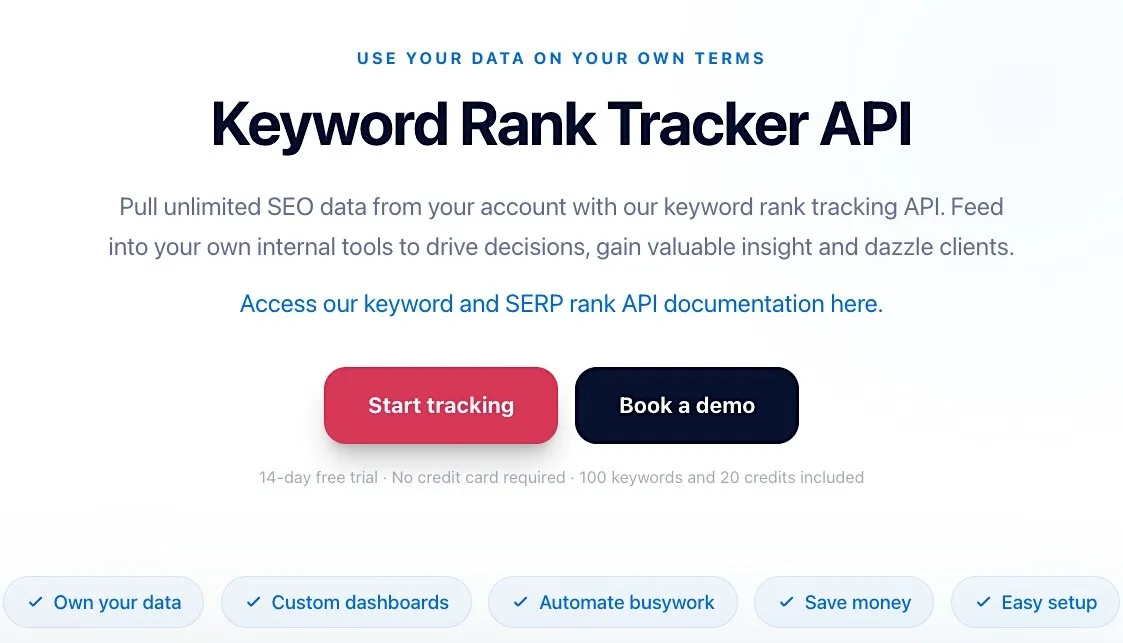
Keyword.com is a rank tracking platform built with agency reporting workflows in mind. It offers a Keyword Rank Tracker API that provides access to keyword position data, ranking history, and search visibility trends across locations and devices. It also provides Share of Voice (SoV) data showing how your domain compares against competitors for tracked keywords, and includes the latest snapshots and historical trend data.
Key Features
- Keyword position tracking and ranking history accessible via REST API
- Provides the top 10 domains for Share of Voice in a 7-365 day range
- Retrieve keyword ranking metrics, historical rank charts, competitor analysis, tracked regions, and top-performing pages.
- Run on-demand updates for all the keywords in a project or group.
Review
“I like the keyword-by-keyword ranking and trends.”
11. AccuRanker API – Recommended for on-demand rank tracking where data freshness is the priority
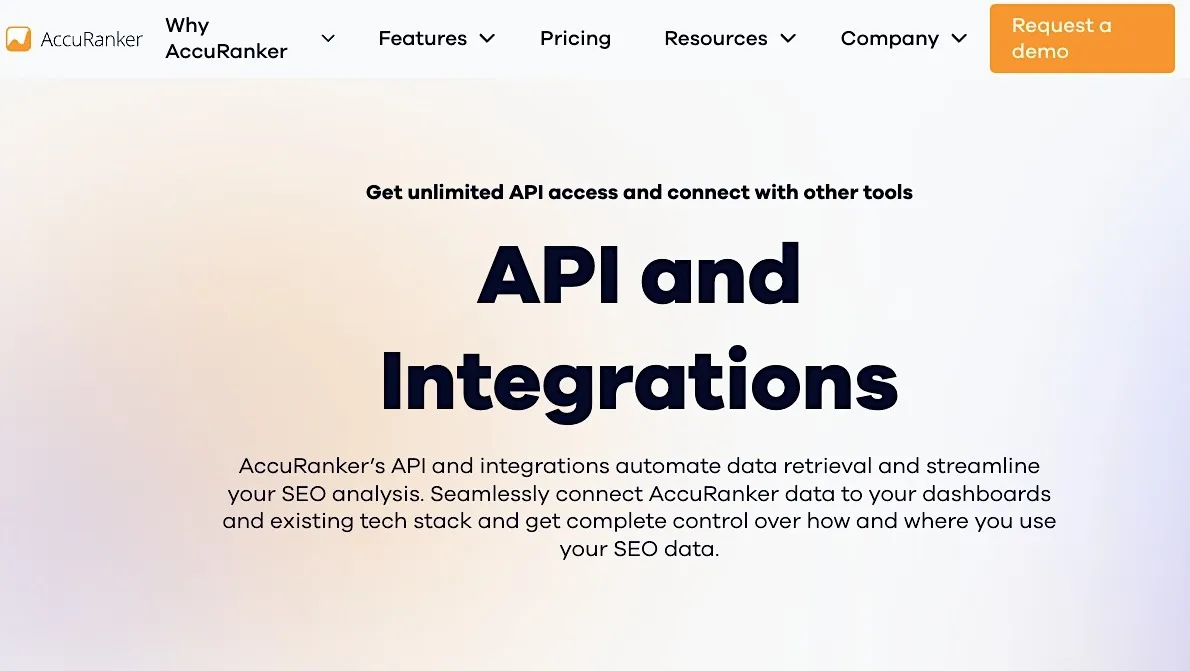
AccuRanker’s rank tracking API gives teams full programmatic access to every metric the platform tracks. These metrics include keyword rankings, SERP features, competitor insights, and LLM visibility. The ranking API supports both read and write operations, so teams can retrieve data and manage keywords and domains programmatically without touching the interface. With unlimited API calls and no request volume restrictions, it’s a strong fit for operations that need to access ranking data continuously and at scale.
Key Features
- AI visibility tracking across ChatGPT, Perplexity, Google AI Overviews, and AI Mode via the AccuLLM module
- Native integrations with BigQuery, Looker Studio, Google Analytics, Google Search Console, Adobe Analytics, Databox, and Google Sheets
- Custom segments usable directly as API filters, removing the need to hard-code query logic
- AccuRanker MCP server for integration into AI assistant workflows
Review
"AccuRanker redefines efficiency in SEO, offering instant data that is crucial for timely and effective decision-making."
12. Serpstat API – Recommended for all-in-one keyword, backlink, and rank tracking data without enterprise-tier pricing
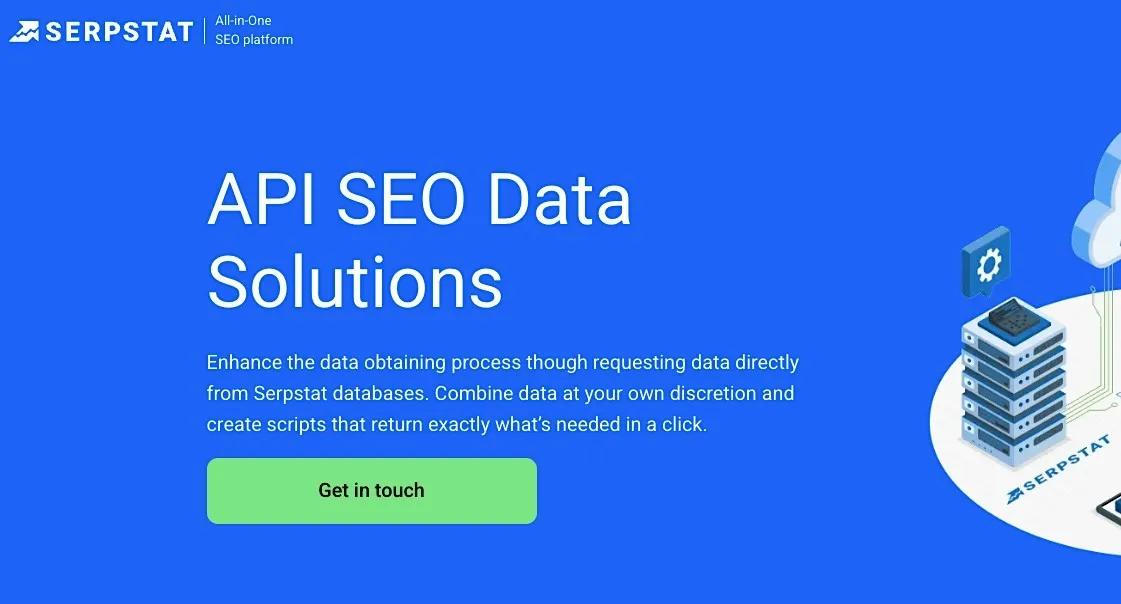
A dedicated API layer gives technical teams programmatic access to Serpstat’s all-in-one SEO platform. That includes a keyword database of over 7 billion terms, a backlink index of 1 trillion links, a self-maintained SERP crawling infrastructure, and website health score crawlers. Teams can combine and query this data to build custom dashboards, scripts, and reporting outputs tailored to their specific needs.
Key Features
- Keyword data, including related terms, search questions, suggestions, and up-to-date search volume at any location level
- SERP results for any keyword set retrieved at any geographic location
- Backlink data with a focus on index freshness and top-performing link sources
- Organic and paid competitor analysis, including keyword gaps and content opportunities
Review
“When you're managing an SEO team, it's critical to have a reliable platform with powerful capabilities at your fingertips. Serpstat fully meets this need, from daily position tracking to in-depth competitor analysis.”
Technical SEO & Site Auditing APIs
Teams that need technical SEO and site auditing functionality, like website crawling, Core Web Vitals measurement, and indexing diagnostics, turn towards these APIs. Here, we evaluated the depth and accuracy of technical data returned and how well each API integrates into existing audit, monitoring, and alerting workflows at scale.
13. Google Search Console API – Recommended for first-party Google query and indexation data at scale
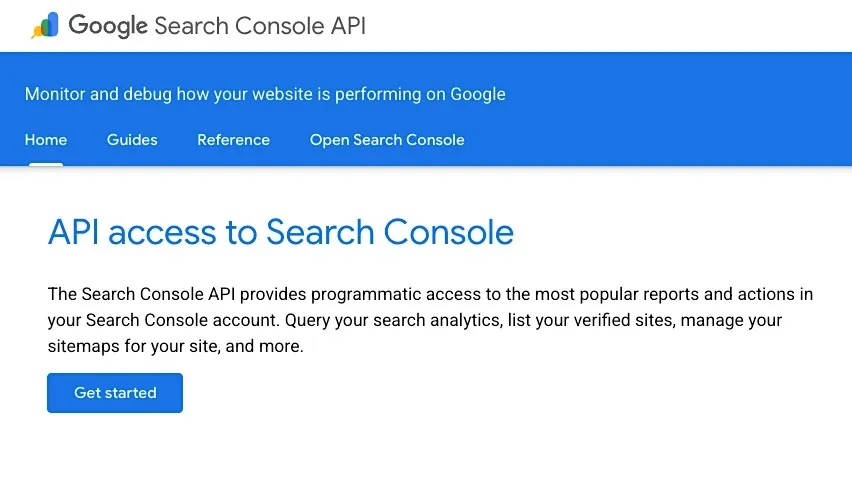
The only source of query-level click, impression, CTR, and position data that comes directly from Google, Google Search Console API is an essential component of any technical SEO monitoring pipeline. The API provides direct programmatic access to first-party Google data, including search performance metrics, sitemap data, site/property data, and URL inspection results. It is the only source of query-level click, impression, CTR, and position data that comes directly from Google, making it an essential component of any technical SEO monitoring pipeline.
Key Features
- First-party query data, including clicks, impressions, CTR, and average position by page and keyword
- URL Inspection endpoint for checking Google index status and inspection results programmatically
- Sitemap submission and management via API
- Official client libraries for Python, Java, Node.js, and other languages
Review
“I like that it helps me understand how my website is performing on Google without needing a bunch of extra tools. It’s been useful for checking search traffic, spotting indexing issues, and seeing which pages are actually getting visibility.”
14. Google PageSpeed Insights (PSI) API – Recommended for programmatic Core Web Vitals auditing across large page sets
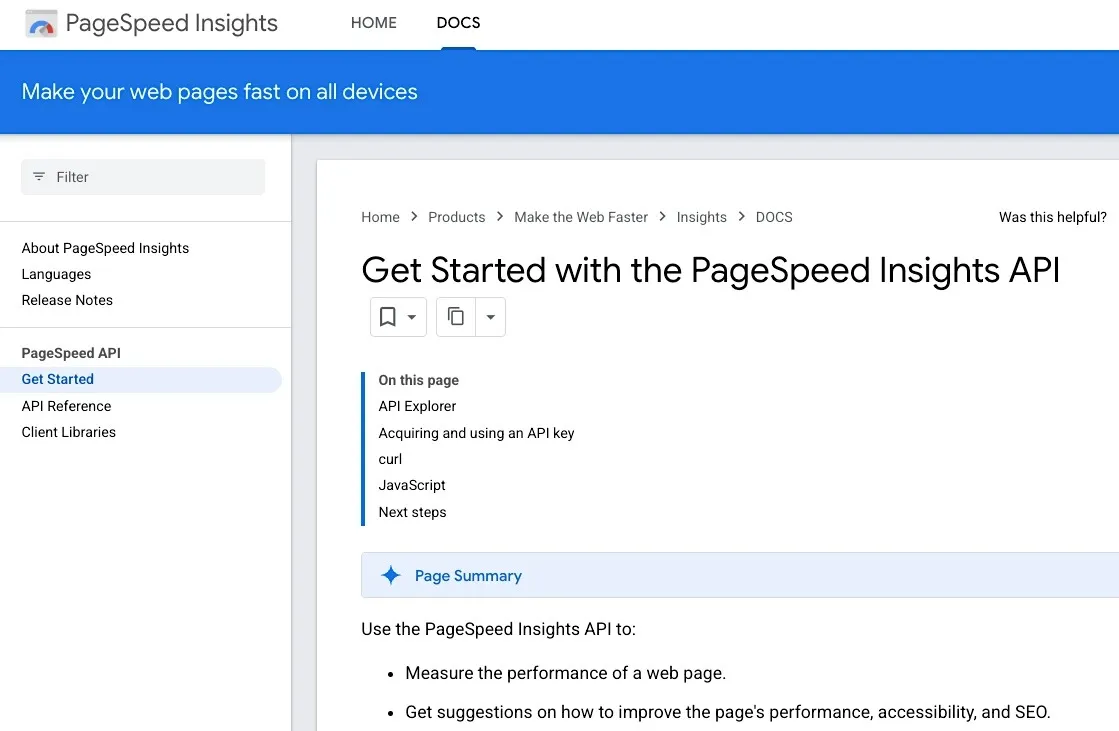
The Google PageSpeed Insights API provides programmatic access to Lighthouse lab data, performance diagnostics, and field data from the Chrome User Experience Report when available. It is the standard tool for automating technical performance audits at scale, integrating directly into CI/CD pipelines, monitoring workflows, and regression testing systems.
Key Features
- Lighthouse lab metrics and performance diagnostics through PSI, with real-world Core Web Vitals field data available through the CrUX API or CrUX History API
- Chrome User Experience Report field data for real-world performance benchmarking
- Simple REST interface suitable for integration into CI/CD pipelines and automated monitoring workflows
Review
“Google PageSpeed Insights is a tool we use daily for our client websites at our search engine marketing agency. From sales to account managers, our whole team uses the tool. It addresses website speed or performance.”
How We Compared These Tools
We evaluated each SEO Analysis API by reviewing publicly available documentation, vendor feature pages, and credible third-party sources as of 30 May 2026. Tools were assessed within their own category, so a dedicated rank tracker was not held to the same standard as a full-stack SERP intelligence API. For enterprise buyers, that evaluation also includes operational reliability, governance requirements, and third-party risk monitoring, especially when SEO data feeds business intelligence, reporting, or AI workflows.
What we reviewed:
- Official API documentation and developer resources
- Pricing information and access model (where publicly available)
- Search engine and AI surface coverage at the API level
- MCP and agent compatibility
- Third-party reviews, user feedback, and credible independent comparisons
How we compared tools:
We focused on the criteria that matter most to technical buyers, data teams, SEO teams, and agencies evaluating these APIs, and varied the evaluation focus by category to reflect what each type of tool is actually being chosen to do.
Each category had its own evaluation focus:
- Live SERP and Search Intelligence APIs – How broadly does the provider cover search engines and AI visibility surfaces? How is the data structured and delivered? Does it support agent workflows or real-time querying at scale?
- Backlink Intelligence APIs – How large and fresh is the underlying link index? What authority and trust metrics are available programmatically? How well does the API support bulk analysis workflows?
- Enterprise SEO Operations APIs – What data types are accessible through the API specifically, as opposed to only through the platform UI? What is the integration and onboarding overhead for data engineering teams?
- Rank Tracking and Search Visibility APIs – How many search engines and AI surfaces does the API cover? How frequently is rank data refreshed, and can updates be triggered on demand?
- Technical SEO and Site Auditing APIs – What technical, indexing, performance, or search-performance data is returned, and how well does it integrate into existing audit and monitoring workflows?
We did not run hands-on benchmarks for every tool, and we avoided attributing capabilities that were not clearly documented in official API references or credible third-party sources.
The Right SEO Analysis API Is the One That Fits Your Data Problem
Choosing the optimal SEO Analysis API comes down to what your team needs to query, how often, and where that data needs to land inside your existing stack. For teams building with AI agents, the choice must address that autonomous workflows need data that is structured at the point of delivery, fresh enough to act on, and accessible without brittle scrapers or stale exports getting in the way.
Nimble’s SERP API and SEO Intel skill are designed for engineering teams building AI-native SEO pipelines. The SERP API returns live Google search results as structured data while handling JavaScript rendering, anti-bot mitigation, and proxy infrastructure automatically. SEO Intel extends that live data layer into structured SEO workflows, helping teams analyze visibility, competitors, and technical issues without building custom collection infrastructure. Together, they give AI-native SEO pipelines reliable structured data ingestion and live web access for autonomous workflows.
Book a Nimble demo to see how live SERP data, SEO Intel workflows, and managed web data infrastructure can power AI-native SEO analysis at scale.
FAQ
Answers to frequently asked questions
.webp)
.webp)
.avif)
.webp)