

Max Extract: Nimble’s full extraction stack behind a single request
Every Nimble driver races on every URL, and the first successful response goes back to your agent.



Alon Goldenberg
Max Extract: Nimble’s full extraction stack behind a single request
Every Nimble driver races on every URL, and the first successful response goes back to your agent.
Alon Goldenberg
Agents constantly read through the web to gather relevant context, but content retrieval isn't always trivial. Some pages are plain HTML, some need a browser to render, and some actively block automated requests. Pick the wrong retrieval method and the agent waits, fails, or retries.
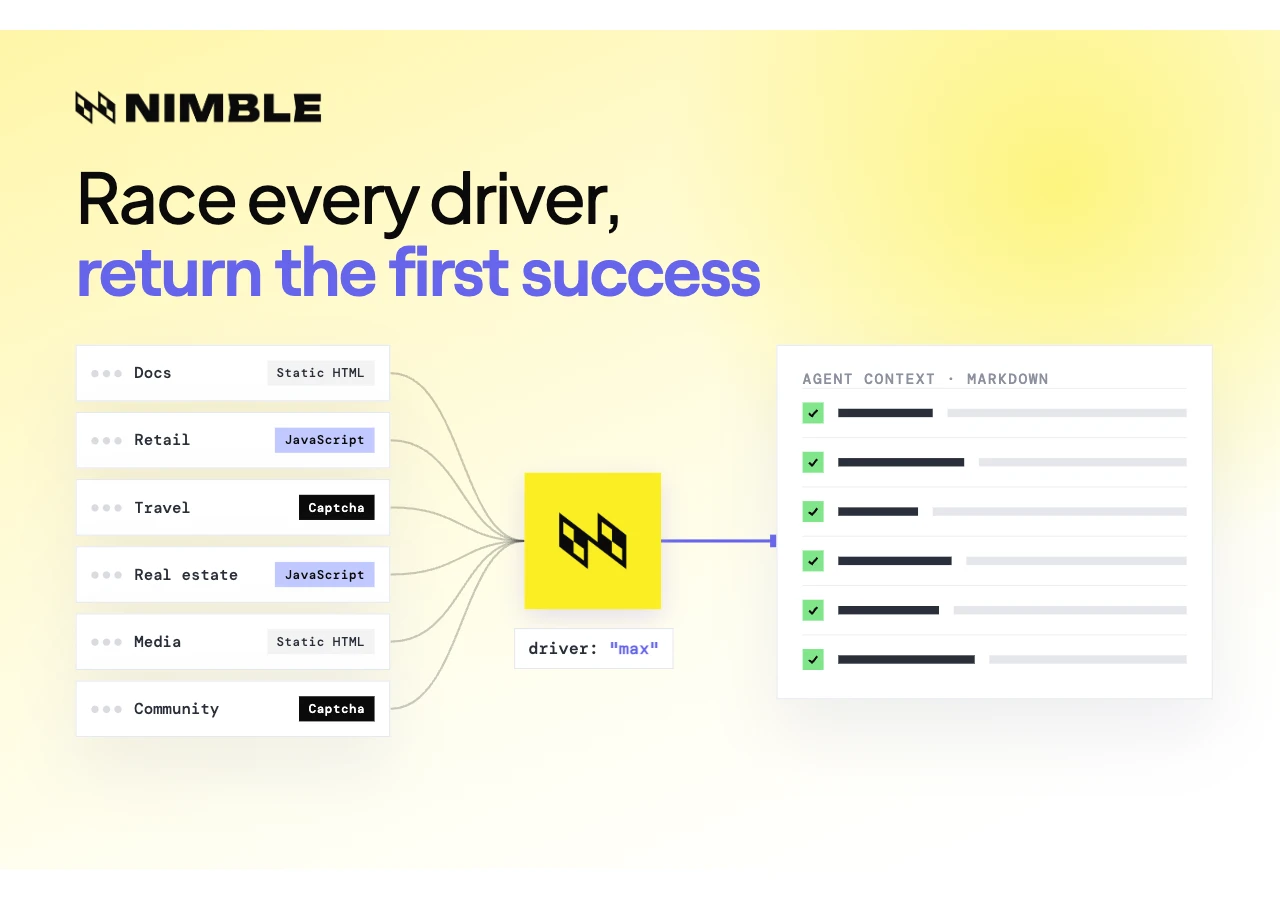
This is why we launched the max driver, which is the premium tier of Nimble’s Extract API. It puts everything Nimble has behind one request: plain HTTP, headless and headful browsers, and our strongest stealth capabilities, all launched at once for every URL. The first successful response goes back to the agent. You get the fastest result Nimble can produce for that page, with the highest chance of success, and you never choose a driver.
What max gives you
- Every Nimble driver on every request. Nothing is held back. Stealth and full browsers start at the same moment as HTTP, so the hardest pages get the strongest treatment from the first millisecond.
- The fastest successful response. Easy pages come back at HTTP speed. Hard pages come back as soon as the first capable driver succeeds, with no escalation ladder in between.
- No configuration. No render flags, no per-domain driver rules, no fallback logic in your agent. One setting works across sites you have never seen.
- One success, one charge. You pay for the response you receive. Slower attempts finish in the background and cost nothing extra.
Why one driver is never enough
Different drivers are optimized for different combinations of static HTML, JavaScript execution, and bot protection:
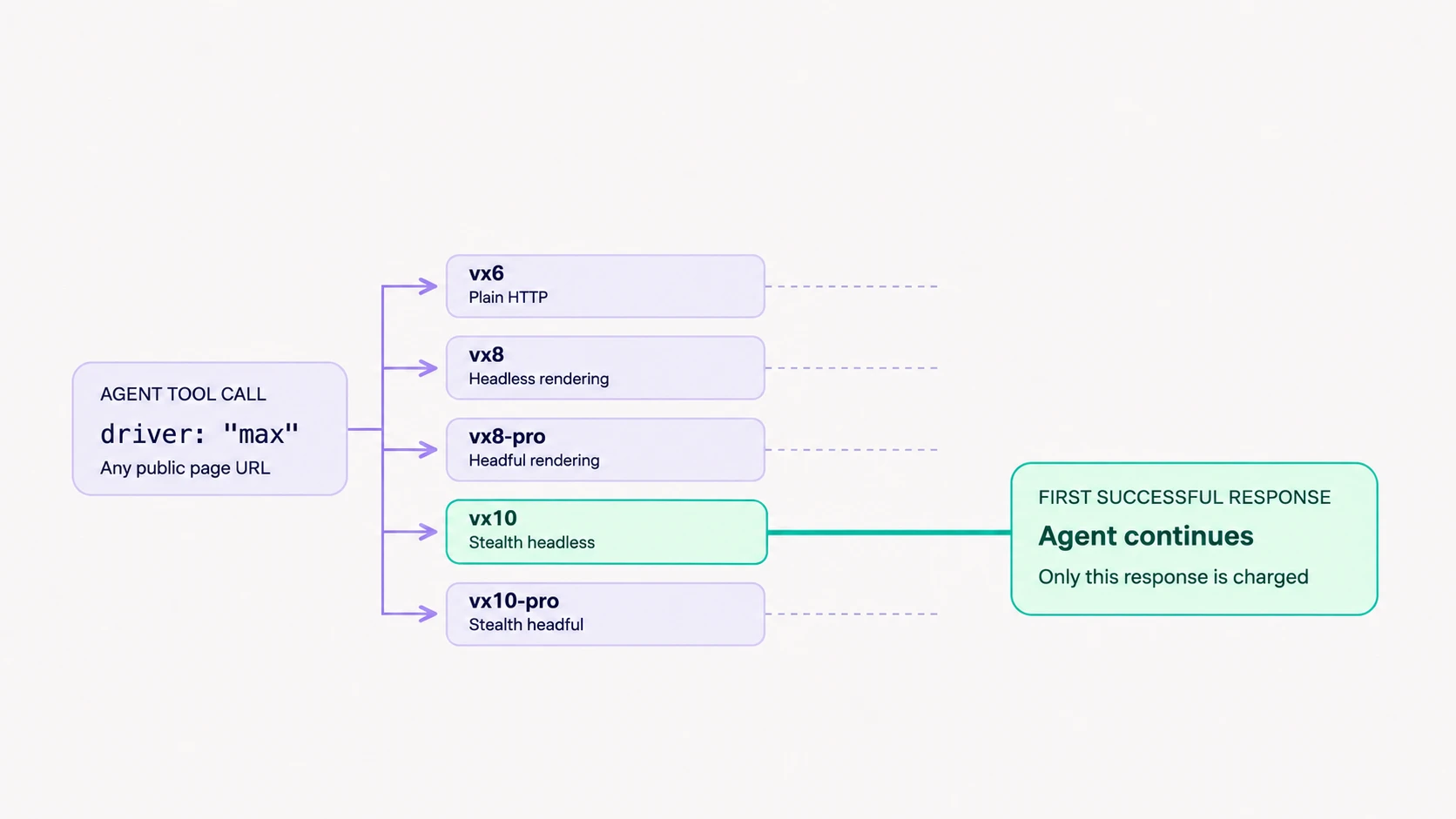
- vx6: plain HTTP. Fetches HTML without executing JavaScript, making it a fit for static pages, APIs, and high-volume retrieval.
- vx8: headless browser. Executes JavaScript for dynamic pages that need browser rendering.
- vx8-pro: headful browser. Uses a full browser with more realistic behavior for pages with moderate protection.
- vx10: stealth headless browser. Adds advanced anti-detection capabilities for protected pages.
- vx10-pro: stealth headful browser. Combines a full browser with Nimble’s strongest stealth capabilities for difficult targets.
Each driver is the right tool for some pages and the wrong one for others. An agent working through unfamiliar URLs cannot know in advance which one a page needs.
The usual answer is escalation: try HTTP, fail, try a browser, fail, try stealth. Every failed attempt adds a full round trip before the next one can start. Max removes the ladder. Rendering and stealth are already running while HTTP makes its attempt. The first successful response returns immediately and the rest finish in the background without delaying it or adding charges. See how the race works.
Fast where pages are easy, successful where they are hard
We tested 72 pages across documentation, retail, travel, real estate, media, and community sites, then selected ten examples with useful returned content and API times below 12 seconds. Every request used driver: "max", Markdown output, a 60-second timeout, and no explicit render setting or per-domain driver configuration.
For each webpage, the five drivers launched in parallel according to documented max behavior; the API responses report the results from the winning driver.
Easy pages stay fast. MDN came back through plain HTTP in 0.297 seconds and Wikipedia in 0.707 seconds. Running browsers and stealth alongside cost nothing in latency because HTTP simply won. The same driver also won on the Sephora product page and Zillow: a complex storefront does not always mean a browser is needed.
Hard pages come back. B&H, Stack Overflow, Sephora’s category page, Product Hunt, and Realtor.com all needed the stealth headful browser, Nimble’s strongest driver. With max it was already running, so each returned in about a second instead of after three or four failed attempts.
You never have to know which is which. Within Sephora alone, the product page returned through HTTP and the category page through stealth. The agent used one setting for both and never issued a fallback request.
Give your agent access through Nimble’s MCP server
Connect Nimble’s MCP server to your MCP-compatible agent, then use the Extract tool with driver: "max". Your agent can retrieve pages directly in its workflow, while Nimble handles the race between HTTP, rendering, and stealth.
Add this server URL to your client and follow the authentication steps in the setup guide:
https://mcp.nimbleway.com/mcp
Once connected, ask your agent:
Use Nimble Extract to retrieve this page as Markdown. Set the driver to “max” so every driver races and the first successful response comes back.
You can also call Extract directly from your application:
curl -X POST 'https://sdk.nimbleway.com/v2/extract' \
  -H "Authorization: Bearer $NIMBLE_API_KEY" \
  -H 'Content-Type: application/json' \
  -d '{
    "url": "https://www.example.com",
    "driver": "max",
    "formats": ["markdown"],
    "request_timeout": 60000
  }'
Pricing is $2.50 per 1,000 URLs. That price buys every driver Nimble has on every URL, and you are only charged for successful responses. You pay for the result you receive; the slower attempts finish in the background at no extra cost.
Give your agent the best Nimble can do
Agents make better decisions when they can reach the web data their task needs. Max is the simplest way to get there: Nimble’s full extraction stack on every request, the fastest successful response back, and one charge per result. Use it when success and speed matter more than tuning individual drivers, so your agent spends its time on the answer, not on retrieval.
FAQ
Answers to frequently asked questions