

Where Should Investment Firms Build Their AI Edge?
Turning institutional knowledge into a measurable advantage in web discovery.


Tom Lerner
Where Should Investment Firms Build Their AI Edge?
Turning institutional knowledge into a measurable advantage in web discovery.
Tom Lerner
When sophisticated AI becomes available to anyone, where should an investment firm build proprietary technology?
For technical teams at hedge funds, the question is where to invest engineering effort to build a research advantage competitors cannot easily reproduce.
A fund’s accumulated knowledge is a natural starting point. Years of research produce relationships between companies, an understanding of sector dependencies, leading indicators, and evidence standards. That knowledge shapes which questions analysts ask and what would change their minds.
Companies increasingly adapt AI models to their domains through fine-tuning, proprietary data, and distillation to improve quality and reduce costs. Financial research presents the same opportunity to make AI systems work with an organization’s expertise.
Understanding a fund’s investment thesis is only useful if the research process finds the evidence to test it. Institutional knowledge can guide which entities to investigate, sources to pursue, and milestones to verify.
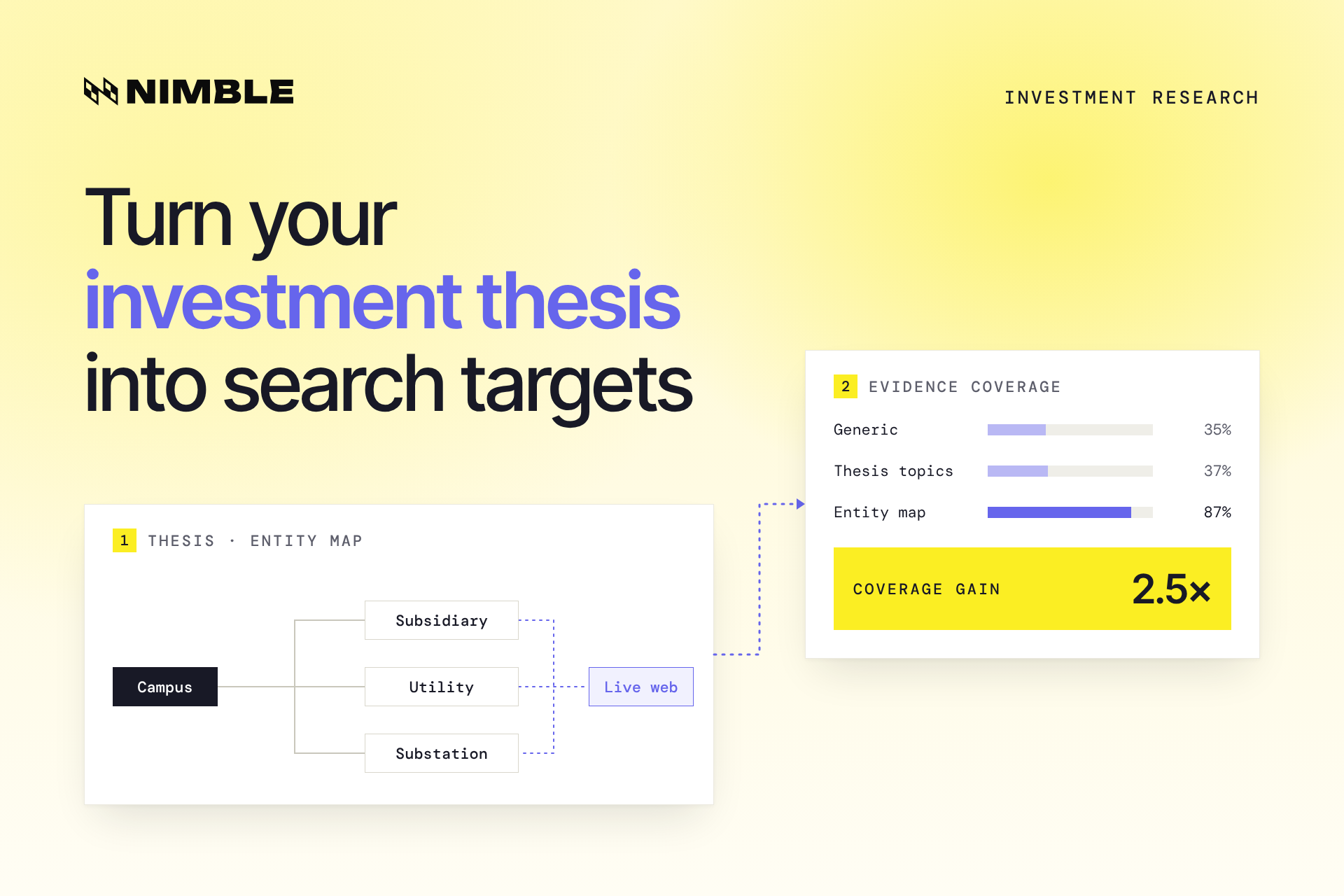
Consider a fund assessing whether announced AI data-center capacity can become usable compute within 24 months. Its internal research connects a campus to a subsidiary, utility, and planned substation, giving its agent specific search targets. A utility update that never mentions the campus could contain a milestone that changes the investment view.
For engineers, the opportunity is to translate institutional knowledge into search behavior, and to measure whether that behavior uncovers more of the evidence the thesis requires.

Where expertise gets lost
In a typical agent workflow, the model receives detailed investment context but sends broad queries to a general-purpose search tool. The fund’s expertise shapes how results are interpreted, but much of its knowledge about where to look goes unused.
This creates a discovery gap: the agent can reason carefully about the evidence it finds while missing sources that could challenge its conclusions.
Privacy adds another constraint. Customers and partners often raise concerns about exposing proprietary investment theses to external services. A better approach translates internal expertise into targeted search instructions while keeping sensitive context governed within the fund’s environment.
An investment thesis contains more than keywords: hypotheses, relevant entities, leading indicators, source preferences, and evidence standards. These should guide discovery toward evidence that tests or challenges the thesis.
For example, testing whether announced data-center capacity can become usable compute within 24 months requires investigating power availability, grid upgrades, cooling, equipment delivery, and commissioning. Critical evidence may come from a utility or project subsidiary rather than the operator itself.
Applying your investment thesis to your search strategy
Imagine two hypothetical funds examining the same AI data-center projects. Their agents receive the same question: “Which announced campuses can deliver usable compute over the next 24 months?”
Their research strategies should diverge even if they use the same public web.
Fund A: Power and delivery constraints
Its thesis is that announced capacity runs ahead of operational readiness. Its agent searches utility filings, grid-project updates, permit conditions and commissioning schedules. The fund’s project map connects each campus to relevant counterparties, directing web discovery beyond operator announcements. The agent also seeks evidence that would resolve each suspected bottleneck.
Fund B: Phased deployment and mitigation
Its thesis is that staged deployment can bring some capacity online before the full buildout is complete. Its agent searches for phased energization, permitted bridge power, equipment allocations and first-phase acceptance milestones. It tests whether each workaround covers usable capacity on the promised timeline, and seeks conditions or dependencies that could invalidate it.
Neither strategy is universally better. Each encodes a different definition of what matters. The important question is whether the search process can translate those definitions into distinct, verifiable research paths rather than simply returning different prose summaries of similar generic results.
From institutional knowledge to a web-search policy
Internal knowledge becomes useful to web discovery when it is translated into search instructions: entities to investigate, source classes to prioritize, operating signals to track, and evidence that would challenge the thesis. The resulting facts must still be retrieved and verified from public sources.
A useful architecture treats the investment thesis as an input to a research planner, not only an input to the final answer generator. The planner creates an evidence plan: what must be learned, which source classes might contain it, which entities and relationships are relevant, what constitutes strong evidence, and when further retrieval is justified.
The architecture is a feedback loop, not a one-way pipeline: evaluated findings and reusable search patterns return to the fund’s institutional context, improving future hypotheses, source priorities, and research coverage. Proprietary inputs remain governed within the fund’s environment.

The research edge depends on what you find
A well-written answer can still be incomplete. An agent that stops after a few relevant sources may miss disclosures, supplier updates, or conflicting timelines that change the conclusion. The value of deeper search lies in uncovering material evidence that shallower workflows may overlook.
The system should therefore iterate: retrieve → extract → identify evidence gaps → pursue the next high-value source → repeat or stop. The goal is decision-relevant completeness: enough corroborated evidence to test the thesis and its alternatives while balancing search depth and cost.
When evidence is missing or contradictory, the agent should make those gaps explicit. Recognizing the limits of coverage is part of rigorous research.
Example: From announced AI capacity to usable compute
Which announced AI data centers can deliver usable compute within 24 months? The thesis is that power, grid connections, and commissioning could delay operational capacity beyond announced timelines. Search must find the evidence to test that gap.
The discovery gap: a campus has more than one name
Consider a campus targeting a September 2027 opening, while a grid operator schedules its substation upgrade for October 2028. Finding this mismatch requires connecting the campus to the substation. But counterevidence matters too: staged connections or temporary power could support an earlier first phase despite the delayed upgrade.
A fund’s internal project map connects operators, subsidiaries, utilities, substations, and suppliers. These relationships guide discovery toward sources that may never mention the campus by name. Operational facts must still be verified against retrieved evidence.
Separating topic knowledge from entity knowledge
The comparison tests three retrieval strategies using the same search engine, 16 queries each, and identical result-fusion rules. All three search for both delays and mitigating evidence:
- Generic multi-query: Searches the campus name alongside broad topics like capacity, opening dates, construction, and power.
- Thesis topics: Adds specific requirements such as grid energization, commissioning, permits, cooling, and equipment delivery.
- Expert + entity map: Uses those same requirements but expands discovery to mapped utilities, contractors, and suppliers.
The primary metric is weighted required-evidence coverage, measuring how much predefined evidence each strategy retrieves. Power, grid connections, and commissioning carry greater weight. Duplicate claims count once, and missing evidence remains a gap. Each strategy has a 24-page cap per task, though actual retrieval counts may differ.
Better search targets change what becomes visible
At the 24-page cap, generic multi-query retrieves 35.2% of required evidence, compared with 36.6% for thesis topics and 86.8% for expert + entity map. The improvement comes primarily from reaching the right counterparties, rather than refining search queries alone. Distinct claims retrieved also increase from 5.6 to 14.0 per task.

The curve tests whether additional page allowance closes the discovery gap. A larger allowance only helps when the query plan reaches sources with new evidence. Repeated announcements do not substitute for a utility service date or a commissioning milestone.
Coverage must include the dependencies that can change the answer
The largest practical gaps appear in operational dependencies. Grid-connection coverage moves from 35.0% to 84.4%; commissioning from 32.8% to 84.4%; equipment delivery from 33.9% to 91.1%. The heatmap separates these requirements so a strong aggregate score cannot hide a missing dependency.

Finding risks is only half the task. Counterevidence coverage rises from 35.7% to 88.5%. The share of dependency categories with evidence on both sides rises from 11.8% to 75.6%. In this example, an early transformer shipment or staged power agreement may support first-phase delivery even when the full campus remains constrained. Search must preserve that distinction.
A control: what happens when the relationships are wrong?
Replacing the correct counterparties with other campuses’ counterparties reduces coverage from 86.8% to 36.3%, close to the topic-only policy. The query count, retrieval engine and page cap stay fixed. This control isolates the value of the correct relationships within this example, rather than attributing the gain to more searches.

These results illustrate a specific discovery mechanism; they do not establish a performance ranking of commercial search products. A production comparison should hold the expert agent constant, give generic tools access to the same institutional context, and measure which public-web evidence each retrieval workflow actually finds.
For a hedge fund, the opportunity is concrete: translate institutional knowledge into entities to investigate, operational milestones to verify and counter-hypotheses to pursue. Evaluate web search by the evidence needed to test the investment view, including what remains unresolved.
FAQ
Answers to frequently asked questions