









The missing layer in web agents
Why agents need expert web context between search APIs and computer use.



Uri Knorovich
The missing layer in web agents
Why agents need expert web context between search APIs and computer use.
Uri Knorovich


Most popular articles


Get structured, reliable data for your stack.
“Find all open AI engineering roles across the Fortune 500 and identify which companies appear to be building agent infrastructure.”
AI search can answer pieces of this. An AI controlling a browser can visit 500 career sites.
But answering the question requires discovering where each company publishes jobs, ranking relevant sources, navigating recruiting systems, collecting and normalizing postings, deciding when to refresh them, and returning evidence back to the agent that supports the conclusion.
Web search tools can help agents discover relevant information, but they rely on web indexes that don’t have the granularity of freshness needed for this task. To find job listing details that won’t come up in search results, you would need to configure agentic site browsing to navigate each career site to dig into job listings.
Even with these tools, the agent doesn’t know how to discover the data it needs…all it can do is guess and explore.
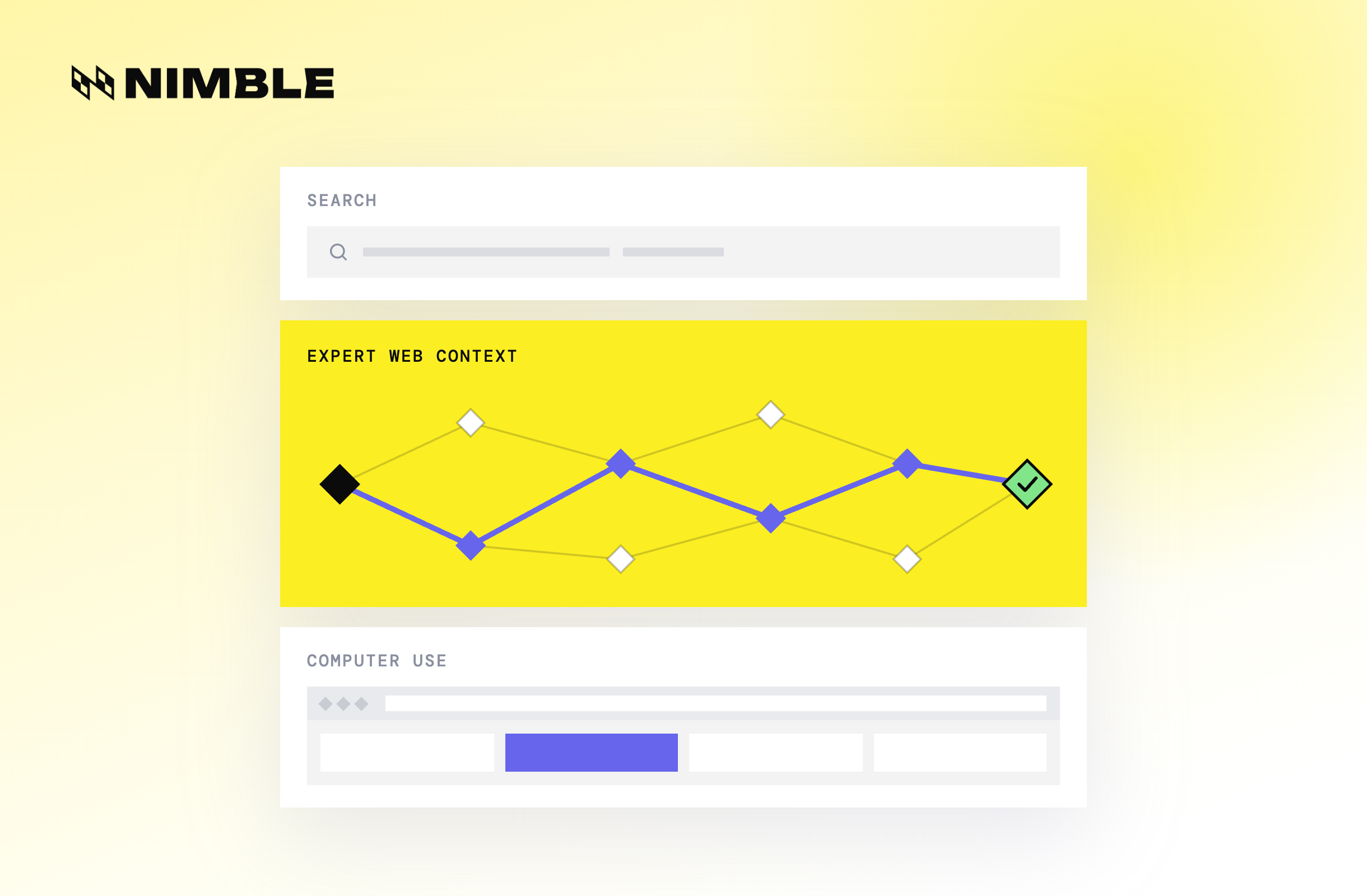
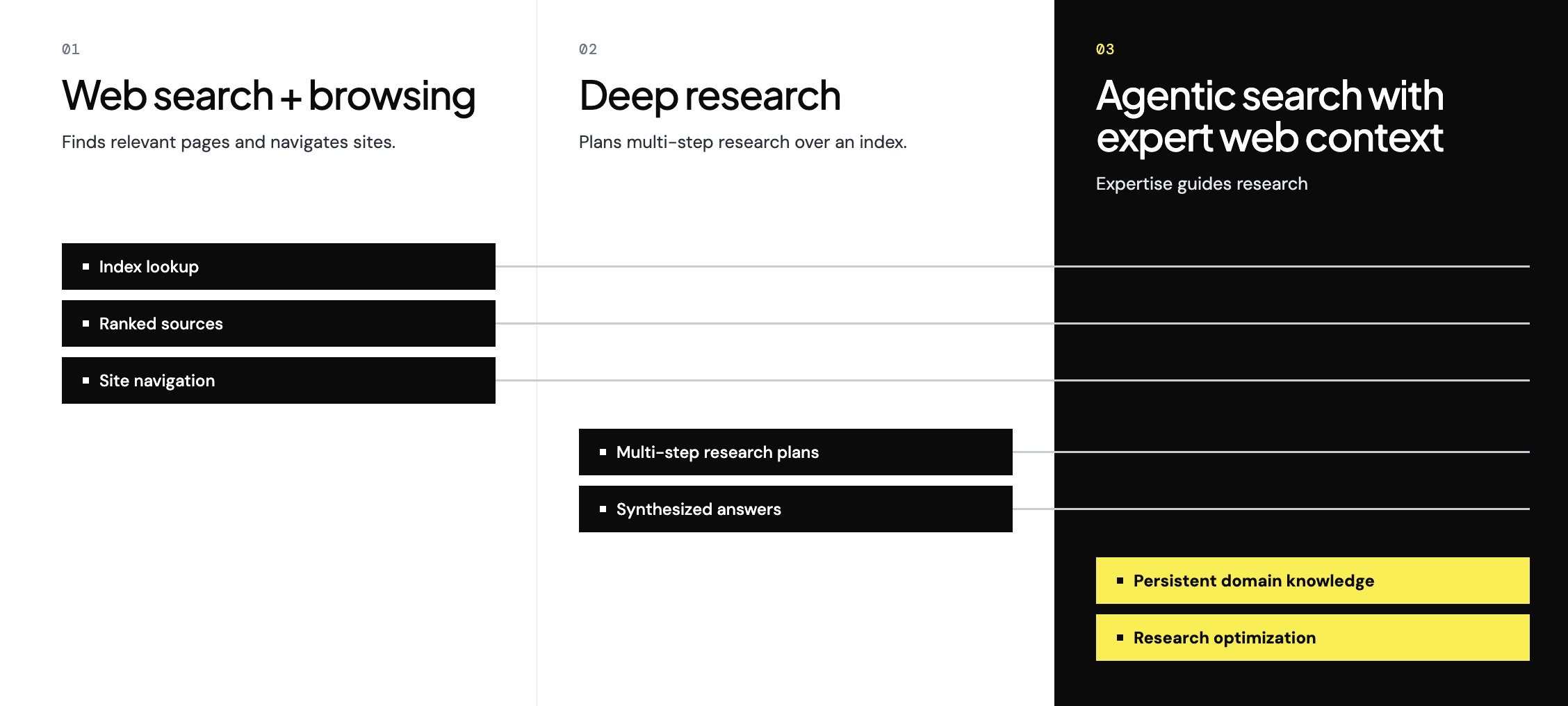
“Knowing” is the missing middle layer between search and computer use, which is why we need expert web context for agents.
Where we are today
There is high demand for agents that can be treated as domain experts. To do this, an agent must retrieve, reason, and verify that the context data is relevant, current, consistent, and complete enough for the decision.
These agents rely on two approaches to get the information they need from the web.
Search APIs from Exa, Tavily, You.com, and Brave help agents find relevant information and discover sources. Several also offer extraction and research capabilities.
Computer use gives agents the flexibility to operate websites through their interfaces. Browserbase, Browser Use, and Kernel provide browser infrastructure and automation capabilities that developers can use to build these workflows.
Research agents already orchestrate these types of tools to create loops that discover and evaluate information from the web. Anthropic’s research system, for example, coordinates agents that search different aspects of a question and synthesize their findings. LangChain’s Deep Agents is a great framework to build this loop.
General web retrieval is capped because the indexes they rely on can never be complete or 100% fresh. Computer use is getting better as models improve, and WebMCP adoption and work are small-scale use cases.
Even ignoring efficiency, the best model struggles to achieve expert‑level results with naive tool use of general web‑retrieval and extraction tools.
Most “deep research” tools today are simple reasoning graphs on top of an index, feeding more context to the agent per question. We are in the early days of agents reasoning on the web.
From deep research to agentic search
Building a research agent means taking responsibility for an entire retrieval process.
Research agents must decide when to search an index, extract a page directly, invoke an API, or use a browser. They must validate results, resolve conflicting evidence, fill gaps, and determine when further investigation is worth the cost.
Fetching data from the web isn’t enough. Agents need to make the data useful by: identifying entities, removing duplicates, normalizing fields, aggregating records, and running calculations.
Then comes the RL or the agent fine-tuning. Which observations should persist? Which sources change frequently? Which collection paths still work? When should the system revisit a page?
Expert-level accuracy comes from orchestrating these steps. The infrastructure opportunity is to make that expertise reusable across tasks and agents.
That is the role I see for agentic search: taking an information request and managing the work required to produce usable evidence, within a defined scope, freshness requirement, and compute budget, all within the context of the specific domain that requires a deeper, semantic understanding of how to research a specific topic.
The browser gives the agent a car; expert web context provides knowledge of the roads, the entrances, and the routes that work.
The reasoning model can determine what the task requires. It should be able to draw on infrastructure that already knows a great deal about how to obtain it.
Agentic search requires expert web context
Agentic search combines expert web context with the ability to act on it.
Expert web context requires deep domain knowledge for researching a specific topic, like which sources matter, how sites are structured, how entities relate, which navigation and extraction paths work, and when observations need refreshing.
That understanding persists between jobs and is revalidated as websites change.
A route that worked yesterday may be closed today and new high-quality sources appear constantly, so optimizing research strategies also means knowing when to look for other routes to the best data.
Consider what it enables.
E-commerce intelligence: “Find every running shoe currently sold by Dick’s Sporting Goods, including price, availability, ratings, and promotions.”
The infrastructure should understand categories, products, variants, and pagination. It should distinguish a product’s listed price from a promotion and check availability for the relevant size and location.
As a consumer, I don’t need to see thousands of products. I want confidence that my agent considered the relevant options before recommending a few that fit my needs. Broad, fresh product data should support a simple answer.
Financial research: “Find every pricing change Cloudflare has made across its products during the last 12 months.”
The evidence may span pricing pages, documentation, changelogs, announcements, and archived versions. The task requires knowledge of those sources and their historical content.
The infrastructure should preserve observations, compare versions, and make gaps in the historical record explicit. Today’s website cannot, by itself, establish every change made over the past year.
Competitive monitoring: “Tell me whenever one of these 200 companies launches an AI product, changes pricing, or adds an enterprise security feature.”
Once the system has identified the relevant pages, it should revisit them, distinguish meaningful changes from routine edits, and return supporting evidence. Each monitoring cycle should benefit from what previous cycles established.
Across these examples, coverage is part of the product.
“Found 800 records” is useful. Knowing which sources were checked, when they were checked, which records were validated, and which areas remain inaccessible makes the result accessible. Confidence should be grounded in that evidence.
We already have important building blocks: crawlers, reranking models, browser automation, entity extraction, and data processing.
The opportunity is to bring them together around a persistent understanding of the web, accessible to any agent that needs it.
Towards specialized intelligence
Different tasks require different web expertise.
Commerce depends on understanding products, variants, promotions, and availability. Hiring research depends on recruiting systems, role definitions, and the distinction between a job posting and evidence of company strategy. Pricing research depends on historical versions and comparable commercial terms.
Those differences should shape source selection, collection, validation, and refresh decisions.
As this expertise accumulates, agents can spend more of their reasoning on the user’s actual question. Each task can begin with established knowledge about where the evidence lives and how to evaluate it.
Even a race car driver relies on knowledge of the circuit, changing conditions, and lessons from previous laps.
That is the path towards specialized intelligence: capable models working with infrastructure that continuously improves its understanding of the information they need.
Every agent should be able to draw on web expertise that outlasts a single task.
FAQ
Answers to frequently asked questions




.webp)
.avif)
.webp)
.webp)